A Conceptual Study on ‘After-Critical’ Global Citizenship: A New Perspective of Interconnected Society Based on Critical Realism
Article information
Abstract
This paper explores the critical realist approach to global citizenship education (GCED) by reviewing contemporary discussions of GCED, primarily addressing the most relevant concepts of global citizenship from post-colonial/critical perspectives. In particular, this paper aims to discuss the distinctiveness of critical realist GCED in comparison with the preceding approach. While critical GCED has advanced important implications towards theory and practice in the field, and it is one of the most intensively accepted among the most recent scholarly discussions, it still encounters challenges such as a binary standpoint, a lack of deeper ontological consideration, and a failure to involve generative mechanisms to judge and achieve social justice. This necessitates a new or an alternative conceptualization of GCED. In response to the arguments, this paper suggests ‘after-critical’ global citizenship education that offers theoretical and methodological implications in developing a balanced analysis of the complex globalization and education. Calling for transformative praxis and reflexivity, it promotes relational engagement with concerns that situate oneself within and beyond a mode of being as global citizen. It envisages reconfiguring and responding the possibility of self and collective ontology, grounded in a deeper recognition of our essential totality in the social world in globalized community.
1. Introduction
With the expanding differentiation of globalization and the rapid rise of global crises, scholarly discussions of global citizenship and education have accelerated and often been renewed. Typically, theories of globalization have deterritorialized and denationalized the human community. The new one is that they even redefine not just the lines between the global and local (i.e., glocalism) but also between human, animal, and other non-humans (i.e., post-humanism). Further rise of such planetary crises (e.g., global capitalism, digital revolution, climate change, and the COVID-19 pandemic) has prompted renewed international efforts to articulate shared global responsibilities. These developments are reflected in global policy frameworks such as United Nations Sustainable Development Goals (SDGs). In particular, SDG situates global citizenship education (here-after, GCED) as global agenda within broader commitments to sustainable development in SDG 4.7.
Moreover, recent discourse points to the need to conceptualize GCED as planetary ethics embracing humans and non-humans in achieving global solidarity (Torres & Bosio, 2025). It necessitated a rediscovery of the conception of the place of human community and nature, a shift in a new ontology. Perhaps, however, it is still too early to refer to the newly emerging form of society without deeply formulating relational properties and the complexities of global configurations. We still encounter the crisis at the sustainable unity of the human and all species or all beings, in a situation where our interdependence or interconnectedness has never been more acute (Bhaskar, 2002/2012).
The contemporary notion of interdependence (or interconnectedness), intrinsically connected to the social dynamics of globalization and globalization-within, is underpinned in education that upholds cosmopolitan morality, advocates inclusiveness for minorities, promotes social justice, and overcomes liberal, western-oriented globalism. Transnational semantics of interdependence and strategies of global citizenship serve those whose identities have been historically excluded from state citizenship, rearticulating themselves in modern territorial logic (Ong, 1996; 2006; Yuval-Davis, 1999). In this regard, recognizing how the typology of global citizenship and education is situated, "constructs (different) realities" (Andreotti, 2010). In accordance with it, the theoretical development of GCED is conceived as constitutive of a transformative trajectory to critical approaches, in emerging conflict to revise unity and responsibility in changing society (Bellino, 2018). This reveals the importance of noticing how discourses of GCED interact with transnational networks and power structures within adoption and interpretation on local, national, and global scales.
Widespread research on GCED underscores the importance of a critical approach and capacities for deliberating on social issues linked to global problems, structures, and systems, and call for a more critical approach has been emphasized in educational policy and practices (Andreotti, 2006; 2010; Alviar-Martin & Baildon, 2021; Goren & Yemini, 2017; Bellino, 2018; UNESCO APCEIU, 2024). It attempts to provide the space to reflect the notion of interdependence in the relationships among their own and others’, in particular among contingencies (Andreotti, 2006). However, it leads to a crucial question to explain how you can judge what is socially just or not, even though the critical approach inevitably entails a transformative orientation to social justice.
This parallels what Bhaskar (2002/2012; 2008) called ‘ontological irrealism’ and ‘epistemic fallacy,’ which systematically dissolve the irreducible and ontologically independent world into only that of the transitive network, and what network describes. Moreover, this lack of ontology fails to explain how existing relativity and interconnectedness emerge and mediate in the collective entities. In essence, its emphasis on individuals as autonomous actors falls back to superficial interplay between structure and agency, which is still caught in binary oppositions. The overarching discussion in critical GCED addresses the contrasting relations between the global North and South, as well as the dominant and subordinate. Moreover, this reveals the risk of weakening internal properties by neutralizing cultural differences and justifying post-modernist life forms in extreme cultural relativism.
In the meta-analysis of the theoretical discussions on GCED from Pashby et al. (2020), it stated that GCED asks only methodological and epistemological questions rather than those in the ontological aspect. The GCED requires a new ontological stand-point that ‘would likely not be legible for those over-socialized within a modern/colonial ontology.’ Therefore, they argue that GCED should support learners in the modern/colonial ontology. However, the post-modernist/post-colonial approach, properly socalled, finds it almost impossible to grasp a sense of underlying unity as members of a collectivity. Concerned with possibilities, tendencies, and powers, this paper argues that the concept of ontology should concern real categories that essentially construct our social world. There is no way of thinking about structural change without invoking a causality that exists constitutive of reality in different social actions of different social agents (Bhaskar & Hartwig, 2010).
In the pursuit of significant change and social justice, critical GCED aims for a better world than the existing system. It still remains, however, critical questions: How can we judge whether something is worth changing? How far should change be pursued? Throughout, what is the alternative, and where to the next step of critical interrogation? In response to these inquiries, therefore, this paper examines the discourse of critical GCED and suggests the ‘after-’ critical global citizenship education. This critical realist approach can offer an alternative perspective.
2. The Discourses of Global Citizenship Education and Interpretations
The branches of the conceptualization of GCED are aligned with globalization process and development of citizenship. It has evolved through theoretical discourses synthesized from neoliberal, moral, social justice, and critical orientations (Franch, 2020; Pashby et al., 2020; Bosio & Schattle, 2021). With the historical resurgence of global citizenship, it relates and conflates with the roots that inherit the contested nature of citizenship and the complexities of global sentiment. The emergence of different local agendas and cultural frameworks informs the diverse languages and grammars surrounding the concept of global citizenship (Oxley and Morris, 2013), in both correlated and conflating ways. Aligning with the question of whether a global conception of citizenship does constitute a new theory of citizenship, the global notion of education is intensively discussed as a necessity for culturally diverse societies (Pashby, 2011, as cited in Franch, 2019).
The modern idea of nationstates and national citizenship had not destructed the idea of globalization and global citizenship. However, it assumes the reification of global society, or globalization as a dynamic historical process that has become (and it becomes) more complex, more uncertain, and more problematic. Although the economic dimension has been predominantly referred to as a scale of globalization, it has also generated responses to new global problems across interdisciplinary arenas across political, social, economic, and cultural dimensions of ‘time-space compression’ (Beck, 2002). It requires focusing more on other actors and spaces.
Global citizenship has its historical roots in a tradition that predates that of national citizenship (Schattle, 2008). However, it is challenging to see how notions of the ‘global citizenship’ can be defined and understood among the various concepts of ‘global (or globalization)’ or citizenship. One interpretation of the globalization processes questions they lead to the establishment of the socalled ‘global village’. Instead, this realist approach suggests that the processes largely coincide with the Westernization of the world (Bauman, 1998). Global citizenship, through this standpoint, is not secure but is contingent. Put simply, the realist perspective emphasizes sovereignty, national interest, self-determination, and tends to critical against transnational justice (Mearsheimer, 2003, as cited in Auh & Kim, 2025). In this sense, education serves to individuals to navigate transnational interactions while prioritize the continuity of national identity as well as state-centric responsibility over normative universality. In that GCED aspires to universal values, global solidarity, and responsibility for humanity, it rather contrasts with the realities of global power dynamics and state-centric ideologies. As realist argues, the globalization process disinherited the roots of masses, but does not integrate them. In the processes of industrialization, technological change, nor does it include them in a ‘global citizenship’ (Zolo, 2007).
Despite its stance against global integration, realism indeed acknowledges the influence of globalization on transnational obligation and rights. From this vantage point, GCED is considered as “a new form of currency that aligns with global power dynamics”. This leads education to be critical on the limitations of global citizenship while maintaining learners’ national identities and fundamental rights in the form of the states. This approach encourages a pragmatic understanding of global dynamics, aligning with realism’s focus on the strategic deployment of GCED (Auh & Kim, 2025). However, the realist assumption tends to dismiss the educational necessities to be involved in the global issues, and empowering learners to address borderless issues like climate change, migration, and discrimination. The critics, therefore, stresses that such approaches risk maintaining power imbalances and fail to address global challenges, particularly including social justice, and systemic inequality (Carr, 2004).
3. The Post-Colonial/Critical Approach to Global Citizenship Education
The critical approach to GCED has been highlighted in response to the limitations of preceding interpretation of global citizenship and education. With the primary emphasis on social justice in challenging the status quo, critical GCED addresses the question: How can global citizenship education advance equality and justice within unequal societies? This includes identity-based conflict, the complex nature of democracy in multicultural societies, whether it promotes substantive change in the power relations inherent in the deepening inequalities of globalization, or whether it remains trapped within the neoliberal pressures that produce global competitiveness in markets. The GCED framework aims to expand circles of identification and shift toward collective values such as human rights, respect for diversity, and social justice. It warrants a critical approach to education; the purpose of change should be to examine and overcome the underlying structural inequalities of power and advocate for those marginalized to advance their expression of diversity and difference.
This post-colonial/critical approach to GCED relates to the epistemology of cultural relativism (Andreotti, 2006). Cultural relativism asserts that no culture can be judged by absolute or fixed standards. This contributed to deconstructing the Western-centric approach to the conceptual framework of globalization and to empowering voices of non-Western countries, including the Third sector. It highlights the complex, contingent, multicultural, and heterogeneous approach to deconstruct systemic injustice. This assertion of the difference is impactful to the conversation of global citizenship and GCED. It objects to the homogenizing structures of traditional politics and seeks to avoid imposing uniformity that shadows the oppressed people. As Andreotti (2014) suggested, critical GCED pursues social justice by cultivating critical literacy to realize that all subjects are a multiplicity of power relations. Indeed, critical assessment of ‘false dichotomy’ within, for example, global capitalism and global justice contributes to grappling with how the complexity of neoliberal power relations interacts with multiple scales and how it privileges some but oppresses others. It underscores the extension of our critique by pointing out ‘onto-epistemic possibilities’ beyond modernity (Oxley and Morris, 2013) and by promoting a discussion of modern/colonial imaginary, focusing on the systemic changes to the status quo.
The distinction between ‘soft’ GCED and ‘critical’ GCED, proposed by Andreotti (2014), has gained attention in both theoretical and empirical studies. The soft version of GCED is grounded in equality of interdependence, aiming for achievement development, harmony, tolerance, and acting in accordance with the general principles of democracy and universal values in a single moral community and common humanity (Schattle, 2008; Stein, 2015). It imposes values and norms constructed under the standardization of equality, which tends to eliminate difference and avoid critical investigation of sociopolitical issues. This drives education to focus on competitiveness in the global market and enterprise (Gaudelli, 2009). In contrast, critical GCED contains the interdependence arising from a structured, unjust, and violent system and inequality. In the critical interrogation of pedagogy, learners critically perceive and what surrounds their world as global common, advancing practical action to reconstruct and change asymmetries (Torres, 2017; Torres & Bosio, 2025). Likewise, critical GCED accepts a more relativist ideology that aims to empower individuals to become agents of social transformation, particularly through a localized, grassroots, and post-colonial agenda in uneven globalization (Oxley & Morris, 2013; Shultz, 2007). Therefore, critical GCED involves examining a ‘complex web of cultural and material local/global processes and contexts’ (Andreotti, 2014), exploring social phenomena within their own context, identifying problems, and taking responsible actions.
GCED, particularly in a critical perspective, has been seen as pluralized, context-dependent, and discursively framed, which promotes the inclusion of the marginalized by power systems (Andreotti, 2014; Goren & Yemini, 2017; Shultz, 2007; Pashby, 2016). Therefore, it requires acknowledging complexity, contingency, multiple and partial conception, and underlying asymmetry and injustice; and education in a postcolonial/post-critical approach is accepted as the way to address this demand (Andreotti, 2010). While their orientations are rooted in various typologies, they ‘represent a conflation of key debates regarding the extent to which structural change should focus on changing existing structures or forging entirely new ways of relating’ (Pashby et al, 2020). In parallel with post-colonial orientation, a continued revision and mapping of discursive configurations is emphasized to enable GCED to be responsive to different kinds of challenges and situated interventions. Therefore, a postcolonial or post-critical GCED needs to center on continuing processes. This more critical orientation involves an educational framework that moves beyond traditional learning models, emphasizing the ‘unlearn the learning from below.’ (Andreotti, 2006). It is important to reflectively examine their own context and that of others through ethical relations to difference. It should serve as a means of ‘conscientization’ (in Freire’s conception), involving gaining a deep, critical understanding of the world; enabling the detection and discussion of social and political contradictions and fostering identity development through the transmission of knowledge, skills, and values across generations (Bosio & Schattle, 2021).
Critical GCED claims to analyze one’s position within the situated structures, thereby altering the underlying assumptions and power relations. That is, through critical literacy, education can empower individuals to challenge and change for social justice. However, this approach to emancipation education remains caught within a colonial way of thinking (Biesta, 1998, 2010, as cited in Mannion et al., 2011). Therefore, it necessitates a new perspective of GCED that seeks alternative theoretical discourse and practice in response to today’s interrelated and complex community crisis which cannot be divided into binary way such as majority and minority, dominant and surrendered. In the following paragraphs, this paper will introduce the approach based on the critical realism.
4. Exploring an Alternative Approach to GCED based on Critical Realism (CR)
Critical realism (CR) is a metatheory in philosophy and the social sciences, developed by Roy Bhaskar. This began with intensive critiques against the positivist conception of science, which substitutes observable events for reality. CR also contests the resurgence of idealism and its discursive persuasion, which asserts that science operates by constructed imaginaries. Rejecting the collapse of ontological reality into epistemological notions (i.e., epistemic fallacy) and skepticism about deep structures making ontological commitments (i.e., ontological irrealism), CR insists on explanatory knowledge to understand the causality in social events as a sui generis reality. It primarily aims to explore the collective entities that exist with underlying properties and causal mechanisms rather than the regularities.
CR is distinctively featured by its commitment to ontology, or the theory of being. It believes that there is a real world that exists and acts independently of our knowledge. It consists of structures, generative mechanisms, and all sorts of complexity and relations. It is important to notice that from a critical realist standpoint, ontology cannot be reduced to epistemology. By virtue of the dispositional ontology, the world exists independently of conceptions, descriptions, and representations, as a real, causal structure that possesses emergent properties and generative powers. At the same time, knowledge is socially produced and therefore contextual, changeable, and fallible. It is concept-dependent; the structures do not exist without a conception of agents, but at the same time, we must remember that agents do not always have an absolutely correct conception (Bhaskar, 2008). We are open to the possibility that the social world can be falsely categorized, which could be in contrast to underlying structures or even conceal other truths. The social process and what we know can change over time.
While we cannot always separate observation from reality, we can approach the truth only if we can acknowledge that some are better than others and judge the best argument available. Put differently, it is possible to give better or worse grounds for preferring one system of beliefs or practices to another, so that we can sustain the rationality of our grounds for choice. Through these ideas, CR features in virtue of its explicit thematization of being; its understanding of the stratification of being; and its development of the ideas of being as in process, as a totality, can show the possibilities of a non-dualistic world (Bhaskar, 2002/2012).
Referring to stratified ontology means that each stratum is coconstitutive of the others, and should be conceived of in relational terms. It should be noted that higher orders do not determine lower orders of reality that mediate and actualize the causal powers of the systems. In this sense, CR understands society as an open system in which causality interweaves within a specific context, in contrast to a closed society that cuts off external influences, which is impossible in social activities. CR considers a social reality more than a transaction (open system) in which different causal powers emerge in contingent operation. Therefore, throughout these premises, CR asks: ‘What are the distinguishing features of structures (or mechanisms) in the social world?’ (Bhaskar, 2002/2012)
CR understands reality as structured and ongoing, and social structure as identified through generative powers as mechanisms treated in causal analysis. This feature has the advantage of reconciling the overriding dichotomies, such as between positivism and idealism, and between macro-social and micro-social distinctions (Granados-Sánchez, 2023). In fact, historically, GCED has often been caught in binary oppositions: nationalism and cosmopolitanism; universalism and particularism; liberal and social justice; global and local; top-down and bottom-up; Western and non-Western; human and non-human; abstract and concreteness, theory and practice. In contrast, CR stands for the reality of non-dual states and phases of being, showing how they underpin and sustain all complex and multiple determinations of social forms and human history.
By analytically distinguishing social systems and citizens at different levels, this provides a device for examining their causal mechanism, rather than reducing them to mere interaction. This ontological vantage point includes conceptual shift in such as interconnection, objectivity, subjectivity, internal relationality, universality or totality. Objectivity and subjectivity both emerge in the relation and presuppose sociality. In this sense, critical realist approach can be distinctive from post-colonial/critical approach (Table 1). Post-colonial/critical perspective on GCED emphasizes difference and diversity. It views society as a verb, ongoing process, and as always in flux. Each of individuals is engaged in a complex series of collectivity through exchange of diverse perspective. In contrast, critical realist says we are different, if we do not split or alienate ourselves from our universal structure (‘essential unity’) as human beings with others (Vandenberghe, 2014). That underlying unity is what the critical approach dismisses, or the lack of authentic notions of truth or objectivity. The critical realist approach is distinctive in accepting citizenship with ‘intersubjectivity’ of collective entities. It thematizes the specificity of both group interest and individual identity, without downgrading the idea of the essential unity of humanity, particularly concerning the global crisis, as our interconnection has become striking. Therefore, it aims to uncover the mechanisms of interplay among different powers and reconstruct the complex globalized society (Vincent & O’Mahoney, 2018).
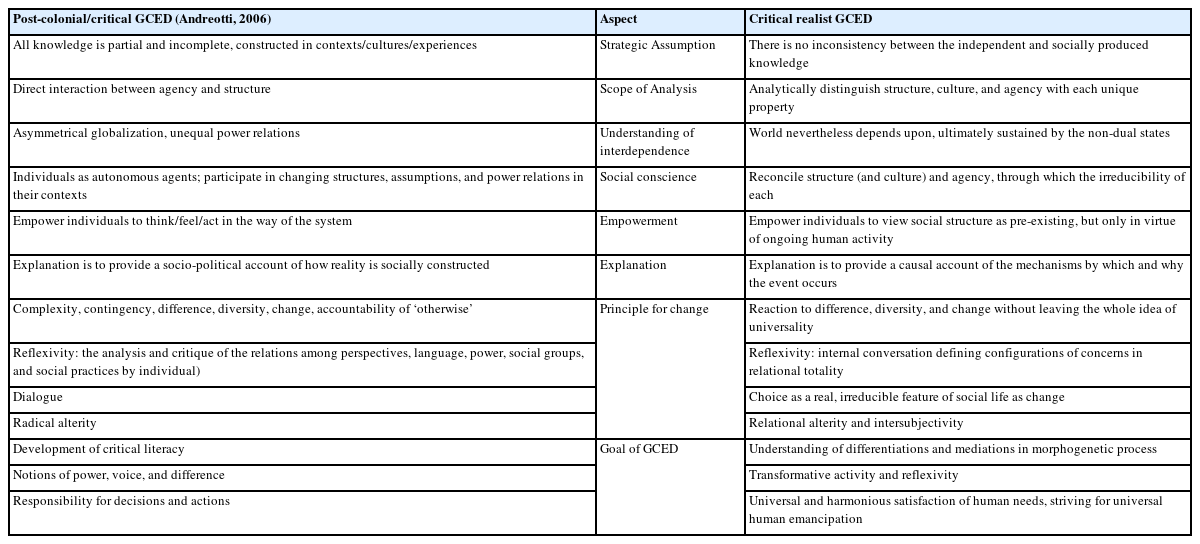
Post-colonial/critical GCED and Critical Realist GCED
5. Discussion: The Implications for ‘After-Critical’ Global Citizenship Education to promote transformative praxis and reflexivity
Through the novel conception of stratified reality and the acknowledgement of the irreducibility of emergent properties, CR provides a balanced examination of possibilities in the complexity and coexistence of social elements: On the one hand, social phenomena have underlying mechanisms and relations (not only functional, but also causal) among other phenomena, rather than being reduced to regularities and tendencies. On the other hand, in order to access the generative mechanisms, they are articulated and experienced through investigation and judgment. It enables us to transcend the macro/micro debate; rather, it opens the ‘black box’ of the connection between macro-, meso-, and micro-orders (Vandenberghe, 2014). For example, at the macro level, we can identify the social and cultural order which constitutes citizenship in relational terms. At the meso-level, we find the institutional order of citizenship as a set of most efficacious ways. At the micro level, global citizenship exists as both the order of individual identification and interconnected association (Figure 1).
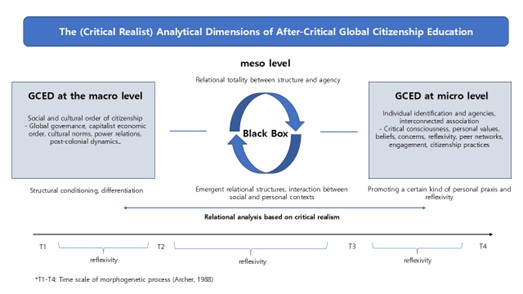
The Comprehensive Conceptual Framework for after-critical GCED (Source: drawn by author).
Referring to globalizing parameters not only indicates the transformation of de-territorial modifiers but also the radical transformation of human existence and sur-vival. It should be understood dialectically, with explanatory critiques on the ‘flux/dilemma’ of globalization and global citizenship. In response, an ‘after-critical’ GCED grounded in the paradigm of critical realism can be an alternative. It is important to note that the term ‘after-’ is meant to be relevant but distinctive (as Pierpaolo Donati (2011) explains in his term of after-modernity) from critical GCED as we turn back to the next page and shift to the beginning of a new chapter of the story, whereas ‘post-’ assumes the continuity in the same chapter.
We are one world, a single world. Therefore, for de-alienation, we must think very profoundly of our own role in that universality. Because each and every one of us in what we do can make a difference. But we can only make a difference if, in some way, we are not alienated from ourselves.
This approach offers theoretical and methodological implications in developing a balanced analysis of the complex global citizenship and education. With its distinctive vantage point of ontological realism, it opens up the avenues for discussion about the multifaceted phenomenon of social activity, politics of identity, and difference. Notably, it simultaneously suggests abstract but ‘real’ universality, which is the critical GCED has considered problematic. Calling for transformative praxis and reflexivity, it offers the possibility for social transformation and change for examining emergent and complex mechanisms in global life forms. The new social movements are explained through interconnectedness in which a sense of our unity as members of the species, let alone as citizens within a united society, has been more essential to assert (Bhaskar, 2002/2012). It envisages reconfiguring and responding the possibility of self and collective ontology, grounded in a deeper recognition of our essential totality in the social world.
Based on CR, ‘After-critical’ GCED suggested in this paper can promote new approach to global society by showing explanatory critiques of the complex connection between individual needs and society. The praxis of the global citizen for social change is not just cognitive but consists of trouble, conflict, changes in power relations, the breaking up of social structures, and the building up of others. In this sense, global citizenship education in this framework focuses on examining the generative mechanism of how to understand the interconnectedness of the global community, and how the international subjects collaborate and take actions to address global crisis and collective goals for sustainable world as relational reality. The inquiries of this conceptualization of GCED, therefore, should produce explanations answering the ‘why’ question, which is relevant to the essential relations that necessitate social life in the globalized community.
This understanding emerges through ‘reflexivity.’ Critical realism, by virtue of its thematization of the stratified being as a new conception of interconnectedness and as transformative praxis and reflexivity, can show the possibilities of social life as change (Bhaskar, 2002/2012). Archer develops the conception of reflexivity as the internal conversation in which people are concerned with the connection of their social context. It is a mediating mechanism between structure and agency rather than conflating them, or between individual’s situated outcomes and their actions (and vice versa) (Archer, 2003; 2012). The actor’s powers of reflexivity on both self and society enable them to mobilize and commit themselves towards their ‘concerns’ (Archer, 2007). In a rapidly changing, dynamic society accorded by globalization, Archer emphasizes that reflexivity as an activity ‘shared by all people, to consider themselves in relation to their social context and vice versa’ (Archer, 2012), plays a primary role in enabling people to pursue ‘concerns,’ such as a sustainable society and well-being.
Post-colonial/critical GCED claims reflexivity to analyze one’s position within the situated structures, thereby altering the underlying assumptions and power relations. That is, through critical literacy and self-emancipation, reflexivity can empower individuals to challenge and change for social justice. However, this approach to emancipation education remains caught within a colonial way of thinking (Biesta, 1998, 2010, as cited in Mannion et al., 2011). Moreover, that conception of reflexivity as well as the relationship between social structure and individual just points to transaction without “ the specification of the conditions under which a transaction was likely to be successful, one whose are and to what end” (Archer, 2020). Therefore, it necessitates a new concept of GCED that seeks alternative educational theorization and practice in response to the interrelated crisis.
Such emphasis on the understanding of society and its relations in globalization process highlights that global challenges should not be addressed through isolated act. Rather, it requires forms of collective engagement grounded in concept of totality and universality based on critical realist approach. This vantage point presents an ontological inquiry into how relational structures sustain or hinders sustainable community. It necessitates reconsidering humanity’s place within ontological unities and calls for a renewed understanding of the generative properties that shape global interconnectedness. In this sense, the educational role to global citizenship with relational praxis for social change, is not simply a goal but a relational reality that must be understood ontologically.
Conclusion
This paper examined GCED through the lens of critical realism and proposed the conceptual framework of ‘after-critical’ global citizenship education. By reviewing theoretical discoursed and interpretations regarding GCED, particularly post-colonial/critical approach. At the same time, it identified limitations focusing on ontological understanding and the tendency to remain in binary oppositions that constrain deeper explanations of social transformation that global citizenship aims to promote.
In response to this argument, this paper introduced critical realism as a meta-theoretical framework to address these limitations. By emphasizing stratified ontology, emergent properties of transformative social change and analytically investigating the relational totality, the critical realist approach provided a framework for new understanding interconnectedness in more balanced way as an alternative world view. This perspective aimed to enable a more coherent account of how generative mechanisms shape both individual and social structure mutually conditions in complex global networks.
Based on the aforementioned discussions, this paper articulated ‘after-critical’ GCED. It tried to rediscover – rather than dismiss the critical approach – GCED with a relational ontology that acknowledges difference while affirming the structural interdependence of social life. Through this concept, GCED can be understood as situated within stratified social realities in which sustainable forms of society depend upon underlying causal relations.
In conclusion, this conceptual study can contribute to ongoing theoretical discussions GCED and sustainable global community. By clarifying the new ontological assumption of GCED, this paper can offer a conceptual basis for understanding how education can promote relational forms of cooperation in an increasingly interconnected world.