Scholarship at “Machine” Speed
Article information
Artificial intelligence (AI) is not waiting for academia to catch up. Journal writing no longer unfolds as it did only a few years ago. Figures are generated in seconds. Statistical platforms such as R, SAS, and SPSS now draft Cox proportional hazards regression code and publication-ready tables almost instantly. Literature reviews and meta-analyses are synthesized accurately at scale, and grammar, tone, and structural flow are refined before our morning coffee cools.
The bottleneck is no longer production but judgment. For journals, this shift demands operational clarity. This month, IGEE Proceedings updated its Author Guidelines to state explicitly:
“Authors who use artificial intelligence (AI)–assisted technologies in writing, data analysis, or figure preparation must acknowledge their use transparently in the manuscript.”
If AI assists in drafting, visualizing, analyzing, or refining scholarly output, disclosure must become part of methodological integrity. (Disclosure: The present editorial has been lightly refined using AI-assisted tools to improve clarity and flow; the ideas remain human, though the polish may not be.) The more consequential question is not whether AI is accelerating scholarship, but how we choose to direct that acceleration.
A landmark analysis in Nature Communications found that AI could potentially enable 134 of the 169 Sustainable Development Goal (SDG) targets (79%), while also posing risks to 59 targets (35%) if poorly governed (Vinuesa et al., 2020). AI was identified as a potential enabler for 93% of environmental targets, yet concerns were raised about energy consumption, inequality, and algorithmic bias. Acceleration therefore depends not on speed alone, but on direction and stewardship.
The papers in this issue were selected with that stewardship in mind. In the invited perspective Navigating the Future of Higher Education: Embracing Change While Preserving the Relational Core of Learning, An (2026) argues that even within an exponentially expanding “knowledge ecosystem,” universities must remain sites of professional identity formation rather than mere information distribution. In Collaborative Strategies for Raising Human Capital, Primulando, Kristiatmo, and Joewono (2026) extend this reflection to institutional collaboration, contending that interdisciplinarity must function as ethical integration grounded in shared commitments rather than technical coordination alone.
The empirical contributions reinforce how structural conditions shape health and sustainability outcomes across the SDGs. Non-Prescription Antibiotic Use and Unsafe Household Medicine Disposal in Indonesia: Implications for Antimicrobial Stewardship demonstrates that antibiotic literacy and household medicine management are intertwined challenges for SDG-aligned health governance (Prasiska & Jang, 2026). Social Isolation and Socioeconomic Determinants Among Ghanaian Older Adults (2019–2024) shows that social disconnection is strongly patterned by socioeconomic disadvantage rather than merely individual psychology (Azoya & Oh, 2026). Individual and Socioeconomic Determinants of Antenatal Care Access for Disadvantaged Pregnant Women: A Systematic Review and Empirical Analysis illustrates that maternal healthcare utilization cannot be understood through individual variables alone, but must be examined through broader structural and system-level determinants (Wulandari, 2026).
Across these domains, sustainability emerges not as a matter of individual virtue but of collective action. The conditions under which people learn, seek care, age, or manage healthcare resources are shaped by broader frameworks of policy, infrastructure, and accountability. AI intensifies this dynamic because it amplifies the consequences of those frameworks.
Discussions about the need for such collective action will take concrete, visible form at Yonsei University’s upcoming 2026 Global Engagement & Empowerment Forum on Sustainable Development (GEEF), convened March 12–13, 2026, under the theme “Time for Action: Emerging Technology & Global Solidarity” (Figure 1). The Forum will not treat AI governance, digital equity, or sustainable technological integration lightly. Instead, these themes will be positioned at the center of global engagement, alongside climate resilience, public health, institutional trust, and cross-sector collaboration. GEEF 2026 will be a safe space where policymakers, researchers, industry leaders, and students collectively examine how emerging technologies can be aligned with the 17 Sustainable Development Goals (SDGs) through accountable frameworks and shared ethical standards. Our readership at IGEE Proceedings is warmly invited to join these conversations in person. The questions raised in our journal’s pages will be debated, tested, and refined across multiple disciplines and sectors. Registration and program updates are available at: https://geef-sd.org
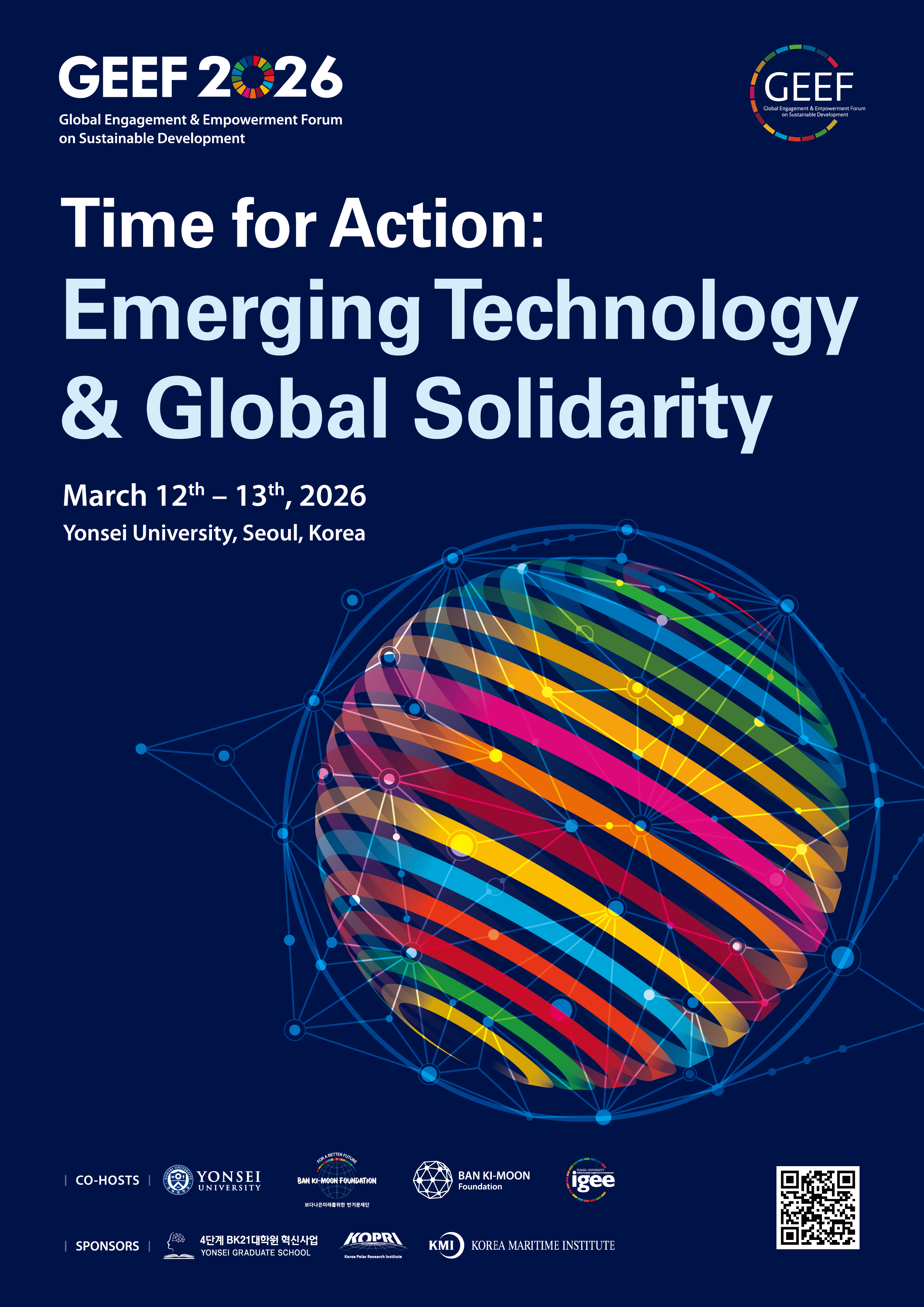
GEEF 2026 (Global Engagement & Empowerment Forum on Sustainable Development), March 12–13, 2026.
To conclude, scholarship at “machine” speed is now a technical reality. What remains unsettled is whether that speed will translate into global solidarity or merely into… volume. AI has expanded our capacity to produce, but it has not determined the purposes toward which that knowledge is directed. That responsibility rests with us, beginning with academia’s commitment to transparency and accountability. If 2026 is to be defined by machine speed, it must also be defined by deliberate alignment, ensuring that the acceleration of scholarship advances equity, strengthens governance, and helps those in need. As Scripture counsels, “From everyone who has been given much, much will be demanded; and from the one who has been entrusted with much, much more will be asked” (Luke 12:48).