IGEE
IGEE
Articles
- Page Path
- HOME > IGEE Proc > Volume 2(3); 2025 > Article
-
Article
Student Involvement in SDG Projects: Seven Years of Yonsei University’s Social Engagement Fund (2018–2025) - Sarah Soyeon Oh1, In Han Song1,2, Shinki An1,3*
-
IGEE Proc 2025;2(3):178-183.
DOI: https://doi.org/10.69841/igee.2025.023
Published online: October 15, 2025
1Institute for Global Engagement & Empowerment, Yonsei University
2School of Social Welfare, Yonsei University, Seoul, Republic of Korea
3Department of Medical Education, Yonsei University College of Medicine, Seoul, Republic of Korea
- *Corresponding author: Shinki An, E-mail: shinki.an@yonsei.ac.kr
• Received: September 30, 2025 • Revised: October 5, 2025 • Accepted: October 10, 2025
© 2025 by the authors.
Submitted for possible open-access publication under the terms and conditions of the Creative Commons Attribution (CC BY) license (http://creativecommons.org/licenses/by/4.0/).
- 1,386 Views
- 24 Download

Abstract
-
Background
- The Institute for Global Engagement & Empowerment (IGEE) at Yonsei University established the Social Engagement Fund (SEF) in 2018 to align with institutional commitments to the UN Sustainable Development Goals (SDGs). This study examines how IGEE's student-led projects as part of Yonsei University's SEF program have expanded SDG coverage over the past seven years and identifies factors contributing to improved integration across multiple goals.
-
Methods
- We analyzed all 49 SEF projects implemented between 2018 and 2025, coding each project for SDG alignment and tracking coverage patterns over time. Annual SDG engagement was measured using two indicators: (1) the total number of SDGs addressed per year and (2) the average number of SDGs addressed per project.
-
Results
- The number of SEF projects increased steadily from 5 in 2018 to 12 in 2025, reflecting growing student participation and institutional support. Over the same period, annual SDG coverage expanded from 9 total SDG mentions in 2018 to 59 in 2025, demonstrating a marked diversification of focus areas. The average number of SDGs addressed per project rose from 1.8 in the early years (2018–2021) to 4.9 in 2025, peaking at 8.3 in 2022. Early projects primarily centered on institutional and educational goals such as SDG 4 (Quality Education) and SDG 9 (Industry, Innovation, and Infrastructure), while later years showed stronger engagement with SDG 10 (Reduced Inequalities), SDG 11 (Sustainable Cities and Communities), and SDG 13 (Climate Action). Some goals—including SDG 6 (Clean Water and Sanitation) and SDG 14 (Life Below Water)—remained relatively underrepresented.
-
Conclusions
- Student engagement initiatives like SEF can significantly broaden and deepen SDG coverage through structured mentorship, interdisciplinary collaboration, and targeted project funding. By enabling applied, student-driven practice, IGEE’s SEF model demonstrates how universities can translate institutional SDG commitments into measurable and expanding impact across a wide range of sustainability goals.
- The Institute for Global Engagement & Empowerment (IGEE) at Yonsei University is dedicated to planning and implementing various social engagement programs that contribute to achieving the Sustainable Development Goals (SDGs). As a leading research institute, IGEE strives to solve issues arising in different sectors of society and seeks practical solutions for a better future through community engagement and global partnerships. This is in alignment with Yonsei University’s goals to encourage innovative higher educational programs that promote sustainability and progress for global citizens and communities (Shin et al., 2024).
- IGEE launched the Social Engagement Fund (SEF) program in July 2018 to support a wide range of research activities that contribute to achieving the SDGs (Rhee & Oh, 2025). A central part of IGEE’s vision since its inception has been to integrate social engagement into the university curriculum by prioritizing research, teaching, and services that contribute to sustainable development (An, 2024). Through the SEF initiative, IGEE calls for students and researchers from Yonsei University to submit research and project proposals that emphasized implementing and evaluating the impact of the SDGs; acknowledging that universities can serve as fundamental catalysts for creating positive impact by embedding sustainability into business strategies, decision-making processes, and practices that improve accountability among stakeholders (Mori et al., 2019).
- Under IGEE's guidance, the SEF program supports students' awareness of global social issues and helps transform their ideas for solutions in to real, impactful change. Notably, since IGEE established the SEF program, 49 SEF projects have been funded across diverse contexts. Thus, this study examined whether IGEE's SEF has successfully expanded SDG coverage over its seven-year history to identify factors contributing to improved SDG integration across multiple goals.
1. Introduction
- We analyzed all SEF projects from 2018-2025, extracting data on SDG alignment, project themes, and geographic focus. Annual SDG coverage breadth (number of distinct goals addressed) and the average number of SDGs per project were identified. Project documentation included original proposals, progress reports, and final summaries submitted to IGEE.
- All data analysis and visualization were performed using Rstudio, enabling reproducible and transparent examination of patterns across projects, and selected visualizations were further refined using Google Gemini’s Canvas feature to enhance clarity and presentation.
2. Materials and Methods
- Table 1 shows the general characteristics of SEF projects by year (Table 1). From 2018 to 2025, the number of projects generally increased alongside the number of international projects and SDGs covered per project.
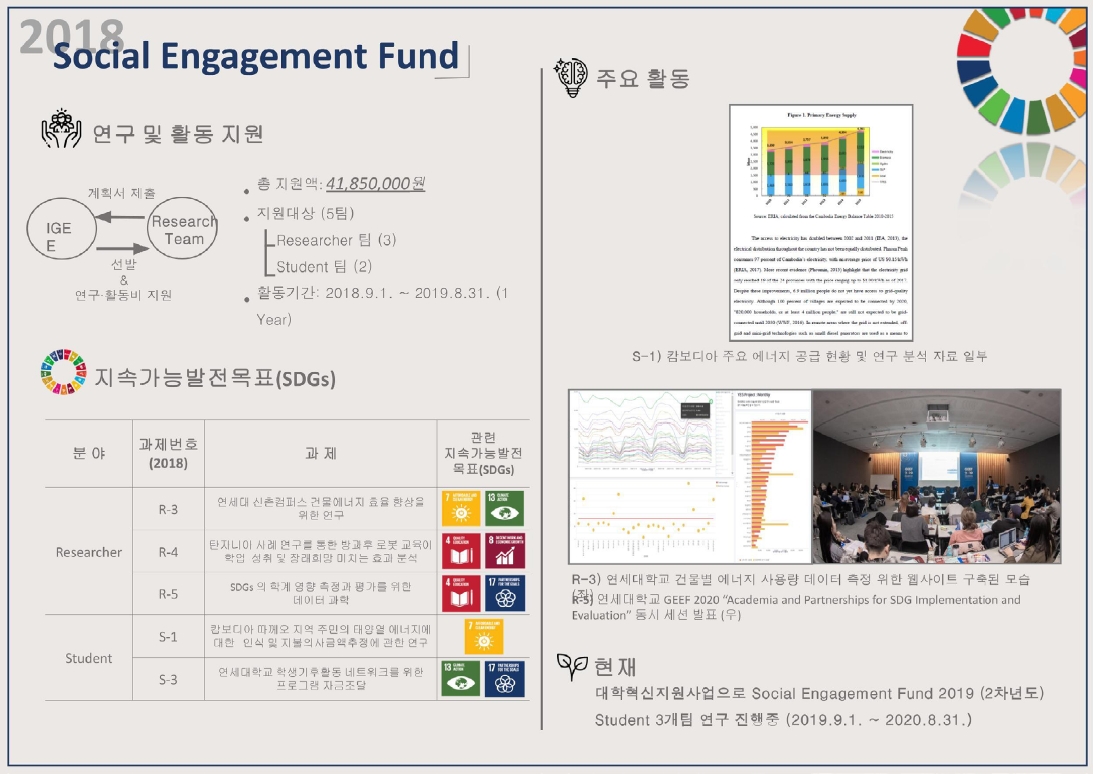
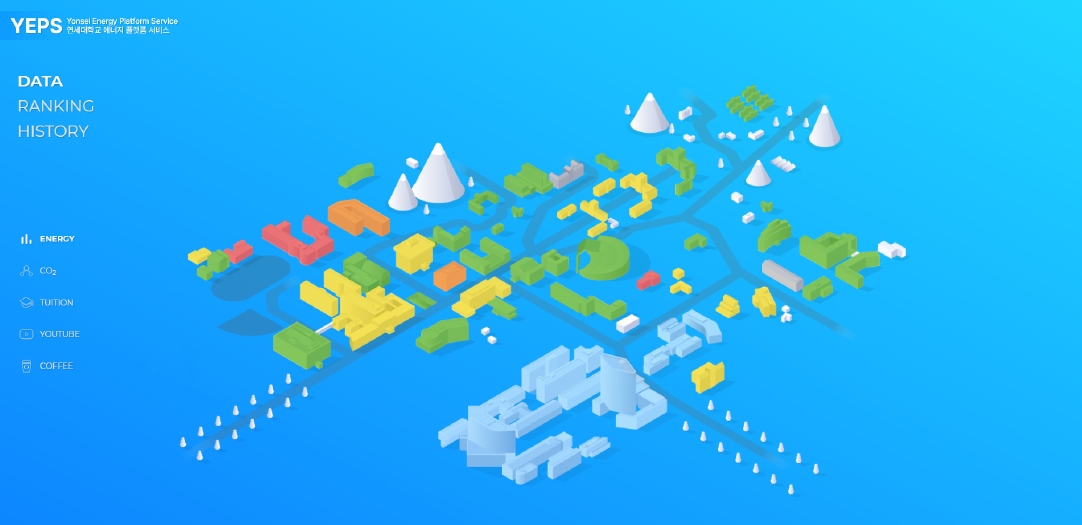
- Early years addressed 1-2 SDGs, and were split into research (3) and student (2) teams (Figure 1). Notable outcomes of the 2018 SEF was the creation of a prototype for Yonsei University’s Energy Platform Service which still monitors campus carbon movements to date (Figure 2) (Cho, 2019). Developed as part of the 2018 SEF Researchers’ Cohort, YEPS is a platform that allows real-time monitoring of electricity consumption across 44 major buildings on Yonsei University’s Sinchon Campus. With support from the Sinchon Campus Facilities Department, the YES project gathered real-time electricity data—daily and monthly—for each measurable building on campus, and visualized the building energy consumption data. YEPS has since enhanced accessibility by introducing diverse and intuitive process (Cho, 2019).
- Since 2018, total project numbers have gradually increased, with the largest cohort (n=12) selected for 2025. This trend reflects IGEE’s program maturation toward selective, impact-driven integration rather than volume maximization (Table 2). Cross-national initiatives addressing mental health, digital inclusion, and climate adaptation spanning countries such as India, Uganda, Cambodia, Tanzania, Madagascar, Mongolia, and the United States, highlight SEF’s evolution from a locally focused student scholarship program into a globally engaged, interdisciplinary platform fostering collaboration across sustainability, technology, and public health domains.
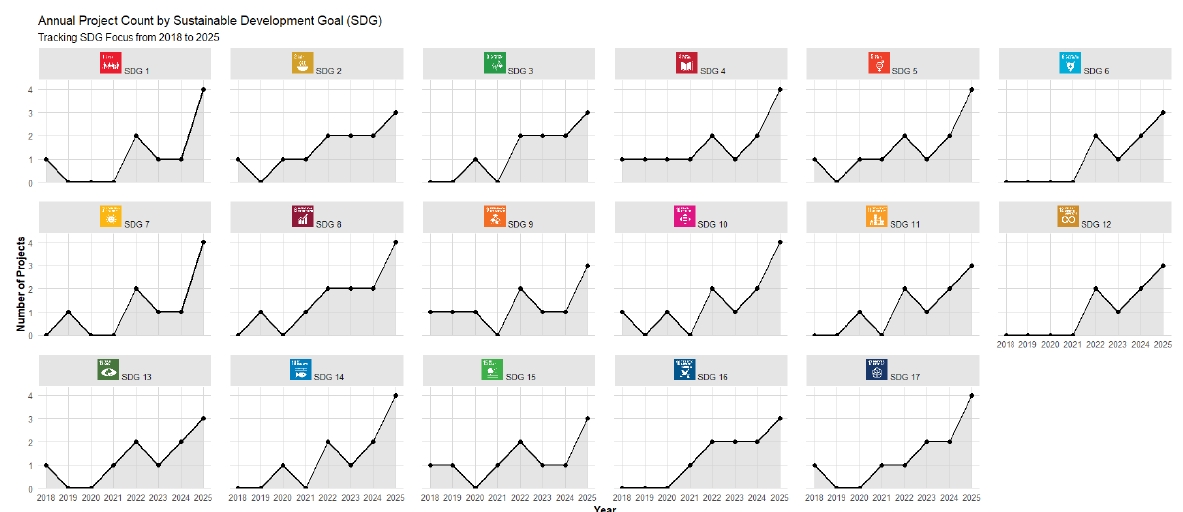
- While earlier projects concentrated on institutional and educational goals such as SDG 4 (Quality Education) and SDG 9 (Industry, Innovation and Infrastructure), later years demonstrated stronger engagement with SDG 10 (Reduced Inequalities), SDG 11 (Sustainable Cities and Communities), and SDG 13 (Climate Action). Several goals, including SDG 6 (Clean Water and Sanitation) and SDG 14 (Life Below Water), remain relatively underrepresented (Figure 3).
3. Results
- The substantial improvement in SDG coverage observed over the seven-year period reflects several interconnected factors that contributed to IGEE's program evolution. Since SEF’s launch in 2018, the number of research projects and international collaborations have greatly increased. Emphasis on cross-disciplinary team formation may have played a role in expanding SDG coverage; for example, the Mongolian Ger District project combined expertise from the Yonsei University School of Business, School of Chemical and Biomolecular Engineering, and School of Electrical and Electronic Engineering, to create an integrated village planning approach that addressed five different SDGs (Song et al., 2025).
- Our pattern matches external evidence that students lead best when backed by embedded processes. Briggs et al. (2019) demonstrate how partnerships between universities and students at Keele University enabled sustainability projects to overcome common barriers—such as volunteer turnover, siloed operations, and short project lifespans—by embedding initiatives in institutional systems while preserving student leadership (Briggs et al., 2019). Notable SEF projects including the 2018 YEPS platform are still being used by the university portal system to-date, emphasizing how initiatives like the SEF can achieve long-term institutional integration when aligned with the SDGs. Similarly, Mittal and Bansal (2024) highlight through a series of case studies that even small-scale student-led projects can generate transformative community outcomes when given institutional support and opportunities for youth agency (Mittal and Bansal, 2024). Taken together, these findings suggest that sustainable impact emerges where student creativity is coupled with institutional scaffolding, creating both short-term innovation and pathways for longer-term SDG integration.
- While the SEF program currently has many contributions to Yonsei University’s sustainable development initiative, our findings are yet to measure the long-term real-world impacts of these student projects, and the time frame between 2018–2025 does not capture post-project outcomes or the meaningful lasting effects that communities may have experienced following project initiation. Another limitation lies in the variation of SDG selection guidelines across the study period: some SEF cohorts were advised to focus on one or two primary SDGs, while others were encouraged to address multiple or all 17 goals—potentially influencing the diversity and comparability of projects in this study.
- Despite such limitations, we believe that the SEF program provides a valuable foundation for understanding how higher education institutions can drive sustainable development. Future studies analyzing both the long-term community impacts of projects and the evolving balance between curricular and co-curricular SDG engagement are essential to fully capture this lasting value.
4. Discussion and Conclusions
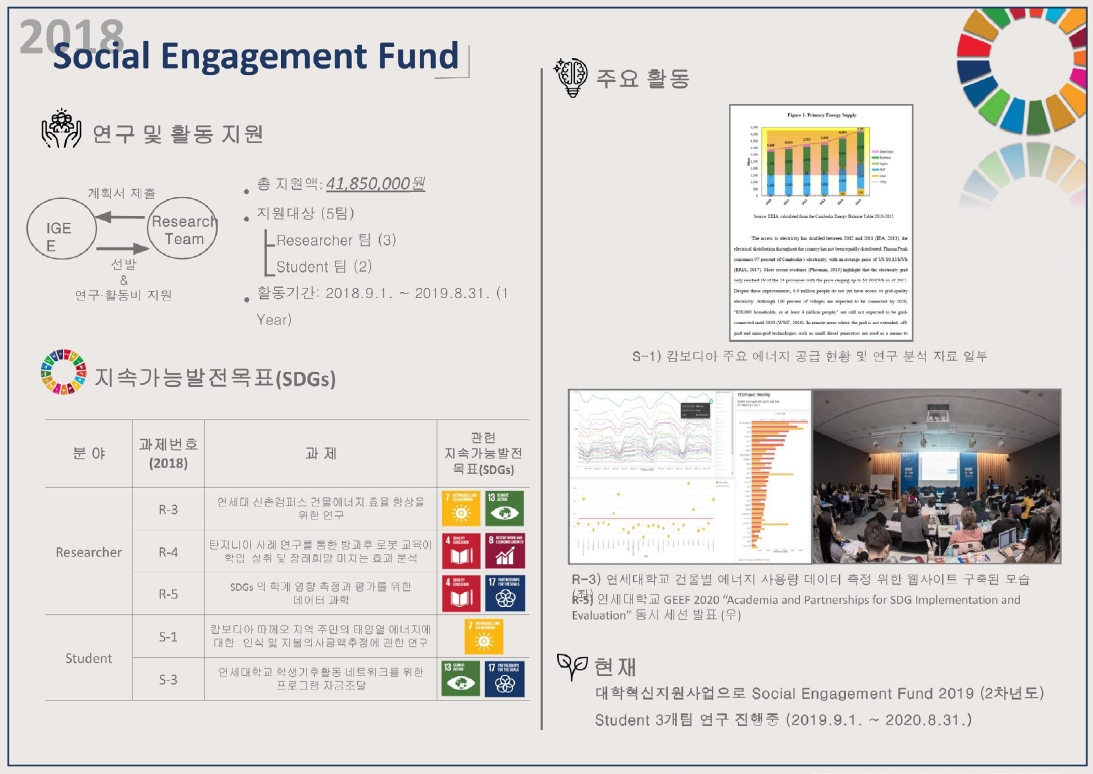

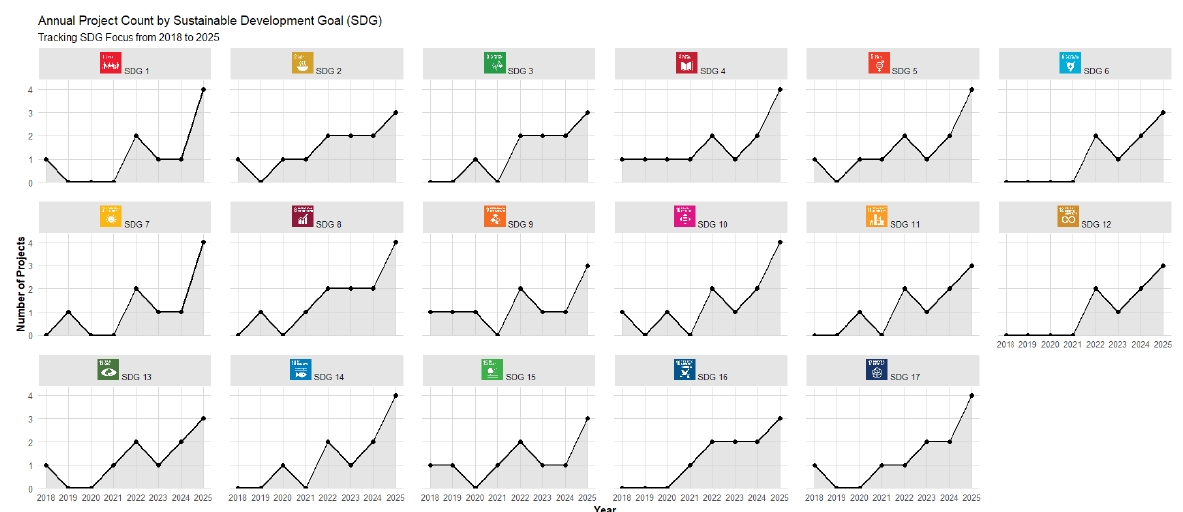
Table 1.General Characteristics of SEF Projects by Year
Table 2.SEF Projects by Cohort (2018-2025)
- An, S. (2024). The urgent call for academic action: Rebooting SDGs to reset our future. IGEE Proceedings, 1(1), 20-31. https://doi.org/10.69841/igee.2024.003Article
- Briggs, S. J., Robinson, Z. P., Hadley, R. L., & Laycock Pedersen, R. (2019). The importance of university, students and students’ union partnerships in student-led projects: A case study. International Journal of Sustainability in Higher Education, 20(8), 1409-1427. https://doi.org/10.1108/IJSHE-01-2019-0050Article
- Cho, S. (2019, August 30). Research improving energy efficiency of buildings on Yonsei’s Sinchon campus [Unpublished report]. Center for Sustainable Buildings, Yonsei University.
- Mittal, P., & Bansal, R. (2024). Case studies: Successful student-led sustainability projects. In Community engagement for sustainable practices in higher education: From awareness to action (pp. 107-123). Springer Nature Switzerland. https://doi.org/10.1007/978-3-031-63981-4_7Article
- Mori, R., Fien, J., & Horne, R. E. (2019). Implementing the UN SDGs in universities: Challenges, opportunities, and lessons learned. Sustainability: The Journal of Record, 12(2), 129-133. https://doi.org/10.1089/sus.2019.0004Article
- Rhee, E. K., & Oh, S. S. (2025). Introducing the 2024 'Social Engagement Fund' cohort. IGEE Proceedings, 2(2), 64-67. https://doi.org/10.69841/igee.2025.019Article
- Shin, J. E., Rhee, E. K., An, S., Kang, Y., Lee, K., & Song, I. H. (2024). Establishing the ESD and GCEd system in higher education: Analyzing the holistic approach of Yonsei University in South Korea. IGEE Proceedings, 1(1), 6-19. https://doi.org/10.69841/igee.2024.002Article
- Song, E., Bazarragchaa, K., Kim, G., & Lee, S. (2025). Establishment plan for sustainable villages through resolving Mongolian Ger district issues. IGEE Proceedings, 2(1), 68-82. https://doi.org/10.69841/igee.2025.014Article
References
Figure & Data
References
Citations
Citations to this article as recorded by 
 PubReader
 ePub Link
 Cite
Cite XML Download