IGEE
IGEE
Articles
- Page Path
- HOME > IGEE Proc > Volume 3(1); 2026 > Article
-
Perspective
Navigating the Future of Higher Education: Embracing Change While Preserving the Relational Core of Learning - Shinki An*
-
IGEE Proc 2026;3(1):1-8.
DOI: https://doi.org/10.69841/igee.2026.006
Published online: February 23, 2026
Department of Medical Education, Yonsei University College of Medicine, Seoul, Korea
- *Corresponding author: Shinki An, E-mail: anshinki@yuhs.ac
• Received: February 3, 2026 • Revised: February 10, 2026 • Accepted: February 10, 2026
© 2026 by the authors.
Submitted for possible open-access publication under the terms and conditions of the Creative Commons Attribution (CC BY) license (http://creativecommons.org/licenses/by/4.0/).
- 2,189 Views
- 203 Download
- 1 Crossref

- Abstract
- 1. Introduction
- 2. The Changing Knowledge Ecosystem
- 3. Mega-Environmental Challenges and the VUCA World
- 4. Medical Evidence for the Primacy of Human Connection
- 5. Why Relationships Matter More, Not Less, in the AI Age
- 6. Strategic Response: Three Pillars of Institutional Transformation
- Conclusion
- ACKNOWLEDGEMENTS
- References
Abstract
- Driven by rapid technological innovations, global crises, and growing uncertainty about the role of universities in the 21st century, higher education is at a critical inflection point. This paper proposes a conceptual framework for understanding how these circumstances may be navigated, with a focus on the changing knowledge ecosystem, marked by exponential knowledge growth stemming from the rapid development of artificial intelligence (AI). While these changes offer important opportunities for enhanced learning, they also raise significant ethical and educational concerns that must be addressed. Throughout these shifts, one element that remains unchanged is how humans learn in the context of relationships. Drawing on evidence from medical research and educational theory, this paper argues that social connection and communities of practice are fundamental for institutions that seek to use technology to support, rather than replace, the human connections that shape students into competent and ethical professionals.
- Higher education is experiencing rapid transformations, as universities navigate the development of artificial intelligence (AI), alongside major global disruptions such as the COVID-19 pandemic. Following the pandemic, educational systems were forced to “rewrite the rules” governing student-teacher interactions, and online systems for remote education, as well as AI-driven educational tools, have increasingly become the norm for learning (Pantelimon et al., 2021). Within a single decade, institutions have witnessed the emergence of AI capable of passing professional licensing examinations, responding to patients’ inquiries, and facilitating scientific writing and learning (Chau et al., 2024). These disruptions demand a comprehensive framework for understanding change while identifying those elements of education that must be preserved and strengthened.
- This paper responds to these disruptions by proposing a conceptual framework for understanding changes in higher education. It acknowledges the transformation of our current knowledge ecosystem through the rapid integration of AI, and simultaneously emphasizes the unchanging, relational core of human learning. By examining these dimensions, educators may develop strategies that are both responsive to change and grounded in enduring educational values.
1. Introduction
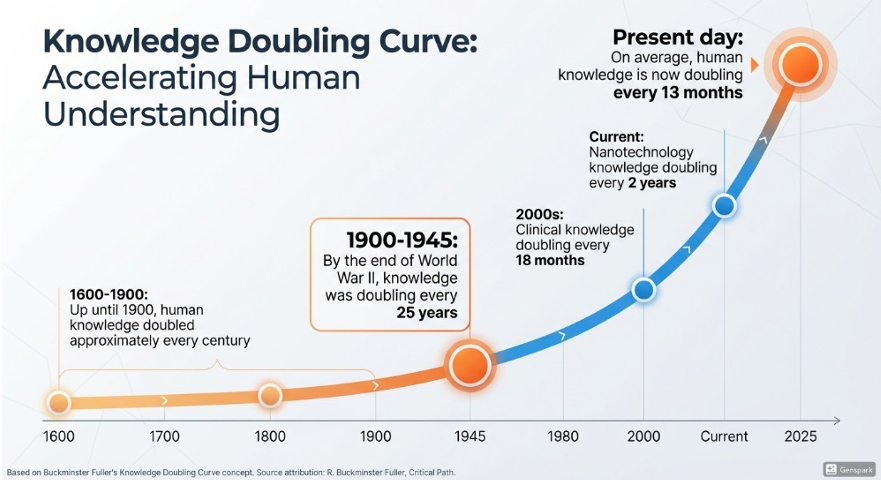
- The acceleration of knowledge creation represents one of the most dramatic shifts in human history. Buckminster Fuller's 'Knowledge Doubling Curve' noted that prior to 1900, human knowledge doubled every century (Fuller, 1981) [Figure 1]. More recently, IBM has extended this observation, estimating that human knowledge now doubles every 13 months, fuelled by technological developments and the “Internet of Things” (Chamberlain, 2020). In medical education, this acceleration is particularly pronounced: estimates suggest that medical knowledge now doubles approximately every 73 days (Densen, 2011). By comparison, the doubling time of medical knowledge was approximately 50 years in 1950, decreasing to 7 years by 1980, and shortened to 3.5 years by 2010 (Regan, 2022). This exponential growth renders traditional approaches predicated on memorization of a stable body of knowledge fundamentally inadequate.
- Concurrent with the knowledge explosion, we have witnessed the democratization of access through Massive Open Online Courses (MOOCs), YouTube, and open-access resources, challenging universities' role as gatekeepers of knowledge. Recent evidence shows that over 70% of university students regularly use YouTube as a primary or supplementary learning resource, underscoring the educational centrality of informal digital platforms in contemporary learning (Bote-Vericad, 2025). Large language models can now pass professional licensing examinations, generate academic essays, and provide personalized tutoring at scale. The EDUCAUSE 2024 AI Landscape Study revealed that 86% of students already use AI tools for academic work (EDUCAUSE, 2024). This is not a technology we can ignore or ban; it is an integral part of the world for which we are preparing students.
- However, active embrace of AI must be accompanied by critical awareness of its limitations. Recent studies have exposed troubling biases embedded in these systems. A Lancet Global Health study demonstrated that image-generating AI, despite over 300 attempts, could not produce images of Black African doctors treating white children—consistently reproducing racist 'white savior' stereotypes embedded in training data (Alenichev et al., 2023). Notably, informal replication attempts conducted by the author for the purpose of this study suggest that such outputs may now be technically achievable, pointing to rapid system updates rather than the resolution of underlying structural biases [Figure 2].
- Meanwhile, AI-assisted cheating scandals have swept through universities worldwide, including Korea's most prestigious institutions, where surveys indicate over 90% of students use AI for academic work while most institutions lack clear guidelines (Korea Herald, 2025). These challenges do not argue for rejection of AI but for thoughtful integration that includes robust ethics education and critical evaluation skills. Students must learn not merely how to use AI but how to question it—identifying biases, understanding limitations, and maintaining human oversight. We must develop not mere 'AI users' but 'AI citizens' capable of commanding these powerful tools with moral clarity. This ethical competency cannot be taught through lectures alone; it requires practice within communities where professional values are modeled and reinforced.
2. The Changing Knowledge Ecosystem
- The COVID-19 pandemic represented the most significant disruption to education in human history, with 1.6 billion students—91% of the world's student population—affected by school closures (UNESCO, 2020). Climate change, rising healthcare costs, geopolitical instability, and technological unemployment add to challenges for which traditional education has not prepared students. The acronym VUCA—Volatility, Uncertainty, Complexity, and Ambiguity—a term introduced by the United States Army War College in 1987, captures the turbulent and rapidly changing, chaotic nature of these challenges (Murugan et al., 2020). Traditional educational models, in which instructors pose questions with known answers, are fundamentally misaligned with a world where the most important problems—climate change, pandemic preparedness, AI governance—have no established solutions. Students must be prepared to address unprecedented challenges with incomplete information.
- Preparing students for a VUCA world requires institutional transformation: embracing problems without known answers, dismantling disciplinary silos, and connecting curricula to real-world challenges. Steve Jobs attributed creativity to the ability to connect disparate experiences to synthesize new insights (du Plessis, 2016), frequently observing that “creativity is connecting things” (Dyer, 2009). Neuroscience explicitly supports Steve Jobs' insight on 'connecting dots.' A study published in PNAS (Beaty et al., 2018) revealed that the creative brain is defined not by the activity of a single region, but by the robust functional connectivity between disparate neural networks—specifically, connecting the imagination network (DMN) with the executive control network. Therefore, educational institutions must foster this capacity through creative synthesis across traditional boundaries and strengthened connections between academia and the broader community.
3. Mega-Environmental Challenges and the VUCA World
- Despite the transformations in knowledge and environment, one truth remains constant: human beings are fundamentally relational creatures whose flourishing depends on connection with others. This is not merely a philosophical claim but a biological and psychological fact supported by extensive medical evidence: large-scale data from over 650,000 participants in a global well-being MOOC titled The Science of Happiness found that strengthened social connection is associated with sustained increases in happiness, life satisfaction, as well as reduced loneliness and stress (Ekman & Simon-Thomas, 2021). In an age of increasing technological mediation, this unchanging nature becomes not less important but more essential to recognize and preserve.
- Kangaroo Mother Care—the practice of skin-to-skin contact between mothers and preterm infants—demonstrates the power of human touch. Studies consistently show that this simple intervention improves growth, reduces infection, decreases mortality, and enhances neurodevelopmental outcomes. The mechanism is not technological but relational; physical connection triggers biological responses that cannot be replicated through artificial means (WHO, 2003). A landmark meta-analysis by Holt-Lunstad and colleagues demonstrated that social connection is the strongest predictor of longevity, with effect sizes exceeding those of smoking cessation, obesity reduction, and air pollution remediation. Weak social relationships carry a mortality risk equivalent to smoking 15 cigarettes per day (Holt-Lunstad et al., 2015).
- More recent research published in Nature Human Behaviour, analyzing 90 cohort studies, confirmed that social isolation and loneliness are independent risk factors for mortality across populations (Nature Human Behaviour, 2023). The recognition of loneliness as a public health crisis has led the United Kingdom and Japan to appoint ministers dedicated to addressing social isolation, with the WHO establishing a Commission on Social Connection in 2025. Notably, South Korea has been identified as one of the loneliest countries in OECD surveys—a finding with profound implications for educational policy.
- Research on cancer survival has demonstrated that patients with better spousal relationships show improved outcomes across multiple cancer types, even after controlling for disease severity and treatment. A landmark analysis of 734,889 patients revealed that married individuals had a 20% lower risk of cancer death—a survival benefit comparable to, or in some cases exceeding, that of systemic chemotherapy (Aizer et al., 2013). Furthermore, a meta-analysis of 87 studies confirmed that high levels of perceived social support are associated with a 25% reduction in mortality risk (Pinquart & Duberstein, 2009). A study of diabetic patients in Parma, Italy, found that physician empathy was associated with significant differences in complications: patients of physicians scoring highest on empathy measures had complications rates of 4.0 per 1,000, compared to 6.5 to 7.1 per 1,000 for physicians with moderate or lower empathy (Hojat et al., 2011).
- These findings underscore a fundamental truth: healthcare—and by extension, all professional practice—is not merely a technical enterprise but a relational one. The quality of human connection between professional and client affects outcomes through mechanisms that technology cannot replicate. No algorithm can provide the empathic presence that triggers healing responses; no AI can form the therapeutic alliance that sustains patients through difficult treatments. This is not a limitation to be overcome but a feature of human nature to be honored.
4. Medical Evidence for the Primacy of Human Connection
- Paradoxically, the rise of AI makes the relational dimension of education more important, not less. As AI assumes tasks previously performed by humans—information retrieval, pattern recognition, routine analysis—the distinctively human capacities become more valuable. These include empathy, ethical judgment, creative synthesis, and the ability to form meaningful relationships. An AI can diagnose a disease, but it cannot hold a patient's hand. An algorithm can grade an essay, but it cannot inspire a student to find their voice.
- Moreover, the challenges of AI integration themselves demand relational solutions. The biases embedded in AI systems cannot be addressed through technical fixes alone; they require human judgment informed by diverse perspectives developed through community dialogue. The ethical complexities of AI use in professional contexts cannot be navigated by individuals in isolation; they require communities of practice where norms are negotiated, and wisdom is shared. The temptation to use AI for cheating cannot be countered merely by surveillance technology; it requires the formation of professional identity within communities that value integrity.
- The skills most valued by employers in the twenty-first century—teamwork, communication, problem-solving, creativity, leadership—are fundamentally relational capabilities that can only be developed through interaction with others. These competencies cannot be acquired through individual study of recorded lectures or AI-assisted learning alone; they require practice within communities of learning. Edward Hundert, former Dean at Harvard Medical School, articulated this principle clearly: education is not about transmission of information, but transformation of learner (Hundert, 1996). True transformation requires what he termed a 'Community of Practice'—a safe environment where learners can experiment, fail, and receive feedback. This process is deeply rooted in the developmental trajectory described by Robert Kegan, where learners evolve from reliance on external authority toward 'self-authorship,' (Kegan, 1982) and in Alasdair MacIntyre’s concept of 'narrative identity,' where individuals construct their professional selves by locating their stories within a broader moral tradition (MacIntyre, 2007).
- Therefore, the university must function as a communal space that fosters these developmental and narrative shifts through meaningful relational experiences. This necessity is well-documented in medical education by Richard and Sylvia Cruess, who emphasized 'Professional Identity Formation' as the core goal of medical training (Cruess, et al, 2014). Similarly, seminal research on legal and engineering education—such as the Carnegie Foundation’s reports—echoes this finding, demonstrating that professional identity in fields like law and engineering is forged not in isolation, but through socialization into a community of shared values and practices (Sullivan, et al.,2007; Sheppard, et al., 2009). Students, thus, do not become professionals simply by absorbing information; they become physicians, engineers, lawyers, or teachers through apprenticeship within communities that model and reinforce their emerging identities.
- The COVID-19 pandemic's forced experiment with remote learning confirmed what educational theory had long suggested: something essential is lost when learning becomes purely transactional. As John Dewey argued in Experience and Nature, when experience is reduced to “the mere process of experiencing,” it produces “the absurdity of an experiencing which experiences only itself” (Dewey, 1925). While online platforms proved adequate for information transmission, they struggled to replicate the transformative power of in-person community. Students reported feeling disconnected not only from peers and faculty but from their developing professional identities. The challenge for the future is not to choose between technology and community but to leverage technology in service of community.
- This is particularly crucial for developing ethical competencies in AI use. Students cannot learn to be 'AI citizens'—critical, ethical, and responsible in their use of these tools—through online modules alone. They must observe mentors navigating ethical dilemmas, discuss ambiguous cases with peers, and practice decision-making in environments where mistakes can be made safely. The community of practice provides the context in which ethical intuitions are formed and professional judgment is developed.
5. Why Relationships Matter More, Not Less, in the AI Age
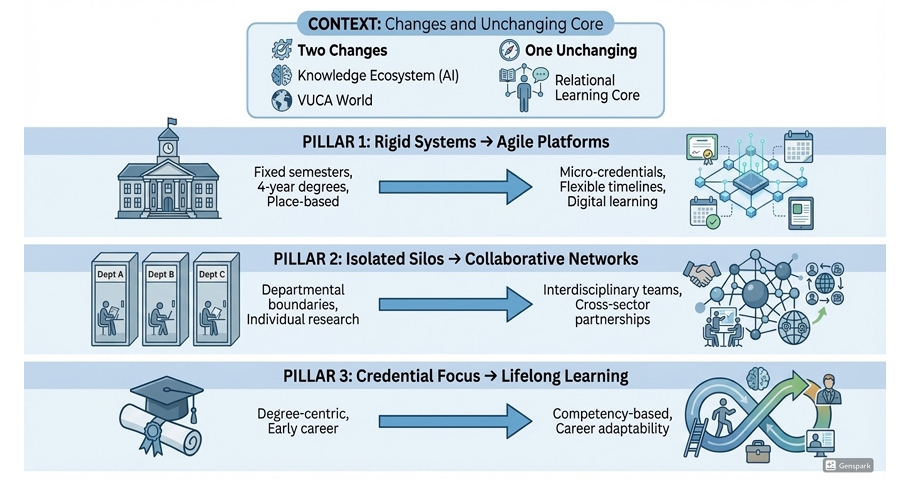
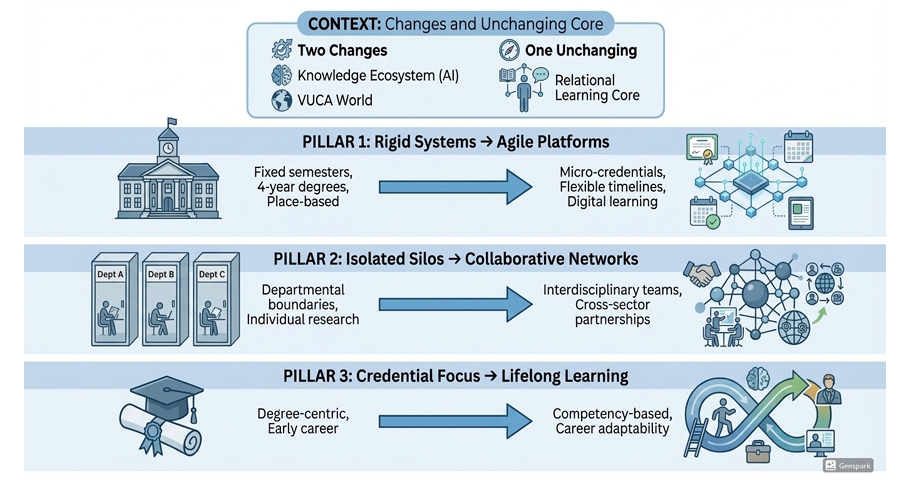
- To navigate the "two changes" while preserving the "one unchanging nature," universities must undertake three fundamental transformations. These shifts represent a move from rigid, isolated structures to agile, connected, and communal ecosystems [Figure 3].
- First, higher education must transition from fixed, immutable academic systems to flexible, agile platforms. The traditional "place-based" education model, bound by four-year degrees and rigid semesters, is too heavy to keep pace with the exponential growth of knowledge. We need to embrace "platform-based" education that actively integrates digital technologies to transcend physical and temporal limitations. Furthermore, academic units must be redefined. We must move beyond the traditional "course" or even "module" to the concept of "educational granules." A granule is a concise, compact, and self-contained micro-unit that integrates instruction, assessment, and certification. Just as one threads beads to create a unique necklace, these granules can be flexibly combined to meet specific learning needs and career goals. This granular approach is practically realized through "electronic badges," such as those implemented by Brown University, which allow learners to stack verified competencies and rapidly update their professional identities (Brown University School of Professional Studies, 2022). This shift from transmission of static information to the continuous transformation of learners requires a fundamental rethinking of our instructional designs and degree structures.
- Second, we must dismantle disciplinary silos to foster true creativity by shifting our focus from "known answers" to "unsolved problems." In the past, higher education evaluated competence based on a student's ability to provide correct answers to pre-existing questions. However, the pressing mega-challenges of our time persist precisely because existing answers have failed. Therefore, true creativity in the AI era is defined by "connectivity to the real world." Universities must move beyond delivering pre-packaged knowledge and instead, expose students to "problems without answers." By connecting academia directly to the business sector and local communities, and by dissolving the barriers between departments, we create an environment where students learn to connect disparate dots—bridging the gap between theory and the complex, unsolved challenges of reality.
- Third, and most critically, the university must redefine itself as a "Community of Practice" that provides the necessary time and safety for professional identity formation. While knowledge can be acquired instantly via platforms, the team-based competencies and relational skills demanded by modern enterprises cannot be rapidly "downloaded"; they must be cultivated over time. This formation requires a safe environment where learners are encouraged to challenge existing norms, experiment, and fail without fear of irreversible consequences. Drawing on Robert Kegan’s developmental theory and Alasdair MacIntyre’s narrative identity, the university must function as a molding cast—a protective frame—where students experience the "deconstruction" of their pre-existing selves and "reconstruction" into professionals. This deep internal shift happens through meaningful relational experiences with mentors and peers—a human-centric process that requires the specific "spacetime" of a community that mere technology can never replace.
6. Strategic Response: Three Pillars of Institutional Transformation
- Higher education stands at a crossroads. The forces of technological disruption, environmental change, and social transformation demand fundamental adaptation. However, the central challenge is not simply whether universities change, but how they change, and which educational values are preserved in the process. The evidence is clear: human beings are relational creatures whose flourishing depends on connection with others. AI is not a threat to be feared but a powerful tool to be embraced—critically, ethically, and in service of human flourishing. The biases embedded in AI systems, the challenges of academic integrity, and the ethical complexities of AI-augmented professional practice all demand not less human judgment but more. The path forward requires institutions to be both adaptive and principled: adaptive in embracing new technologies, new delivery models, and new partnerships; principled in maintaining commitment to the communities of practice that transform students into competent, ethical professionals. The universities that successfully navigate this balance will not only survive but flourish, producing graduates equipped to address the challenges of an uncertain future while maintaining the human connections that give life meaning.
Conclusion
ACKNOWLEDGEMENTS
Figure 1.Buckminster Fuller’s Knowledge Doubling Curve (Redrawn by Author for Publication based on Fuller, 1981) (Fuller, 1981).
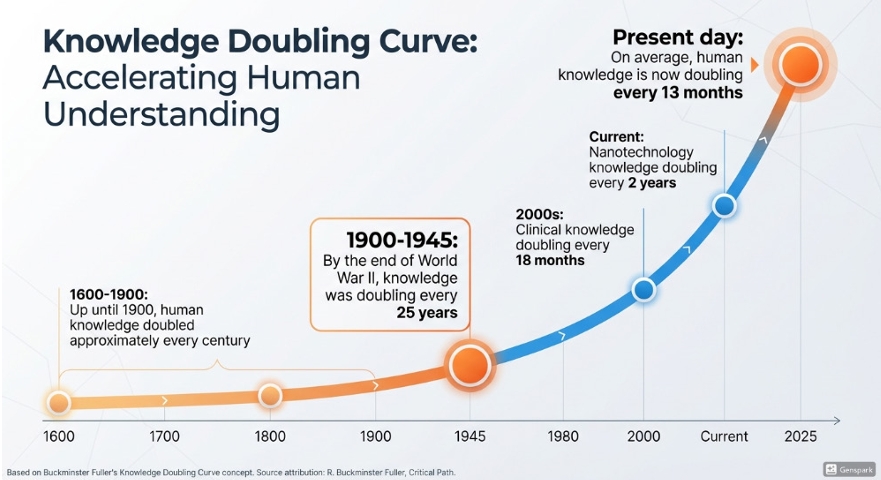
Figure 2.Prompt-African doctors administer vaccines to poor White children in the style of photojournalism (Re-generated using the same prompt as Alenichev et al. for the purpose of this study).

- Alenichev, A., Kingori, P., & Grietens, K. P. (2023). Reflections before the storm: The AI reproduction of biased imagery in global health visuals. The Lancet Global Health, 11(10), e1496-e1498. https://doi.org/10.1016/s2214-109x(23)00329-7ArticlePubMed
- Aizer, A. A., Chen, M. H., & McCarthy, E. P. (2013). Marital status and survival in patients with cancer. J Clin Oncol, 31(31), 3869-3876. https://doi.org/10.1200/JCO.2013.49.6489ArticlePubMedPMC
- Beaty, R. E., Kenett, Y. O., & Christensen, A. P. (2018). Robust prediction of individual creative ability from brain functional connectivity. Proc Natl Acad Sci U S A, 115(5), 1087-1092. https://doi.org/10.1073/pnas.1713532115ArticlePubMedPMC
- Bote-Vericad, J. J. (2025). Information-seeking and content creation: The impact of YouTube educational videos on learning practices in library and information science. Journal of Librarianship and Information Science, 09610006241309102.
- Brown University School of Professional Studies. (2022). Digital Health Innovation Certificate. Retrieved from https://professional.brown.edu/
- Chamberlain, P. (2020). Knowledge is not everything. Design for Health, 4(1), 1-3. https://doi.org/10.1080/24735132.2020.1731203Article
- Chau, R. C. W., Thu, K. M., Yu, O. Y., Hsung, R. T. C., Lo, E. C. M., & Lam, W. Y. H. (2024). Performance of generative artificial intelligence in dental licensing examinations. International dental journal, 74(3), 616-621. https://doi.org/10.1016/j.identj.2023.12.007ArticlePubMedPMC
- Cruess, R. L., Cruess, S. R., Boudreau, J. D., Snell, L., & Steinert, Y. (2014). Reframing medical education to support professional identity formation. Acad Med, 89(11), 1446-1451. https://doi.org/10.1097/acm.0000000000000427ArticlePubMed
- Densen, P. (2011). Challenges and opportunities facing medical education. Transactions of the American Clinical and Climatological Association, 122, 48-58.PubMedPMC
- Dewey, J. (1990). Experience and nature (Vol. 10, pp. 1–328). Southern Illinois University Press. (Original work published 1925).
- du Plessis, R. (2016). The life of Steve Jobs: A psychobiographical study (Doctoral dissertation, University of the Free State).
- Dyer, J. H., Gregersen, H. B., & Christensen, C. M. (2009). The innovator’s DNA. Harvard business review, 87(12), 60-67.
- EDUCAUSE. (2024). 2024 EDUCAUSE AI Landscape Study. EDUCAUSE Publications.
- Fuller, R. B. (1981). Critical Path. St. Martin's Press.
- Hojat, M., Louis, D. Z., Markham, F. W., Wender, R., Rabinowitz, C., & Gonnella, J. S. (2011). Physicians' empathy and clinical outcomes for diabetic patients. Academic Medicine, 86(3), 359-364. https://doi.org/10.1097/acm.0b013e3182086fe1ArticlePubMed
- Holt-Lunstad, J., Smith, T. B., Baker, M., Harris, T., & Stephenson, D. (2015). Loneliness and social isolation as risk factors for mortality: A meta-analytic review. Perspectives on Psychological Science, 10(2), 227-237. https://doi.org/10.1177/1745691614568352ArticlePubMed
- Hundert, E. M. (1996). Characteristics of the informal curriculum and trainees' ethical choices. Academic Medicine, 71(6), 624-633. https://doi.org/10.1097/00001888-199606000-00014ArticlePubMed
- Kegan R. The Evolving Self: Problem and Process in Human Development. Harvard University Press; 1982.
- Korea Herald. (2025, November 10). Mass cheating scandal at Yonsei ignites calls for clearer AI rules on campus. The Korea Herald.
- Machlup, F. (1962). The Production and Distribution of Knowledge in the United States. Princeton University Press.
- MacIntyre A. After Virtue: A Study in Moral Theory. 3rd ed. University of Notre Dame Press; 2007.
- Mehta, N. B.. (2013). Just Imagine. Academic Medicine, 88(10), 1418-1423. https://doi.org/10.1097/ACM.0b013e3182a36a07ArticlePubMed
- Murugan, S., Rajavel, S., Aggarwal, A. K., & Singh, A. (2020). Volatility, uncertainty, complexity and ambiguity (VUCA) in context of the COVID-19 pandemic: Challenges and way forward. International Journal of Health Systems and Implementation Research, 4(2), 10-16.
- Nature Human Behaviour. (2023). Social isolation and loneliness as risk factors for disease. Nature Human Behaviour, 7, 1346-1360.
- Pantelimon, F. V., Bologa, R., Toma, A., & Posedaru, B. S. (2021). The evolution of AI-driven educational systems during the COVID-19 pandemic. Sustainability, 13(23), 13501. https://doi.org/10.3390/su132313501Article
- Pinquart, M., & Duberstein, P.R. (2010). Associations of social networks with cancer mortality: a meta-analysis. Crit Rev Oncol Hematol, 75(2), 122-137. https://doi.org/10.1016/j.critrevonc.2009.06.003ArticlePubMedPMC
- Regan, E. A., Agha, A. M., & Brookshire, R. G. (2022). Digital learning in healthcare: Where we are and where we are going. The SAGE handbook of learning and work, 311-318.
- Schilling, D. R. (2013). "Knowledge Doubling Every 12 Months, Soon to be Every 12 Hours." Industry Tap. (Citing IBM's "The Toxic Terabyte" and IoT forecasts).
- Sheppard SD, Macatangay K, Colby A, Sullivan WM. Educating Engineers: Designing for the Future of the Field. Jossey-Bass; 2009.
- Sullivan WM, Colby A, Wegner JW, Bond L, Shulman LS. Educating Lawyers: Preparation for the Profession of Law. Jossey-Bass; 2007.
- UNESCO. (2020). Education: From disruption to recovery. UNESCO Global Education Coalition.
- World Economic Forum. The Future of Jobs Report 2025. World Economic Forum; 2025. Accessed January 20, 2026. https://www.weforum.org/reports/the-future-of-jobs-report-2025
- World Health Organization. (2003). Kangaroo mother care: A practical guide. WHO.
- World Health Organization. (2025). Social connection: A priority for the WHO. WHO Commission on Social Connection.
- Zack, T., Lehman, E., & Suzgun, M. (2024). Assessing the potential of GPT-4 to perpetuate racial and gender biases in health care. The Lancet Digital Health, 6(1), e12-e22. https://doi.org/10.1016/s2589-7500(23)00225-xArticlePubMed
References
Figure & Data
References
Citations
Citations to this article as recorded by 
- Scholarship at “Machine” Speed
Sarah Soyeon Oh
IGEE Proceedings.2026; 3(1): 14. CrossRef
 PubReader
 Cite
Cite XML Download