IGEE
IGEE
Articles
- Page Path
- HOME > IGEE Proc > Volume 3(1); 2026 > Article
-
Article
Environmental Carcinogens and Cancer Inequality: How Air Pollution Challenges the Achievement of SDG 3 - Hyeonjung Yun*
-
IGEE Proc 2026;3(1):61-66.
DOI: https://doi.org/10.69841/igee.2026.007
Published online: February 24, 2026
Department of Biotechnology, Yonsei University, Seoul, Korea
- *Corresponding author: Hyeonjung Yun, E-mail: yunhj803@gmail.com
• Received: January 15, 2026 • Revised: February 10, 2026 • Accepted: February 11, 2026
© 2026 by the authors.
Submitted for possible open-access publication under the terms and conditions of the Creative Commons Attribution (CC BY) license (http://creativecommons.org/licenses/by/4.0/).
- 958 Views
- 11 Download

Abstract
-
Background
- Cancer has traditionally been understood as a disease driven primarily by genetic mutations; however, growing evidence indicates that environmental exposures play a significant role in shaping cancer risk and outcomes. Among these exposures, air pollution has been classified as a Group 1 carcinogen by the International Agency for Research on Cancer (IARC). Beyond its biological effects, air pollution is unevenly distributed across populations, raising concerns related to health inequality and long-term public health sustainability.
-
Methods
- This narrative review synthesizes epidemiological and molecular studies examining the association between particulate matter (PM2.5) exposure and carcinogenesis. Key biological mechanisms discussed include oxidative stress, DNA damage, chronic inflammation, and epigenetic dysregulation.
-
Results
- The reviewed literature shows consistent associations between long-term PM2.5 exposure and increased lung cancer incidence and mortality, with more limited evidence for other cancer types. Unequal exposure to air pollution, combined with disparities in healthcare access, contributes to differences in cancer risk and survival across socioeconomic groups.
-
Conclusion
- By integrating biological evidence with environmental and equity perspectives, this paper highlights the importance of addressing air pollution as part of comprehensive cancer prevention strategies. Reducing environmental cancer risk factors is essential for promoting equitable and sustainable population health.
- Cancer remains one of the leading causes of morbidity and mortality worldwide, posing a major challenge to global public health systems (World Health Organization [WHO], 2023). Traditionally, cancer has been understood primarily as a biological disease driven by genetic mutations and cellular dysregulation. Advances in molecular biology and precision medicine have improved diagnosis and treatment outcomes in many settings; however, substantial disparities in cancer incidence and survival persist across populations and regions (Bray et al., 2018). These persistent inequalities indicate that cancer risk and outcomes cannot be fully explained by biological mechanisms alone but must also be examined within broader environmental and social contexts.
- Among environmental risk factors, air pollution has emerged as a significant contributor to cancer risk. The International Agency for Research on Cancer (IARC) classifies outdoor air pollution and particulate matter with an aerodynamic diameter of ≤2.5 μm (PM2.5) as Group 1 carcinogens, indicating sufficient evidence of carcinogenicity in humans (IARC, 2016). Epidemiological studies consistently report associations between long-term PM2.5 exposure and increased lung cancer incidence and mortality, with more limited but growing evidence for other cancer types (Hamra et al., 2014; Pope et al., 2020). Despite this evidence, air pollution is often addressed primarily as an environmental or urban planning issue rather than as a central determinant of cancer prevention.
- Importantly, exposure to air pollution is unevenly distributed. Individuals living in low-income communities, densely populated urban areas, or near industrial zones are more likely to experience higher levels of PM2.5 exposure (Hajat et al., 2015). These same populations frequently face structural barriers to healthcare access, including limited cancer screening, delayed diagnosis, and reduced access to advanced treatment, which together exacerbate cancer-related inequalities (Marmot et al., 2020). In South Korea, regional disparities in air quality and cancer outcomes have been reported, particularly in urban and industrialized areas, highlighting the relevance of this issue for national public health policy (Kim et al., 2021).
- Within this context, sustainability is understood not only as environmental protection but also as the capacity of health systems to prevent disease equitably and maintain population health over the long term. From this perspective, effective cancer prevention requires approaches that reduce environmental risk exposures while simultaneously addressing structural inequalities in health and healthcare access. International public health frameworks increasingly emphasize the importance of minimizing preventable disease burden and narrowing health disparities as core components of sustainable development. Accordingly, environmental regulation and equity-oriented public health strategies play a critical role in shaping long-term, sustainable cancer control.
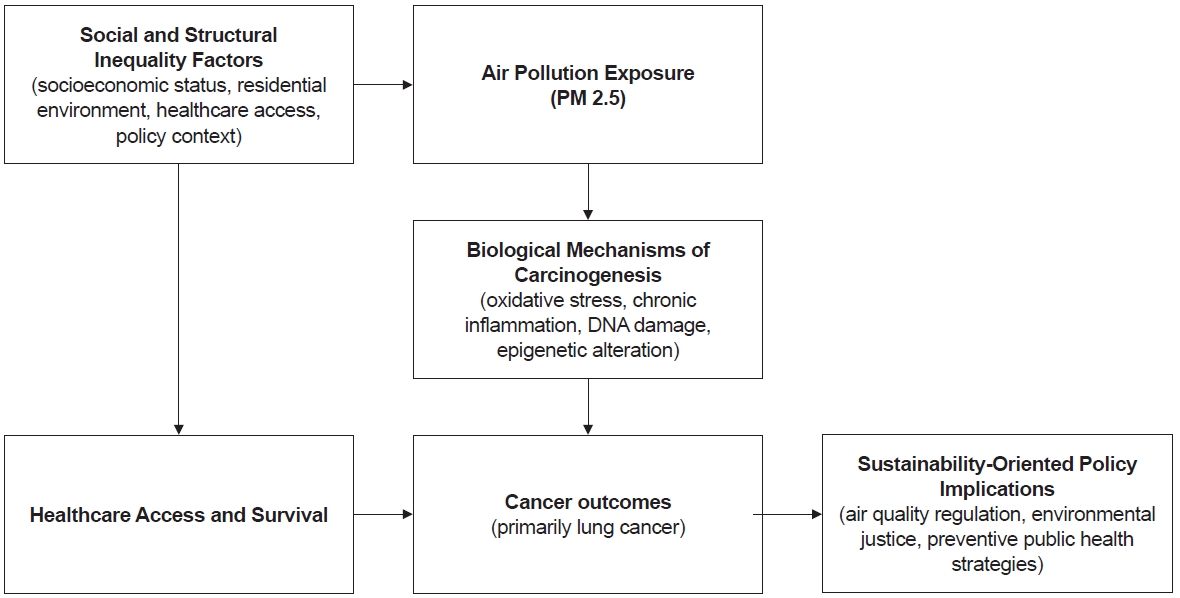
- This paper is a narrative review and conceptual analysis that examines air pollution as both a biological carcinogenic factor and a social determinant of cancer inequality. By synthesizing existing epidemiological and mechanistic evidence, this study explores how PM2.5 exposure is associated with carcinogenesis—particularly lung cancer—and how social and structural factors modify these associations. The aim of this paper is to highlight the necessity of integrating environmental policy and equity-oriented public health strategies into sustainable cancer prevention frameworks. Figure 1 presents a conceptual framework summarizing the key relationships examined in this study.
1. Introduction
- Materials
- This study is based on a qualitative literature review of existing peer-reviewed research. The materials for this study consisted of peer-reviewed academic literature, reports from international health organizations, and publicly available epidemiological studies related to air pollution and cancer. Key sources included publications from the World Health Organization (WHO), the International Agency for Research on Cancer (IARC), and major epidemiological studies examining particulate matter (PM2.5) exposure and cancer risk. These materials were selected to provide a comprehensive overview of both biological mechanisms and social dimensions of cancer associated with air pollution.
- Methods
- This study employed a narrative review methodology to synthesize existing research findings across multiple disciplines, including environmental health, oncology, and public health policy (Grant & Booth, 2009). A literature search was conducted using Google Scholar and PubMed, focusing on articles published in English between 2000 and 2024. Search terms included combinations of “air pollution,” “PM2.5,” “cancer,” “lung cancer,” “health inequality,” “environmental justice,” and “sustainability.”
- Rather than quantitatively aggregating data, this method aimed to identify consistent patterns and themes within the literature, allowing for an integrated discussion of cancer as both a biological and social phenomenon.
- Based on the reviewed literature, a conceptual study model was developed to illustrate how social and structural inequality factors shape exposure to air pollution, biological pathways of carcinogenesis, and cancer outcomes. This framework also highlights the role of healthcare access and sustainability-oriented policy implications in modifying cancer risk and survival (Figure 1).
- Analysis: The selected literature was analyzed qualitatively to extract key themes related to cancer risk, environmental exposure, and inequality. Particular attention was paid to evidence supporting associations between PM2.5 exposure and specific cancer types, especially lung cancer, which is most consistently reported in the literature. Studies addressing regional and socioeconomic disparities—including urban industrial areas and East Asian contexts such as South Korea—were examined to highlight how uneven exposure contributes to cancer inequality.
- The analysis focused on associative evidence rather than causal claims, reflecting the limitations of observational studies and the narrative review design.
2. Materials and Methods
1) Study Model
- This section summarizes key findings from existing epidemiological and molecular studies regarding the relationship between air pollution, carcinogenesis, and cancer inequality. Rather than presenting original experimental data, the results reflect consistent patterns identified across the reviewed literature.
- Associations between PM2.5 Exposure and Cancer Risk
- Across epidemiological studies, long-term exposure to ambient air pollution—particularly PM2.5—has been consistently associated with increased cancer risk. The strongest and most robust evidence has been reported for lung cancer, with cohort and case–control studies demonstrating higher incidence and mortality rates among populations exposed to elevated PM2.5 concentrations (Hamra et al., 2014; Pope et al., 2020). These associations remain significant after adjustment for major confounders such as smoking status, age, and occupational exposure, suggesting an independent contribution of ambient air pollution.
- Emerging evidence also suggests potential associations between PM2.5 exposure and other cancer types, including bladder and breast cancer, although findings remain less consistent and are subject to greater uncertainty (Turner et al., 2017). Overall, the reviewed literature indicates that air pollution contributes to cancer burden primarily through lung cancer, with additional cancer risks requiring further investigation.
- Biological Mechanisms Linking Air Pollution and Carcinogenesis
- Mechanistic studies provide biological plausibility for the observed associations between PM2.5 exposure and cancer outcomes. Experimental and observational research suggests that fine particulate matter induces oxidative stress, leading to DNA damage and impaired DNA repair pathways (Li et al., 2016). Chronic exposure to PM2.5 has also been associated with persistent inflammation, which creates a tumor-promoting microenvironment and facilitates malignant transformation (Coussens & Werb, 2002).
- In addition, growing evidence indicates that air pollution may influence epigenetic regulation, including DNA methylation and histone modification, potentially altering gene expression patterns relevant to carcinogenesis (Bollati & Baccarelli, 2010). While these mechanisms do not establish direct causation in human populations, they support a biologically plausible pathway linking environmental exposure to increased cancer risk.
- Social and Structural Inequalities in Exposure and Cancer Outcomes
- The reviewed studies consistently indicate that exposure to air pollution is shaped by social and structural inequality factors. Populations with lower socioeconomic status and those residing in densely populated urban or industrial areas experience disproportionately higher levels of PM2.5 exposure (Hajat et al., 2015). These exposure patterns overlap with disparities in healthcare access, including reduced participation in cancer screening programs and delayed diagnosis.
- In the South Korean context, regional variations in air quality and cancer outcomes have been reported, particularly in metropolitan and industrialized regions, suggesting that environmental and social determinants jointly influence cancer risk and survival (Kim et al., 2021). These findings highlight that cancer outcomes are not determined solely by biological exposure but are modified by broader structural conditions.
- Implications for Sustainable Cancer Prevention
- Synthesized evidence from the reviewed literature indicates that addressing air pollution has implications beyond environmental protection. Policies aimed at reducing ambient PM2.5 levels—such as stricter emission controls and urban planning interventions—are associated with population-level health benefits, including reduced cancer burden (Pope et al., 2020). Importantly, prevention-oriented strategies that prioritize high-exposure and underserved populations have the potential to reduce cancer-related health inequalities.
- These findings collectively suggest that cancer prevention strategies centered on environmental risk reduction and equitable healthcare access are essential components of long-term, sustainable cancer control.
3. Results
- Discussion
- This narrative review synthesized existing epidemiological and mechanistic evidence to examine how ambient air pollution, particularly PM2.5, is associated with cancer risk and inequality. The findings suggest that air pollution contributes to cancer burden primarily through lung cancer, supported by consistent epidemiological associations and biologically plausible mechanisms. Importantly, the results highlight that cancer risk linked to air pollution is not distributed evenly across populations but is shaped by social and structural conditions that influence both exposure and healthcare access.
- From a biological perspective, the reviewed literature indicates that oxidative stress, chronic inflammation, and epigenetic dysregulation provide plausible pathways through which PM2.5 exposure may increase cancer susceptibility. While these mechanisms do not establish direct causation in human populations, they support the interpretation that environmental exposures interact with biological processes to influence cancer development. This reinforces the need to consider environmental risk reduction as a component of cancer prevention rather than focusing exclusively on treatment.
- The discussion of cancer inequality underscores that environmental exposure and healthcare access are deeply interconnected. Populations experiencing higher levels of air pollution often face barriers to early detection and timely treatment, which may contribute to poorer cancer outcomes. In South Korea, urban density and industrial activity intensify exposure disparities, emphasizing the importance of region-specific environmental and public health strategies. These patterns suggest that cancer prevention efforts that overlook environmental inequality risk reinforcing existing health disparities.
- Framing cancer prevention as a sustainability issue shifts attention toward long-term, preventive approaches that integrate environmental regulation and public health policy. Sustainable cancer control, in this context, refers to the capacity of health systems to reduce preventable cancer risk while promoting equity over time. Policies that reduce air pollution exposure have the potential to deliver co-benefits for population health, healthcare system resilience, and social equity, particularly when targeted toward high-risk communities.
- Limitations
- This study has several limitations. First, as a narrative review, it does not provide a quantitative synthesis of effect sizes, and the interpretation of findings is dependent on the quality and scope of the existing literature. Second, much of the evidence linking PM2.5 exposure to cancer outcomes is derived from observational studies, which are subject to residual confounding and exposure measurement error. Third, regional bias exists in the literature, with a predominance of studies from high-income countries, potentially limiting generalizability to other contexts. Finally, evidence for cancers other than lung cancer remains limited, underscoring the need for further research.
- Conclusion
- This paper examined cancer not only as a biomedical condition but as a public health challenge shaped by environmental exposure, social inequality, and structural policy contexts. Focusing on air pollution as a representative environmental carcinogen, this narrative review synthesized epidemiological and mechanistic evidence suggesting that long-term PM2.5 exposure is strongly associated with increased lung cancer risk and may contribute to other cancers to a lesser extent. Biological processes such as oxidative stress, chronic inflammation, and epigenetic alteration provide plausible pathways through which environmental exposure may influence carcinogenesis.
- Importantly, the findings highlight that cancer risk related to air pollution is not distributed evenly across populations. Communities experiencing higher environmental exposure often face additional barriers to cancer prevention, early detection, and treatment, compounding existing health inequalities. In contexts such as South Korea, where urban density and industrial activity shape regional air quality, these disparities underscore the need for prevention strategies that account for both environmental and social determinants of health.
- From a sustainability perspective, effective cancer control depends on the capacity of health systems to reduce preventable disease burden while promoting equity over the long term. Addressing environmental carcinogens such as air pollution should therefore be understood as an integral component of cancer prevention, rather than as a separate environmental concern. Preventive approaches that reduce population-level exposure offer the potential to lower cancer incidence before irreversible biological damage occurs, while also alleviating pressure on healthcare systems.
- This study also emphasizes the evolving role of life sciences in advancing sustainable health outcomes. Beyond therapeutic innovation, life science research can contribute to cancer prevention by engaging with environmental health, exposure science, and policy-relevant evidence. Integrating molecular biology with environmental and social frameworks enables a more comprehensive understanding of how cancer risk is produced and how it may be mitigated.
- In conclusion, meaningful progress in cancer control requires a shift toward prevention-oriented strategies that address environmental and structural drivers of disease. Reducing air pollution represents a critical opportunity to lower cancer burden, narrow health inequalities, and support sustainable public health systems capable of protecting both present and future generations.
4. Discussion and Conclusions
Figure 1.Conceptual Framework Illustrating Associations Between Air Pollution, Social Inequality, and Cancer Outcomes.
- Bray, F., Ferlay, J., Soerjomataram, I., Siegel, R. L., Torre, L. A., & Jemal, A. (2018). Global cancer statistics 2018: GLOBOCAN estimates of incidence and mortality worldwide for 36 cancers in 185 countries. CA: A Cancer Journal for Clinicians, 68(6), 394-424. https://doi.org/10.3322/caac.21492ArticlePubMedPMC
- Bollati, V., & Baccarelli, A. (2010). Environmental epigenetics. Heredity, 105(1), 105-112. https://doi.org/10.1038/hdy.2010.2ArticlePubMedPMC
- Coussens, L. M., & Werb, Z. (2002). Inflammation and cancer. Nature, 420(6917), 860-867. https://doi.org/10.1038/nature01322ArticlePubMedPMC
- Grant, M. J., & Booth, A. (2009). A typology of reviews: An analysis of 14 review types and associated methodologies. Health Information & Libraries Journal, 26(2), 91-108. https://doi.org/10.1111/j.1471-1842.2009.00848.xArticlePubMedPMC
- Hajat, A., Hsia, C., & O’Neill, M. S. (2015). Socioeconomic disparities and air pollution exposure: A global review. Current Environmental Health Reports, 2(4), 440-450. https://doi.org/10.1007/s40572-015-0069-5ArticlePubMedPMC
- Hamra, G. B., Guha, N., Cohen, A., Laden, F., Raaschou-Nielsen, O., Samet, J. M., & Straif, K. (2014). Outdoor particulate matter exposure and lung cancer: A systematic review and meta-analysis. Environmental Health Perspectives, 122(9), 906-911. https://doi.org/10.1289/ehp.1408092ArticlePubMedPMC
- International Agency for Research on Cancer. (2016). Outdoor air pollution. IARC Monographs on the Evaluation of Carcinogenic Risks to Humans, Vol. 109. Lyon, France: World Health Organization.
- Kim, H., Kim, J., & Kim, S. (2021). Regional disparities in air pollution and cancer mortality in South Korea. Interna-tional Journal of Environmental Research and Public Health, 18(3), 1234. https://doi.org/10.3390/ijerph18031234ArticlePubMedPMC
- Li, R., Kou, X., Xie, L., Cheng, F., Geng, H., Qi, Y., & Sun, Q. (2016). Effect of ambient PM2.5 on lung mitochondrial damage and fusion/fission gene expression in rats. Chemosphere, 136, 89-98. https://doi.org/10.1016/j.chemosphere.2015.04.022Article
- Marmot, M., Allen, J., Goldblatt, P., Herd, E., & Morrison, J. (2020). Build back fairer: The COVID-19 Marmot review. Institute of Health Equity.
- Pope, C. A., Coleman, N., Pond, Z. A., & Burnett, R. T. (2020). Fine particulate air pollution and human mortality: 25+ years of cohort studies. Environmental Research, 183, 108924. https://doi.org/10.1016/j.envres.2019.108924ArticlePubMed
- Pope, C. A., Burnett, R. T., Thun, M. J., Calle, E. E., Krewski, D., Ito, K., & Thurston, G. D. (2002). Lung cancer, cardiopulmonary mortality, and long-term exposure to fine particulate air pollution. JAMA, 287(9), 1132-1141. https://doi.org/10.1001/jama.287.9.1132ArticlePubMedPMC
- Turner, M. C., Krewski, D., Diver, W. R., Pope, C. A., Burnett, R. T., Jerrett, M., & Gapstur, S. M. (2017). Ambient air pollution and cancer mortality in the Cancer Prevention Study II. Environmental Health Perspectives, 125(8), 087013. https://doi.org/10.1289/EHP1249ArticlePubMedPMC
- World Health Organization. (2023). Global cancer burden. World Health Organization.
References
Figure & Data
References
Citations
Citations to this article as recorded by 
 PubReader
 Cite
Cite XML Download