IGEE

Articles
- Page Path
- HOME > IGEE Proc > Volume 3(3); 2026 > Article
-
Article
Can Electric Motorcycles Save Lives? Evidence from Uganda and Rider-Level Barriers to Electric Transition - Hyeongchan Yun1*, Beomjun Kim2, Seoyoon Jung3
-
IGEE Proc 2026;3(3):180-194.
DOI: https://doi.org/10.69841/igee.2026.018
Published online: October 13, 2026
1Sustainable Development and Cooperation, Underwood International College, Yonsei University, Seoul, Korea
2School of Economics, College of Commerce and Economics, Yonsei University, Seoul, Korea
3Cultural Anthropology, College of Social Sciences, Yonsei University, Seoul, Korea
- *Corresponding author: Hyeongchan Yun, E-mail: yhc3902@yonsei.ac.kr
- This article was supported by the IGEE Social Engagement Fund 2025. The contents were developed as a part of an undergraduate educational initiative and are presented for educational and internal academic reporting purposes only. Because the publication and SEF project is academic in nature, this article did not receive IRB ethical approval for the interview of nine motorcycle drivers.
© 2026 by the authors.
Submitted for possible open-access publication under the terms and conditions of the Creative Commons Attribution (CC BY) license (http://creativecommons.org/licenses/by/4.0/).
- 879 Views
- 11 Download

Abstract
- Urban motorcycle taxis, or boda bodas, dominate mobility in Kampala, Uganda, where aging internal combus-tion engine fleets are a primary driver of PM2.5 pollution and associated mortality burdens, yet the transition to electric vehicles (EVs) remains limited. Under a hypothesis that a transition of internal combustion engine motorcycles into electric vehicles will decrease the PM2.5 pollution and eventually generate health benefits, the authors incorporate quasi-experimental method with qualitative thematic analysis. Using a Differ-ence-in-Differences framework that exploits an Ebola-induced mobility lockdown in Mubende district in 2022 as an exogenous shock, we estimate that transportation accounts for approximately 13.9% of ambient PM2.5, implying that full boda boda electrification could reduce total PM2.5 by 5% and avert approximately 58 premature deaths annually in Kampala. Drawing on nine in-depth interviews with boda boda riders analyzed through thematic analysis, we further investigate that adoption hesitancy reflects not attitudinal resistance but three structural barriers: 1) insufficient battery-swap infrastructure generating spatial uncertainty, 2) a policy misalignment between government objectives and riders, and 3) extractive financial structures that amplify income volatility under daily-income dependence. These findings suggest that realizing the public health gains from electrifying motorcycles requires rider-centered policy interventions targeting infrastructure reliability and flexible financing, rather than hardware substitution alone.
- Rapid urbanization across low- and middle-income countries (LMICs) has in-tensified urban air pollution, with motorcycles powered by aging internal combustion engines (ICE) emerging as a principal driver of particulate matter concentrations and respiratory disease burdens (Leong et al., 2001; Tran et al., 2022; Dandapat et al., 2020). Uganda stands out as a salient example in this global trend. The “boda boda” motorcycle taxi sector, now accounting for approximately 98% of Uganda's more than one million registered motorcycles, forms the backbone of national urban mo-bility and serves a majority of the population well beyond private use (Daily Monitor, 2024; Yi, 2016). Beyond its transport function, the boda boda sector represents one of the largest sources of youth employment in an economy characterized by persis-tent informality (East Africa Venture Capital Association, 2022; Amone, 2021). Boda bodas are thus not merely a transport mode; they constitute a livelihood system embedded in the social and economic foundation of Ugandan urban life.
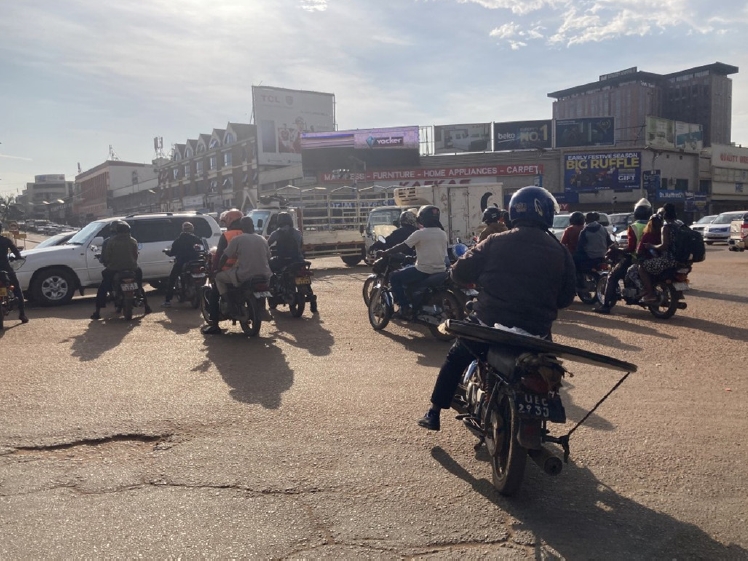
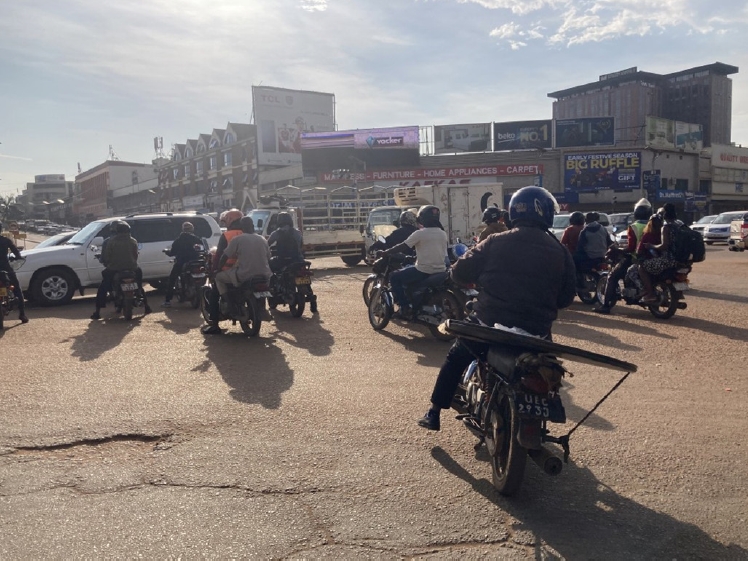
- At the same time, the rapid proliferation of boda bodas has generated severe environmental and public health externalities. In Kampala, poorly regulated and inadequately maintained ICE motorcycles are a primary contributor to PM2.5 con-centrations that routinely exceed WHO guidelines (MEIR Engineering & Research Ltd, 2021; Okello et al., 2024). Prolonged exposure to such pollution has been as-sociated with elevated premature mortality and a rising burden of non-communicable respiratory diseases, particularly among low-income populations (Okello & Tatah, 2025; Park et al., 2021). As shown in Figure 1, motorcycles also account for a sig-nificant share of road traffic fatalities, reflecting structural deficiencies in road safety governance (Uganda Police Force, 2023).
- In response to these challenges, electric motorcycles have emerged as a poten-tially high-impact intervention capable of abating tailpipe emissions, improving ur-ban air quality, and lowering public health costs (Okello & Tatah, 2025; Craig et al., 2021; Vanatta et al., 2022). Private sector actors, most notably Zembo and Spiro, have led early deployment of electric boda bodas in Kampala utilizing bat-tery-swapping models, and an official report documents growth from fewer than 20 electric motorcycles in 2019 to approximately 4,200 by 2024 (STI Secretariat, 2024). The Ugandan government has reinforced this trajectory through a National E-Mobility Strategy, tax exemptions on EV components and charging equipment, and early charging infrastructure investments (Parliament of Uganda, 2024a; 2024b; Mobility Bureau, 2024). Despite this enabling context, EV adoption remains limited relative to the over-one-million ICE fleet, and the question of what constrains tran-sition has not been systematically answered.
- Existing research on electric boda bodas in Uganda can be grouped into three strands: environmental and emissions modeling (Craig et al., 2021; Vanatta et al., 2022), health impact assessment (Okello & Tatah, 2025), and feasibility and scaling analysis (FTVG, 2025; GIZ, 2023; Okello & Reynolds, 2022). While this literature establishes the desirability of electrification and identifies broad infrastructure and financing frictions, it leaves two critical gaps unaddressed. First, the causal contri-bution of motorcycle traffic to ambient PM2.5 concentrations and the resulting mortality burden has not been empirically identified with a credible identification strategy. Most estimates rely on modeling assumptions rather than observed exog-enous variation. Second, while government initiative and policy approach to increase the deployment of EV motorcycles are actively ongoing, the behavioral mechanisms that shape individual riders' adoption hesitancy have received little attention. Most studies rely on policy analyses rather than systematic rider-level evidence (Bbaale et al., 2025; PREO, 2023). As a result, existing literature explains why EV transition is desirable in aggregate, but not why riders, who face daily income dependence, li-quidity constraints, and operational uncertainty, continue to hesitate.
- This study addresses both gaps through a mixed-methods design. The quanti-tative component employs a Difference-in-Differences (DiD) framework, exploiting the Ebola-induced two-month mobility lockdown in Mubende district in 2022 as an exogenous shock to transportation activity, to estimate the causal share of transport-attributable PM2.5 in Kampala and translate this into health impact pro-jections using the WHO AirQ+ model. The qualitative component draws on nine semi-structured in-depth interviews conducted with boda boda riders in Kampala in October-November 2025, analyzed through thematic analysis, to examine the structural and behavioral barriers that constrain EV adoption at the rider level.
- The two components are designed to be analytically complementary. The quantitative analysis establishes the public health stakes of the transition providing an empirically grounded estimate of the mortality burden attributable to motorcycle traffic and the potential gains from electrification. The qualitative analysis then sit-uates the adoption question within the everyday realities of boda boda work, iden-tifying the mechanisms that make EV transition precarious for riders even when its aggregate benefits are widely acknowledged. Together, this mixed-methods ap-proach responds to a recognized gap in the lower middle income countries e-mobility literature, where cross-country syntheses consistently emphasize that effective EV transition requires not only vehicle availability but ecosystem coordination including infrastructure, business models, finance, and institutional support to move in tandem (Agora Verkehrswende, 2025; Republic of Kenya, 2024).
- The remainder of this paper is organized as follows. Section 2 describes the data sources and methods employed in both the quantitative and qualitative components. Section 3 presents the results of the DiD analysis and the health impact assessment, followed by the thematic findings from the rider interviews. Section 4 discusses the implications and limitations of the research method and concludes with recom-mendations for rider-centered transition strategies.
1. Introduction
- Research Design
- This study employs a mixed-methods design combining quantitative causal inference with qualitative field research. The two components address distinct but complementary questions: the quantitative strand estimates the causal contribution of motorcycle traffic to ambient PM2.5 concentrations and translates this into health impact projections, while the qualitative strand investigates the structural and be-havioral mechanisms that constrain individual riders' adoption of electric motorcy-cles. This integration reflects the recognition that understanding EV transition in the boda boda sector requires both an empirical account of the public health stakes and a rider-level analysis of why adoption remains limited despite demonstrated aggregate benefits.
- Quantitative Component
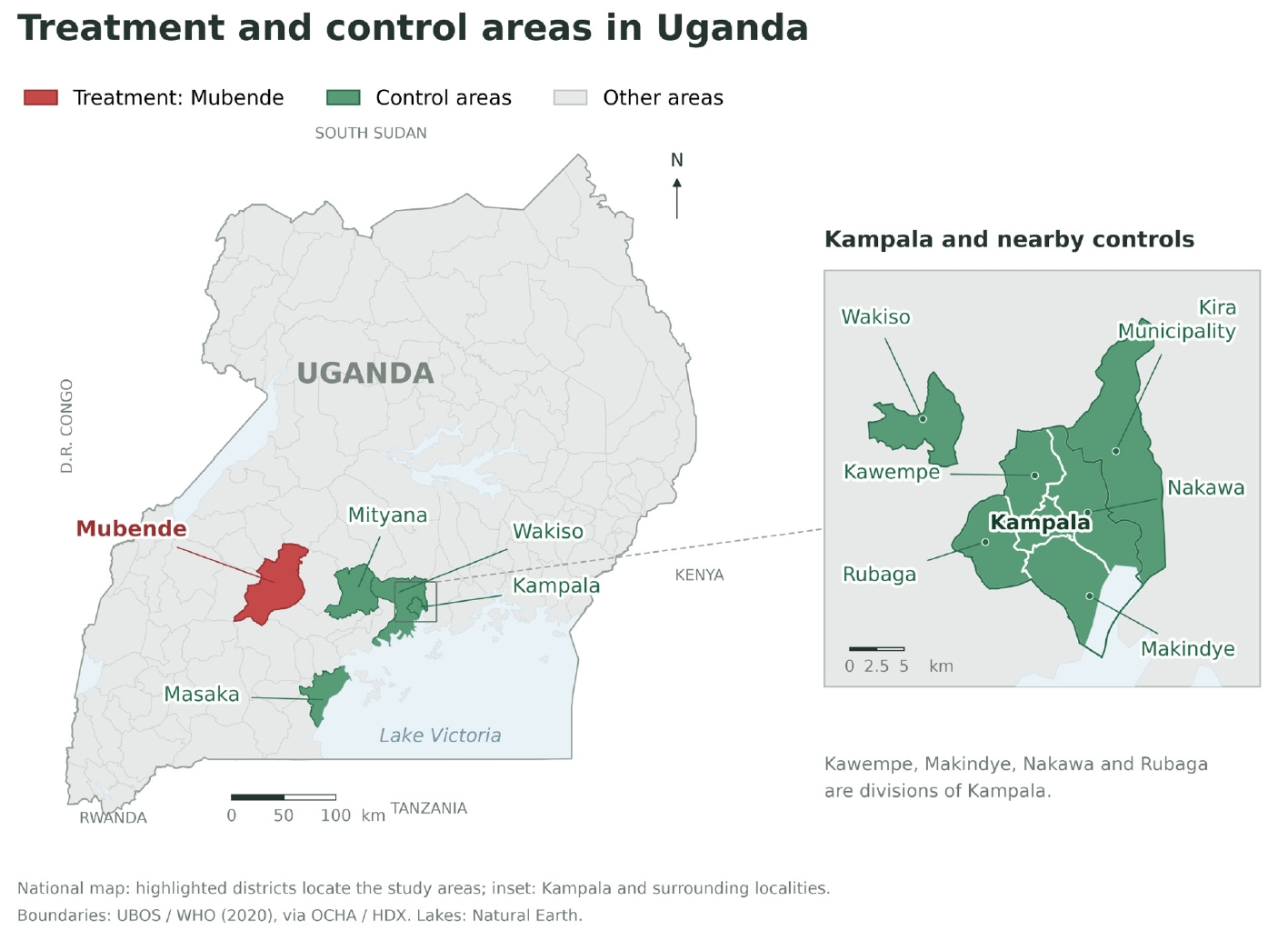
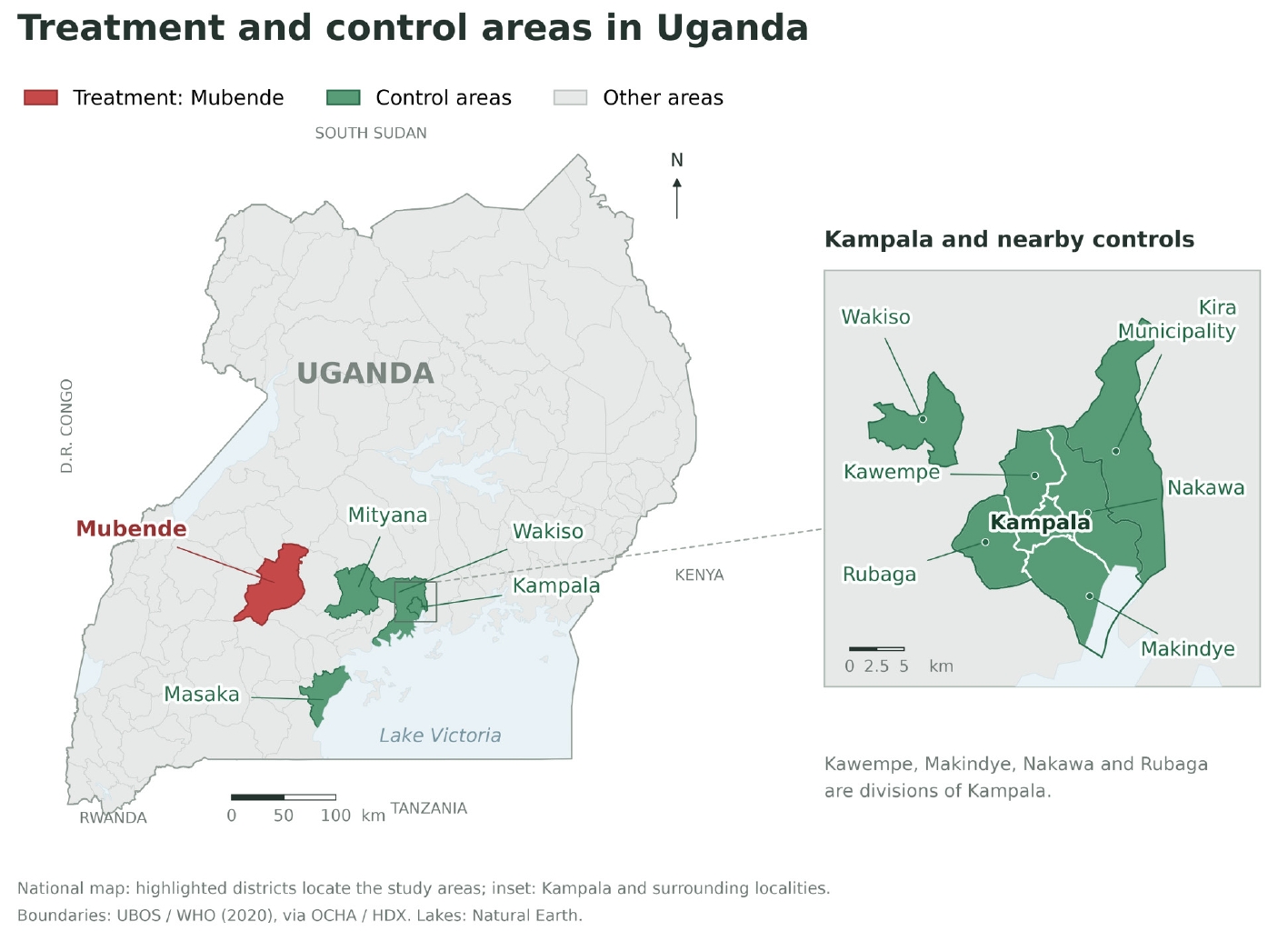
- This study uses hourly PM2.5 concentration data collected by ground-based air quality sensors operated by AirQo (https://airqo.net/home), aggregated to the daily level. PM2.5 was selected as the primary outcome variable because it is a well-established indicator of urban air pollution with direct implications for respira-tory and cardiovascular health, particularly in LMIC contexts. As shown in Figure 2, the treatment group is Mubende district, while the control group comprises Kampala, Kawempe, Kira Municipality, Makindye, Masaka, Mityana, Nakawa, Rubaga, and Wakiso, all located within Uganda's Central Region to ensure geographic and cli-matic comparability. Humidity and temperature are included as control variables, as both are known to influence particulate matter concentrations independently of human activity. The data spans from November 2021 to December 2023 among which the data from April 15, 2022 to September 13, 2022, was missing for all dis-tricts due to its unavailability in AirQo dataset. In empirical nature, the 6-month data gap is non-negligible in analyzing true effect of lockdown on air quality, and authors acknowledge this gap as the major limitation of this research. Nonetheless, in the following section, this research endeavors to mitigate this limitation and support the existing hypothesis by conducting robustness check with various data starting points and looking at the consistency of coefficients.
- For the health impact assessment, baseline mortality and population-at-risk data were drawn from the WHO Global Health Estimates (2019 reference year to avoid COVID-19 effect) and a previous Kampala-specific AirQ+ assessment (Atuyambe et al., 2025): a baseline natural-cause mortality rate of 1,095 per 100,000 among persons aged 30 years and older, and an estimated population at risk of 431,453 persons, representing approximately 24% of Kampala’s total population of 1.80 million. The share of transport-attributable PM2.5 contributed specifically by motorcycles was derived from the report of African Development Bank (AfDB, 2025), which estimates that motorcycles account for 36% of transport-related PM2.5 in Kampala.
- To isolate the causal contribution of transportation activity to ambient PM2.5, this study exploits the lockdown caused by Ebola outbreak in Mubende district that occurred in September 2022 as an exogenous shock to mobility. The outbreak triggered a government-imposed lockdown initially for three weeks from October 15, 2022, to November 5, 2022 (Daily Monitor, 2022). However, the government extended the initial 21-day lockdown to tighten the control on the disease and later lifted all movement restrictions on December 17, 2022 (Voice of America, 2022). The research exploits this two-month mobility lockdown as an exogenous shock for difference-in-differences to identify whether this natural experimental setting has contributed to the reduction in PM2.5 observed in Mubende.
- The identifying assumption is that, absent the Ebola-induced lockdown, PM2.5 trends in Mubende would have evolved in parallel to those in the control districts. The DID estimator is specified as follows. Let PMitdenote the PM2.5 concentration in district i at time t, Treatedi an indicator equal to one for Mubende, and Postt an indicator equal to one for the post-intervention period. The baseline specification is:
- where δt denotes and time (year) fixed effects, γi denotes city×month fixed effect, controlling for seasonality, Xit includes meteorological controls (humidity and temperature), and β is the average treatment effect on the treated (ATET), the estimated reduction in PM2.5 attributable to the mobility shock. A log-transformed specification is also estimated to allow for proportional interpretation of the effect. All regressions were estimated using Stata BE 19.5.
- The estimated transport-attributable PM2.5 reduction from the DiD analysis was translated into mortality impacts using the WHO AirQ+ model. AirQ+ applies concentration-response functions derived from epidemiological evidence to estimate the number of premature deaths attributable to changes in ambient PM2.5 exposure. The counterfactual scenario modeled in this study assumes full electrification of the boda boda fleet, constructed in two steps. First, the DiD estimate is used to identify the transport-attributable share of total ambient PM2.5. However, even in the perfect scenario of full electrification, ambient emission is still likely to occur as driving on the road still flies off dust in the air. Acknowledging this limitation, authors strictly assume that the PM2.5 level under perfect electrification scenario will be equivalent to the level of mobility lockdown. Second, this share is multiplied by the motorcycle-specific contribution derived from the African Development Bank (AfDB, 2025), which attributes 36% of transport-related PM2.5 to motorcycles, to obtain the implied PM2.5 reduction under full electrification. The resulting counterfactual PM2.5 concentration is then entered into AirQ+ using all-cause natural mortality for the population aged 30 and above as the health outcome.
- Qualitative Component
- The qualitative component was designed to examine how boda boda riders experience and evaluate the prospect of EV adoption in the context of their everyday work. A field-based approach grounded in semi-structured in-depth interviews was employed, as this method is well suited to capturing the experiential, relational, and institutional dimensions of adoption decisions that survey instruments cannot readily access. Kampala was selected as the primary field site given its status as the center of Uganda's boda boda sector and the primary geography of EV boda deployment to date.
- Fieldwork was conducted in Kampala over seven days from October 25 to October 31, 2025. Prior to departure, the research team reviewed existing literature on boda bodas, EV transition, and urban health in Uganda, and developed a semi-structured interview guide focused on riders' occupational experiences, perceptions of EV motorcycles, and perceived barriers to adoption. Through correspondence with relevant researchers, contact was established with a local collaborator fluent in Luganda, who facilitated communication with participants and assisted with translation during interviews.
- The fieldwork proceeded in two phases. In the initial phase, exploratory ob-servation was conducted to gain contextual understanding of the research environ-ment, and preliminary interviews were used to refine the interview guide in ac-cordance with the local context. In the main interview phase, participants were re-cruited through two channels. Four riders were approached directly after the research team had used their boda boda services for transportation. Following the trip, the researchers introduced the purpose of the study and asked whether the rider would be willing to participate in an interview. Those who consented were subsequently contacted to arrange a separate interview at a mutually convenient time and location, typically a café, as seen in Figure 3. The remaining five riders were recruited with the assistance of the Bodaboda Association and were interviewed at the Association’s office. One additional interview was conducted with a boda boda association leader, as shown in Figure 4, who provided institutional-level perspectives on EV transition dynamics. All interviews were conducted on a one-on-one basis with the assistance of the local collaborator.
- A total of nine boda boda riders and the president of Kampala Bodaboda As-sociation participated in the study, comprising six internal combustion engine mo-torcycle riders and three electric boda boda riders. The inclusion of both ICE and EV riders was deliberate to compare the perspectives of current EV users with those who have not yet adopted, allowing for a richer account of both the perceived advantages and the experienced barriers of the transition. Participant profiles varied in terms of years of experience, ownership arrangements (owner-operators versus renters), and stage affiliation. All participants provided verbal consent to participation and to audio recording of the interview.
- All interviews were audio-recorded and subsequently transcribed in full. Where interviews were conducted in Luganda, real-time translation was provided by the local collaborator and incorporated into the transcription. Thematic analysis was conducted following the approach described by Braun and Clarke (2006), pro-ceeding through phases of familiarization with the data, initial coding, theme de-velopment, review, and interpretation. Coding focused on recurrent patterns across rider narratives, including perceived advantages and challenges of boda boda work, barriers to EV adoption, and perceptions of electric motorcycles. Four primary thematic categories were identified: (1) perceived advantages of boda boda work, (2) perceived challenges of boda boda work, (3) barriers to EV transition, and (4) per-ceived advantages of EV motorcycles. These categories informed the analytical framework developed in the results and discussion sections.
2. Materials and Methods
1) Data
2) Identification Strategy: Difference-in-Differences
1) Study Design and Site Selection
2) Fieldwork and Participant Recruitment
3) Participants
4) Data Collection and Analysis
- Quantitative Results
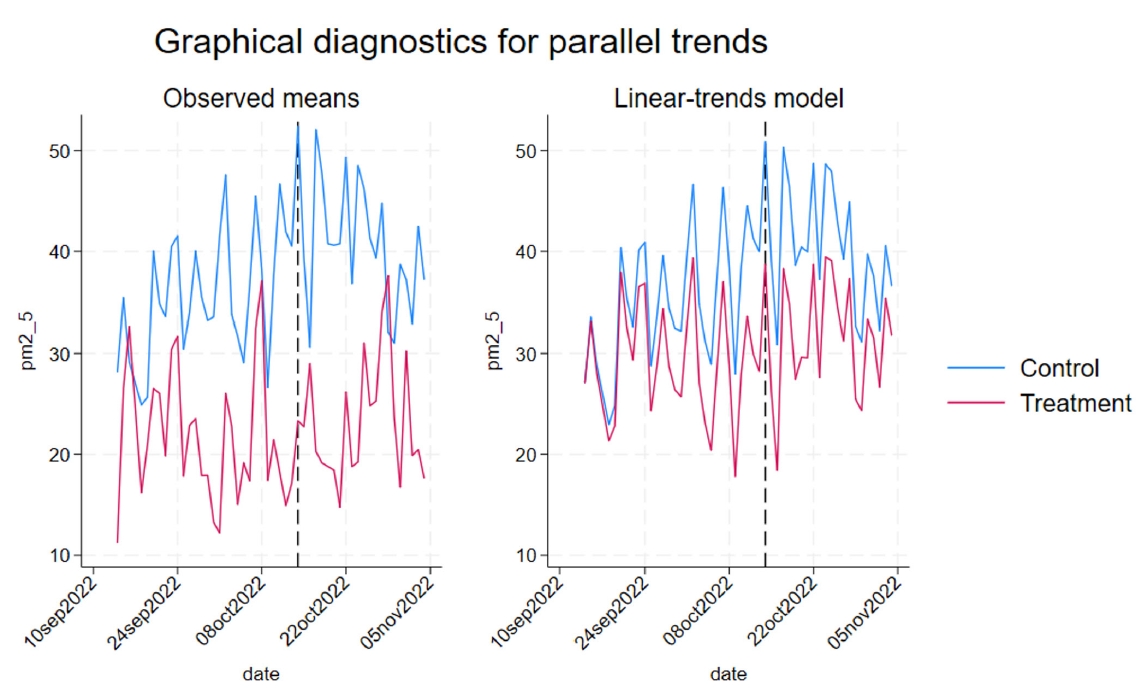
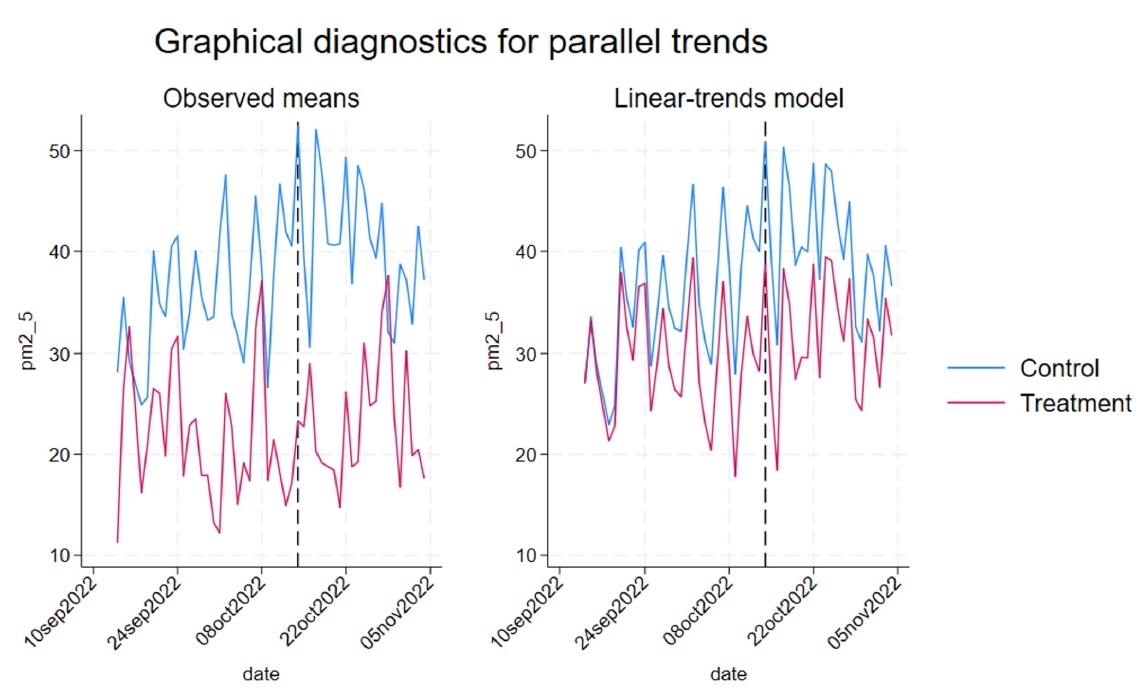
- Prior to presenting the DID estimates, the validity of the parallel trend assump-tion was assessed through visual inspection of PM2.5 trajectories in the treatment and control groups over the pre-intervention period, and the result is illustrated in Figure 5. This pre-intervention window is restricted to September 14 to October 14, 2022, the final continuous stretch of daily observations immediately preceding the lock-down; the preceding six-month data gap (April 15 - September 13, 2022) precludes a longer continuous pre-trend assessment extending further back. The pre-intervention trends for Mubende and the control districts move closely together, with little evi-dence of systematic divergence before the Ebola outbreak. Minor short-term fluctu-ations are observable but appear common across both groups, consistent with shared meteorological drivers rather than location-specific shocks. This pattern supports the plausibility of the parallel trends assumption and provides confidence that post-treatment differences can be attributed to the mobility shock rather than pre-existing heterogeneity.
- Table 1 presents the main result of DID estimates for the full sample period from November 13, 2021, to December 23, 2023 across entire cities in the sample dataset and the selected control group. Column (1) illustrates the DID estimate of the treatment city when compared with entire sample cities with temperature and humidity controlled. PM2.5 level decreased by 6.432µg/m3 and it is statistically significant. When compared with the control group selected under geographical proximity and climatic similarity, columns (2) and (3) exhibit the PM2.5 level decreased by 7 to 8µg/m3 when seasonality was not controlled and columns (4) and (5) report the estimates to be around -5 to -6µg/m3 when seasonality was controlled. The decrease in magnitude of coefficients when seasonality is captured reflects the fact that October and November being the Uganda’s wet season, during which rainfall washes out particulate matter, therefore seasonality absorbs a part of decline in PM2.5. One point worth noting is that, under the model where seasonality is controlled, standard error increases, or the estimate becomes less precise, from 0.976 to 1.301 as temperature and humidity are added as controls (column (4) to column (5)). This is because the city×month seasonality fixed effect already absorbs much of the systematic variation in temperature and humidity. Once this variation is netted out, the remaining variation in temperature and humidity overlaps with the remaining variation in the DID indicator, which is presumed to inflate the standard error of the DID coefficient. All the estimates were statistically significant (p-value less than 0.01) except for the humidity variable when seasonality was uncontrolled.
- Table 2 exploits the log scaled PM2.5 as a dependent variable while maintaining everything else constant with Table 1. Since the dependent variable is in log scale and the DID coefficients are not small in magnitude, we transform the estimated coefficients as 100×(eβ-1) rather than interpreting β directly as a percentage. In Column (1), the lockdown is associated with approximately 11.7% decrease in PM2.5 when comparing the treatment city to all cities in the sample, and a 22.4-22.9% decrease when compared to the control group (Columns (2)-(3)), with seasonality-controlled specifications in columns (4)-(5) showing a smaller but still substantial 13.9% decrease. Researchers use column (5) estimate (-13.9%) that fully controls seasonality and other variables as a representative estimate to be later used in measuring health impact from air quality improvement.
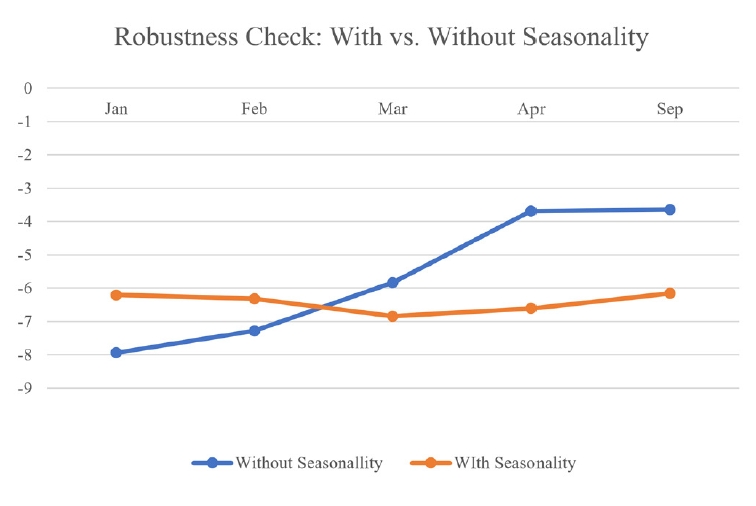
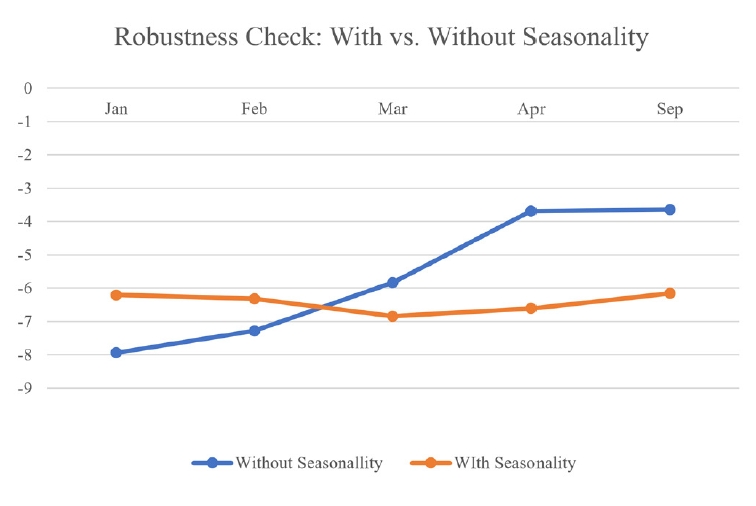
- Since this research possesses a limitation that lacks considerable amount of pre-treatment period observations during April 15 to September 13, 2022, authors conducted robustness checks throughout different data starting points to identify consistency of estimate, and the results are illustrated in Table 3 and 4. Table 3 shows the robustness check without seasonality starting from January to September, whichever month in 2022 where data was available. In January the DID coefficient estimate reaches -7.9µg/m3 but as time goes by, the absolute value gradually de-creases to -3.6µg/m3. However, when the seasonality was controlled (Table 4), the coefficient estimates are very much consistent across the whole period from January to September, ranging approximately between -6 ~ -7µg/m3. Figure 6 illustrates that coefficients without seasonality have higher variance while the values of coefficients with seasonality are stable throughout the whole period.
- The DiD results are used to construct a counterfactual health impact scenario for full boda boda electrification in Kampala. The log-specification estimate implies that transportation activity accounts for approximately 13.9% of total ambient PM2.5 during the lockdown period, interpreted here as a proxy for the transport-attributable share of PM2.5 under normal mobility conditions. Combining this with the AfDB estimate that motorcycles contribute 36% of transport-related PM2.5 yields an im-plied reduction of approximately 5% (13.9% × 36% ≈ 5.0%) of total ambient PM2.5 under a scenario of complete boda boda electrification with a strong assumption that a complete electrification results in the same decline in PM2.5 level equivalent to mobility lockdown.
- Applying this 5% reduction to Kampala’s observed mean PM2.5 concentration of 41.72 µg/m3 during 2022–2023 yields a counterfactual mean concentration of 39.63 µg/m3. The associated mortality impacts were estimated using the World Health Organization’s AirQ+ model. The health endpoint was defined as all natural-cause mortality among adults aged 30 years and older, and a log-linear concentration–response function was applied. A common reference concentration of 5 µg/m3 was used for both the observed and counterfactual scenarios. This value corresponds to the WHO 2021 annual air-quality guideline for PM2.5 (WHO, 2021). The WHO guideline recommends an annual mean PM2.5 concentration of 5 µg/m3, reflecting evidence of adverse health effects even at relatively low exposure levels.
- The concentration–response function was parameterized using a relative risk of 1.08 per 10 µg/m3 increase in long-term PM2.5 exposure, with a 95% confidence interval of 1.06–1.09. These estimates were taken from the systematic review and meta-analysis by Chen and Hoek (2020), which reported a pooled relative risk of 1.08 (95% CI: 1.06–1.09) for natural-cause mortality per 10 µg/m3 increase in PM2.5.
- The baseline natural-cause mortality incidence was set at 1,095 deaths per 100,000 persons aged 30 years and older per year. This rate was derived from the WHO Global Health Estimates for Uganda using 2019 as the reference year. All-cause deaths were summed across the 30–49, 50–59, 60–69, and ≥70 age groups, and deaths classified under the broad category “III. Injuries” were excluded to ap-proximate natural-cause mortality. This yielded approximately 113,999 natu-ral-cause deaths among approximately 10.415 million persons aged 30 years and older, corresponding to an annual incidence of approximately 1,095 deaths per 100,000 population at risk (WHO, 2024). The use of 2019 provides a pre-pandemic mortality baseline and avoids potential distortions associated with COVID-19 mor-tality and related disruptions to health services.
- The population at risk was restricted to persons aged 30 years and older, con-sistent with the selected AirQ+ endpoint. Approximately 24% of Kampala’s popula-tion was assumed to fall within this age group, following the age structure used in the previous Kampala AirQ+ assessment by Atuyambe et al. (2025). This resulted in an estimated population at risk of 431,453 persons.
- The result of health impact is shown in Table 5. Under the observed PM2.5 concentration of 41.72 µg/m3, AirQ+ estimated that 24.62% of natural-cause mor-tality among adults aged 30 years and older was attributable to PM2.5 exposure above the 5 µg/m3 reference concentration. This corresponds to approximately 1,163 attributable deaths annually, with a 95% confidence interval of 910–1,282. Under the counterfactual scenario, in which mean PM2.5 declines by 5% to 39.63 µg/m3, the attributable proportion falls to 23.40%, corresponding to approximately 1,105 at-tributable deaths annually (95% CI: 863–1,219). The difference between the two scenarios implies approximately 58 premature deaths avoided annually (95% CI: 47–63), equivalent to 13.36 avoided deaths per 100,000 persons aged 30 years and older. The attributable proportion declines by approximately 1.22 percentage points.
- Qualitative Results
- Thematic analysis of the nine rider interviews yielded four primary thematic categories: 1) perceived advantages of boda boda work, 2) perceived challenges of boda boda work, 3) barriers to EV transition, and 4) perceived advantages of EV motorcycles. This section presents each category in turn, with representative raw codes, sub-themes, and themes summarized in Tables 6–9, followed by narrative interpretation grounded in interview evidence.
- Riders identified a consistent set of advantages associated with their occupation, organized under three overarching themes: economic incentives, affective and emotional rewards, and operational advantages (Table 6).
- The most consistently cited advantage was the availability of daily income, which riders contrasted favorably with formal employment characterized by monthly salary schedules. Several interviewees also noted that boda boda work provides income levels higher than previous occupations and that access to Savings and Credit Cooperative Organizations (SACCOs) offers a degree of financial security during emergencies. This finding goes well along with the previous literature that revealed the associations function as mutual social networks, offering members economic security and social support (Mukwaya et al., 2022). Beyond economic considerations, riders emphasized the affective dimensions of the work, including enjoyment, self-fulfillment, and the social interactions facilitated by daily encounters with pas-sengers.
- Alongside these advantages, riders identified substantial challenges organized under three themes: safety and health risks, negative social perception, and economic constraints (Table 7).
- Safety and health risks were among the most salient concerns, with riders citing frequent exposure to traffic accidents, hazardous road conditions, and respiratory illness attributed to wind exposure and exhaust fumes. Negative social perception constituted a second major challenge: in a context where boda bodas are publicly associated with criminal activity, and where the sector's low entry barriers contribute to a stigma of occupational failure, riders reported experiencing persistent social disrespect. Economic constraints were also prominent. Despite the value of daily income, riders widely regarded earnings as insufficient for capital accumulation, and many described being locked into exploitative debt arrangements: as one rider ex-plained through a translator, those without initial capital often end up repaying nearly double the market price of a motorcycle, spending years "working for someone else instead of yourself."
- Riders identified barriers to EV adoption organized under two themes: infra-structural barriers and technological barriers (Table 8).
- Infrastructural constraints emerged as the most immediate and tangible barriers. Riders repeatedly emphasized the scarcity and uneven geographic distribution of battery swap stations, which constrains feasible trip routes and creates the risk of being stranded with a depleted battery: "You find you have got a bike and now you are in a place where there is no swap station. That means you are going to push it" (Interviewee 1). Even where stations exist, insufficient charging machines relative to demand generate long queuing delays that directly translate into lost fares. Riders noted that time spent waiting "could have been used to carry passengers and make more money" (Interviewee 2), and that batteries provided at swap stations are not always fully charged: "You pay for the full battery but they don't give you a full one" (Interviewee 3). Load shedding further undermines charging reliability in the absence of backup power at swap stations.
- Technological barriers centered on battery performance. Riders reported usable riding times of only two to three hours per charge, necessitating multiple daily swaps and amplifying dependency on already constrained infrastructure. Concerns about battery degradation over time and the unavailability of spare parts raised additional doubts about the long-term operational reliability of EV systems under the intensity of daily boda boda work.
- Despite the barriers identified above, riders across both ICE and EV groups acknowledged a substantial set of advantages associated with electric motorcycles, organized under four themes: financial benefits, individual fulfillment, safety benefits, and environmental and social benefits (Table 9).
- Financial advantages were widely recognized: lower energy costs relative to fuel, with some riders citing an all-day battery charge at 8,000 UGX, and reduced maintenance expenditures from free remote servicing offered by EV operators. Riders also emphasized the operational ease of electric motorcycles, for example, automatic starting, smoother handling, and reduced mechanical complexity, as well as greater personal comfort during long working hours. A notable finding was the perception of enhanced asset security: riders noted that EV batteries are linked to registered user identities within the swap-station system, deterring theft and reducing exposure to the catastrophic income shock of losing one's primary livelihood asset. Environmental benefits, including the absence of exhaust fumes and noise, were also recognized, with several riders contrasting EV operation favorably against the health consequences of ICE motorcycles they had described earlier. Taken together, these perceived advantages suggest that resistance to EV adoption is not rooted in attitudinal rejection of the technology, but in the structural and operational barriers documented in Section 3) Barriers to EV Transition.
3. Results
1) Difference-in-Differences Estimates
2) Robustness Check
3) Health Impact Assessment
1) Perceived Advantages of Boda Boda Work
2) Perceived Challenges of Boda Boda Work
3) Barriers to EV Transition
4) Perceived Advantages of EV Motorcycles
- Discussion
- The DiD estimates provide quasi-experimental evidence that reductions in transportation activity led to substantial declines in ambient PM2.5 in Uganda’s Central Region. This contributes to a growing literature on transport-related air pollution in Kampala and surrounding areas. Earlier studies documented sizeable reductions in PM2.5 during the COVID-19 mobility restrictions (Green et al., 2022). Galiwango’s research on the effect of COVID-19 on air quality shows lockdown had resulted in PM2.5 decrease from 56.6 µg/m3 to 27.6 µg/m3, or by 51%, in Kampala, and 41µg/m3 to 25.7µg/m3 (37% decrease) in Wakiso following the implementation (Galiwango et al., 2022). This effect of lockdown is higher than the estimates obtained from our research presumably because Kampala and Wakiso are significantly bigger cities with more economic activities than Mubende.
- More recent studies have approached the same question through atmospheric source-apportionment models (Okure et al., 2025) and policy simulations of motorcycle electrification and associated health impacts (Okello & Tatah, 2025). Okello’s research method hypothesized perfect conversion of petrol-powered motorcycle into electric ones in Kampala and estimated the transport share of PM2.5 to be 22.8%, with motorcycle share of transport emissions to be 66%. Therefore, he assumed 15% (0.228×0.66=0.15) decrease of PM2.5 from electrification and connected the estimate with health impacts with results showing that all-cause mortality aged over 30 years will drop from 2,624 to 2,149, and mortality from circulatory diseases aged over 30 years drop from 500 to 413. Considering Mubende’s smaller economy and a smaller number of motorcycle compared to Kampala, the estimate from our research (13.9%) combined with the estimated motorcycle’s transport share of PM2.5 emissions (5%) is significantly in parallel with the previous research.
- Moreover, our analysis advances beyond prior modeling-based estimates by grounding the transport-attributable PM2.5 share in an exogenous natural experiment. By incorporating meteorological controls and a DiD counterfactual, the analysis also addresses an important limitation of simple pre–post comparisons of pollution concentrations. In this sense, the study connects the source-attribution question examined by Okure et al. (2025) with the health-burden question considered by Okello and Tatah (2025), while grounding the change in ambient PM2.5 in an empirically estimated transport shock.
- Although the degree to which air quality improvement is specifically attributable to motorcycle during the lockdown cannot be systematically measured in this research, the fact that Mubende is a predominantly agricultural district with limited industrial manufacturing activity, and that crop-residue burning in the region is typically concentrated in the dry season (June-October) rather than during the October-December lockdown period, lends some plausibility to the author’s assumption there would have been nothing other than transport restrictions that could possibly explain the decrease in PM2.5. It should be noted, however, that the Ebola-induced lockdown encompassed restrictions beyond motorcycle movement, including the temporary closure of markets, schools, and non-essential businesses. The estimated decline in PM2.5 therefore reflects the combined effect of reduced mobility and broader economic activity during the lockdown, rather than motorcycle traffic in isolation.
- Therefore, combining the 13.9% PM2.5 decrease with the AfDB estimate attributing 36% of transport-related PM2.5 to motorcycles, the implied health dividend of full boda boda electrification, approximately 58 premature deaths averted annually in Kampala, is large by any public health standard. The health impact estimate should nonetheless be interpreted as an upper bound, as partial electrification and heterogeneous adoption patterns as well as a realistic mitigation of author’s strong assumption would attenuate realized gains. Even under conservative assumptions, however, the magnitude of the effect supports treating boda boda electrification as one of the highest-impact environmental health interventions available to Ugandan policymakers.
- These quantitative findings substantially raise the stakes of the qualitative barriers documented below. The 58 annual deaths attributable to motorcycle traffic are not merely a modeling artifact. They represent the public health cost of a transition that riders themselves want but cannot execute under current structural conditions. In this sense, the two components of this study are mutually reinforcing. The quantitative analysis establishes why electrification matters urgently, while the qualitative analysis explains why it is not happening.
- Riders across both ICE and EV groups demonstrated clear awareness of EV advantages and several expressed explicit willingness to transition, ruling out attitudinal resistance as a primary explanation for limited adoption. Three interconnected structural mechanisms emerge from the thematic analysis as central barriers.
- First, spatial and income uncertainty generated by insufficient battery-swap infrastructure frames EV adoption as an operational risk. When swap stations are scarce and unevenly distributed, riders must restrict feasible routes and absorb queuing delays that translate directly into lost daily earnings. In boda boda work, where immediate cash needs must be met within a single working day, these reliability shocks function as binding constraints on livelihood feasibility. This is a dynamic consistent with evidence on daily income targeting among transport workers in comparable LMIC contexts (Dupas & Robinson, 2013).
- Second, a scale-and-purpose misalignment exists between government EV policy and rider-level realities. Uganda's national EV strategy concentrates on supply-side objectives, such as domestic manufacturing, ecosystem coordination, and fuel import reduction (Mobility Bureau, 2024; STI Secretariat, 2024) while underweighting the operational constraints that determine demand-side uptake. Without policy mechanisms that address the micro-level risk environment riders face daily, demand-side adoption will remain limited regardless of supply-side expansion, echoing regional evidence from Tanzania where electrification benefits depended critically on whether existing financial structures allowed riders to capture them (A2EI & Greenfoot, 2021; Simwaba & Qutieshat, 2026).
- Third, extractive financial structures amplify income uncertainty and deepen resistance to EV adoption. High-cost debt arrangements inflate effective acquisition costs and leave minimal margin for savings, making riders especially sensitive to short-term income disruptions caused by charging delays or battery unreliability. Current EV transition models, which largely replicate the purchase-or-lease logic of ICE acquisition, do little to address this underlying financial vulnerability.
- Limitations
- Due to data availability, the research conducted DID with an incomplete dataset, missing observations from April 15, 2022 to September 13, 2022. To complement the missing observations, authors expanded sample period to 2021 and 2023 to secure sufficient amount of data for controlling seasonality. Moreover, when calculating the health impact of electrification, the research puts strong assumption that mobility lockdown induces the same effect as complete electrification bodaboda, while in reality, the electrified motorcycles can still cause air pollution by flying away dust on the road. These two limitations shall be dealt systematically with better identification strategy in future research.
- Furthermore, the Ebola-induced lockdown entailed restrictions beyond motorcycle transport, including school and market closures and reduced general economic activity. Consequently, the DiD estimate captures the air-quality impact of the broader lockdown-induced reduction in urban activity, of which motorcycle transport is assumed to be the dominant but not exclusive component. To the extent that non-transport channels also contributed to the observed decline, our transport-attributable share and the resulting health-impact projections should be interpreted as an upper bound.
- In addition, Mubende and Kampala differ in urbanization level, traffic density, and industrial composition, which may affect the comparability of transport-pollution relationships. However, both districts share the same ICE-dominated motorcycle fleet structure and rely on similar fuel supply chains, providing a reasonable basis for the extrapolation. Future work with Kampala-specific exogenous variation would further strengthen this estimate. The health impact estimate further depends on a single AfDB source for the motorcycle contribution figure. On the qualitative side, the sample of nine riders is appropriate for thematic analysis but is not statistically representative; findings are best understood as an analytical account of mechanisms rather than a survey of prevalence.
- Conclusions and Policy Implications
- This study provides converging evidence that boda boda electrification would yield substantial public health benefits, but that realizing these gains requires addressing structural barriers that current policy inadequately targets. EV adoption hesitancy reflects rational responses to uncertainty under conditions of daily income dependence, liquidity constraint, and infrastructural unreliability rather than attitudinal resistance.
- Two policy priorities follow from these findings. First, infrastructure investment should prioritize reliability over quantity. Expanding swap station numbers is insufficient if output capacity and service uptime do not keep pace with fleet growth; each additional adopter under constrained infrastructure increases queuing pressure for all users, generating a negative network externality that stalls diffusion. Backup power systems, battery interoperability standards, and guaranteed service quality should accompany quantitative expansion. Second, financing instruments must be redesigned around the daily-income logic of boda boda work. Flexible repayment schedules tied to realized earnings, income-smoothing mechanisms during transition, and affordable credit would lower adoption barriers and address the broader financial precarity that the qualitative findings identify as a structural feature of the sector.
- More broadly, EV transition policy will be most effective when designed from the rider's perspective outward rather than from the technology inward. The boda boda sector is a livelihood system operating under specific constraints of daily income, physical risk, and debt obligation. Policies that engage with this experiential reality rather than treating electrification as a hardware substitution problem stand a substantially greater chance of realizing the public health gains that the quantitative evidence shows are within reach.
4. Discussion and Conclusions
-
Data Availability Statement
The PM2.5 and meteorological data used in this study are publicly accessible through the AirQo platform (https://airqo.net/home)
NOTES


Standard errors in parentheses. *p < 0.10, **p < 0.05, ***p < 0.01. Note: Column (1) compares treatment group (Mubende) with entire cities in the sample dataset. Column (2)-(5) compares the treatment city with arbitrarily selected nine cities based on geographical proximity and climatic similarities. Column (2) and (3) do not control seasonality and (4) and (5) control seasonality by the term (city × month) in regression formula.
Standard errors in parentheses. *p < 0.10, **p < 0.05, ***p < 0.01. Note: Dependent variable is the level of PM2.5 in log scale. (1) compares treatment group (Mubende) with entire cities in the sample dataset. Column (2)-(5) compares the treatment city with arbitrarily selected nine cities based on geographical proximity and climatic similarities. Column (2) and (3) do not control seasonality and (4) and (5) control seasonality by the term (city × month) in regression formula.
| Baseline | Counterfactual Scenario | |
|---|---|---|
| PM2.5 Mean (µg/m³) | 41.72 | 39.63 |
| Attributable proportion | 24.62% | 23.40% |
| Attributable Deaths | 1,163 | 1,105 |
| Attributable deaths per 100,000 population at risk | 269.6 | 256.2 |
- A2EI & Greenfoot. (2021). E-mobility in Tanzania. https://a2ei.org/wp-content/uploads/2021/06/E-Mobility-in-Tanzania.pdf
- African Development Bank. (2025). Socio-economic impact assessment of the electrification of Uganda's transport sector: Final technical report. African Development Bank Group.
- Agora Verkehrswende. (2025). Towards electric mobility in East Africa. https://www.agora-verkehrswende.de/en/publications/towards-electric-mobility-in-east-africa/
- Amone, C. (2021). Boda-boda, youth employment and globalisation in Uganda.
- Atuyambe, L. M., et al. (2025). Air quality and attributable mortality among city dwellers in Kampala, Uganda: Results from 4 years of continuous PM2.5 concentration monitoring using BAM 1022 reference instrument. Journal of Exposure Science & Environmental Epidemiology, 35, 288-293.ArticlePubMedPMCPDF
- Bbaale, E., Babyenda, P., Sseruyange, J., Kilimani, N., Esther, A., Ankunda, D., Charlse, O., Nabwire, L., & Operimo, V. (2025). Promoting e-mobility in Uganda (Policy brief). EfD Initiative / EfD-Mak Centre.
- Braun, V., & Clarke, V. (2006). Using thematic analysis in psychology. Qualitative Research in Psychology, 3(2), 77-101. https://doi.org/10.1191/1478088706qp063oaArticlePMC
- Chen, J., & Hoek, G. (2020). Long-term exposure to PM and all-cause and cause-specific mortality: A systematic review and meta-analysis. Environment International, 143, 105974.ArticlePubMedPMC
- Craig, M., Tumushime, E., Mwesigwa, D., Levin, T., & Kammen, D. M. (2021). Modeling current and future emission impacts of electrifying motorcycle taxis (boda bodas) in Kampala, Uganda. University of Michigan Graham Sustainability Institute. https://graham.umich.edu/media/files/EmOpps-CW-20-Craig-Report-Web.pdf
- Daily Monitor. (2022, October 15). Ebola: Museveni puts Mubende, Kassanda under 21-day lockdown. https://www.monitor.co.ug/uganda/news/national/ebola-museveni-puts-mubende-kassanda-under-21-day-lockdown-3986934
- Daily Monitor. (2024, February 13). Boda boda registration more than triples motor vehicle licensing. https://www.monitor.co.ug/uganda/business/finance/boda-boda-registration-more-than-triples-motor-vehicle-licensing--4555918
- Dandapat, S., Chattopadhyay, G., & Gangopadhyay, S. (2020). A relook at the pollution certification of in-use vehicles in India and a way forward. Asian Transport Studies, 6(2), 100020. https://doi.org/10.1016/j.eastsj.2020.100020Article
- Dupas, P., & Robinson, J. (2013). Daily needs, income targets, and labor supply: Evidence from Kenyan bicycle taxi drivers (NBER Working Paper No. 19264). National Bureau of Economic Research. https://doi.org/10.3386/w19264Article
- East Africa Venture Capital Association. (2022). East Africa venture capital report 2022.
- FTVG. (2025). Feasibility report for a universal battery charging and swapping infrastructure hub. https://www.ftvg.co.uk/wp-content/uploads/2025/03/Feasibility-Report-for-a-Universal-Battery-Charging-and-Swapping-Infrastructure-Hub-1.pdf
- Galiwango, R., Bainomugisha, E., Kivunike, F., Kattete, D. P., Jjingo, D. (2022). Air pollution and mobility patterns in two Ugandan cities during COVID 19 mobility restrictions suggest the validity of air quality data as a measure for human mobility. Environmental Science and Pollution Research, 30(12), 34856-34871. https://doi.org/10.1007/s11356-022-24605-1Article
- GIZ. (2023). Piloting the business case for solar powered electric motorcycle taxis along the Kampala–Masaka corridor. https://energypedia.info/images/7/77/Piloting_the_Business_Case_for_Boda-Bodas_GBE_Case_Study_GIZ_2023.pdf
- Green, P., Okure, D., Adong, P., Sserunjogi, R., & Bainomugisha, E. (2022). Exploring PM2.5 variations from calibrated low-cost sensor network in Greater Kampala, during COVID-19 imposed lockdown restrictions: Lessons for policy. Clean Air Journal, 32(1), 1–14. https://doi.org/10.17159/caj/2022/32/1.10906Article
- Leong, S. T., Muttamara, S., & Laortanakul, P. (2001). Evaluation of air pollution burden from contribution of motorcycle emission in Bangkok. Water, Air, and Soil Pollution, 131(1–4), 155–174. https://doi.org/10.1023/A:1011905402024Article
- MEIR Engineering & Research Ltd. (2021). Final data compilation report: Data collection for climate change mitigation potential analysis and scenario development in Uganda's transport sector.
- Mobility Bureau, Science, Technology and Innovation Secretariat, Office of the President. (2024). Uganda e-mobility outlook report 2024: Uganda as a net source of e-mobility tools and solutions in the region.
- Mukwaya, P. I., Goodfellow, T., & Titeca, K. (2022). Between regulation and informality: The inner workings of boda boda associations in Greater Kampala. Friedrich-Ebert-Stiftung. https://uganda.fes.de/topical/default-4a1d408f85
- Okello, G., Kisuule, F., Tatah, L., Hlongwane, G., & Tumushime, E. (2024). Association between ambient air pollution and respiratory health in Kampala, Uganda. Urban Climate, 58, 102128. https://doi.org/10.1016/j.uclim.2024.102128Article
- Okello, G., & Reynolds, J. (2022). Pathways to e-mobility transitions in Uganda: Policy brief on transition to electric mobility. Cambridge Institute for Sustainability Leadership.
- Okello, G., & Tatah, L. (2025). Exploring the potential health impacts of electrifying two-wheelers in Kampala, Uganda. Cambridge Institute for Sustainability Leadership.
- Okure, D., Guttikunda, S. K., Sserunjogi, R., Adong, P., Dammalapati, S. K., Lsoto, D., Green, P., Bainomugisha, E., & Xie, J. (2025). Integrated air quality information for Kampala: Analysis of PM2.5, emission sources, modelled contributions, and institutional framework. Environmental Science: Atmospheres, 5, 471-484.Article
- Park, J., Calzavara, J., & Courtright, T. (2021). Environmental and social impact assessment of electric motorcycle taxis in Kampala, Uganda (Final report). University of Michigan Master's Project Team.
- Parliament of Uganda. (2024a). The Income Tax (Amendment) Act, 2024.
- Parliament of Uganda. (2024b). The Value Added Tax (Amendment) Act, 2024.
- PREO. (2023). Charging ahead: Accelerating e-mobility in Africa. https://www.preo.org/wp-content/uploads/2023/03/PRE_E-mobility-report.pdf
- Republic of Kenya. (2024). Draft national e-mobility policy. https://transport.go.ke/publications/draft-national-e-mobility-policy
- Simwaba, D., & Qutieshat, A. (2026). EV battery swapping for developing countries: Benefits, challenges, and perspectives from a local key stakeholders study in Zambia. Energy Reports, 15, 108909.Article
- STI Secretariat. (2024). Uganda e-mobility outlook report 2024. https://sti.go.ug/wp-content/uploads/2025/06/E-Mobility-Outlook-Report-2024.pdf
- Tran, D.-S., Le, H., & Yang, Z. (2022). Two-wheelers in Vietnam: A baseline analysis of fleet characteristics and fuel consumption in 2019 and 2020 (ICCT Working Paper No. 2022-08). International Council on Clean Transportation. https://theicct.org/publication/two-wheelers-in-vietnam-aug22/
- Uganda Police Force. (2023). Official annual crime report 2023.
- Vanatta, M., Tumushime, E., Mwesigwa, D., Levin, T., & Kammen, D. M. (2022). Emissions impacts of electrifying motorcycle taxis in Kampala, Uganda. Transportation Research Part D: Transport and Environment, 104, 103193. https://doi.org/10.1016/j.trd.2022.103193Article
- Voice of America. (2022, December 17). https://www.voanews.com/a/uganda-lifts-lockdown-in-ebola-epicenter-/6881234.html
- World Health Organization. (2021). WHO global air quality guidelines: Particulate matter (PM2.5 and PM₁₀), ozone, nitrogen dioxide, sulfur dioxide and carbon monoxide. Geneva: World Health Organization.
- World Health Organization. (2024). Global Health Estimates 2021: Estimated deaths by cause, sex, age and country or area, 2019. Geneva: World Health Organization.
- Yi, C. S. (2016). Rethinking sustainable mobility: Understanding the use of boda-boda motorcycle taxis in Kampala, Uganda (IIIEE Theses 2016:16). Lund University.
References
Figure & Data
References
Citations

 PubReader
 ePub Link
 Cite
 XML Download