 This theme, time for action, emerging technology, and global solidarity, reminds me of my own time for action twenty years ago, when I was working in humanitarian crises with Médecins Sans Frontières (MSF) and other humanitarian organizations. I tried to contribute something to the most marginalized communities around the world. But after ten years of humanitarian work and research, I found that the structural problems underlying this situation, including violence, poverty, and lack of healthcare access, were extremely difficult to improve, even where we had the resources and the financial and human commitment to contribute.
At the time, as both a researcher and a practitioner, I tried, as a physician, to make my own diagnosis of the fundamental problem. My conclusion was that the key barrier was the lack of a human intelligence system, or more precisely, extreme inequality in the human intelligence system. This was before artificial intelligence; at that time it was a human-only intelligence system. Developing a human intelligence system in healthcare, for doctors, or in other social sectors, requires a very sustainable education system. But the world's circumstances are not like that. Many countries in the Global South, and fragile states in particular, keep encountering conflict, social instability, and political difficulty, which makes it extremely difficult to build the education and training systems needed to strengthen the human intelligence system around the world. Even with significant energy and financial resources moving from the Global North to the Global South, our current world still suffers from extreme inequality. As a young physician, I could not understand why children were dying, and why so many patients could not be diagnosed, despite modern technology and available resources.
In that difficulty, I initially identified the problem as one of political structure, and as a professor and practitioner I focused my research on the political determinants of health crises. But I later realized that even if we could change the political system, that alone had already been attempted, and largely resolved, in the last century. At that point I encountered another transformation. About ten years ago, I encountered AlphaGo. For many of us, it was a shocking experience, and at that moment I recognized it clearly as a new kind of intelligence, a game changer with the potential to rebalance our human intelligence system and address the inequality inherited in its current, unequal distribution. I expanded my research entirely into artificial intelligence, held a series of meetings with MSF and other organizations, and came to see this as an area of huge potential for our future. Over the past ten years, I have devoted my effort to this area. I even changed universities, from the University of Manchester in the UK, which focuses on the humanities, to KAIST, and I have since moved into politics to help prepare for this transformation. But this is no longer only my own understanding; everyone in this room clearly understands the potential of artificial intelligence, and I have seen a strong commitment to translating these emerging technologies into globally marginalized countries on the basis of global solidarity.
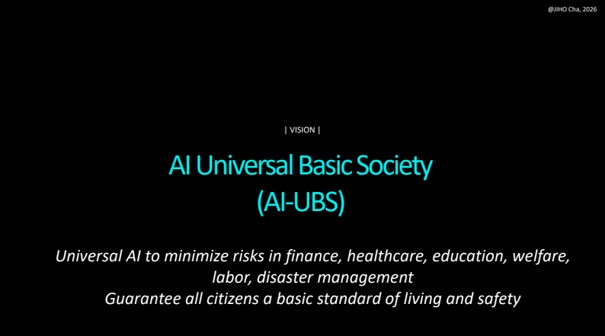
The task now is to design what kind of global AI governance framework, and what type of official development assistance (ODA), needs to emerge in this context. In our government, and particularly during preparations for last year's presidential election, we developed the concept of an AI Universal Basic Society. It began as a concept for domestic AI transformation, but we came to see it as a strategy that could also contribute globally. The concept is simple: using artificial intelligence as a new intelligence model, and conceptualizing it specifically as a form of public intelligence. Treating artificial intelligence as public infrastructure allows us to scale up existing essential social services, healthcare, finance, education, and social care, and to mitigate environmental risk (Figure 1). There are many ways to apply these technologies to our current disparities in access to healthcare and other services.
In South Korea, for example, and in many other countries, even where the healthcare system is quite mature, there remains significant regional disparity in access to specialty care. If we conceptualize an AI-based universal basic healthcare model, not simply primary care but what might be called a "1.5-tier" healthcare system, integrating primary healthcare physicians and other providers with AI, we believe we can scale this idea into something between primary and secondary healthcare. This concept could also apply in other global crisis contexts or resource-constrained settings, because an AI and digital healthcare platform built around primary healthcare can be readily linked to other contexts.
A similar approach applies to social care. If we integrate multidimensional data related to social welfare, economic conditions, and livelihoods, we can predict which households may be at risk of crisis weeks or even months in advance. This allows us to combine different social care models proactively, before a household reaches crisis, and prevent that kind of suffering. The same logic extends to education, where we can build much better accessibility, and to finance. Currently, financial intelligence is distributed unequally; loan terms and interest rates differ based on market logic and each individual's financial knowledge. But if we combine artificial financial intelligence with each citizen's circumstances, we can close the gap between those with greater financial knowledge and those with less, building better access to loans and other financial resources.
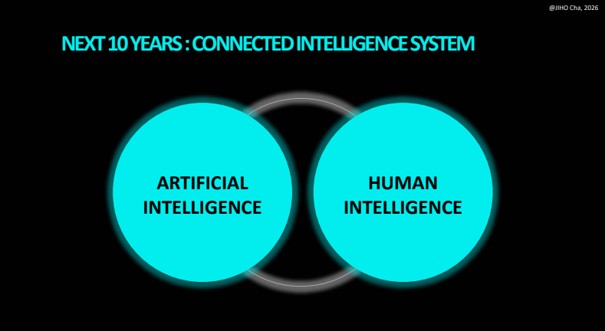
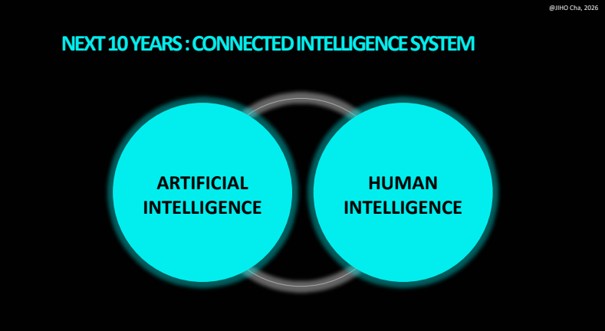
The fundamental fact is that our human intelligence system is unequal, but AI, as a form of public or digital intelligence, can help address this inequality within and between societies (Figure 2). We are working to translate the AI Universal Basic Society concept with other global partners, and we are currently discussing this concept with United Nations partners. Two days ago, we announced an initiative called the Global AI Hub, and we are now building partnerships with seven or eight key UN agencies. The UN system is currently under significant strain, suffering from financial crisis, which leaves it more vulnerable and often without sufficient resources to develop new initiatives in response to challenges like climate adaptation or artificial intelligence. An emerging country like South Korea, with financial resources, strong political commitment to change, a mature AI ecosystem, and standing as a representative democracy, is well positioned to help build this kind of global solidarity in AI application, across healthcare, education, and finance, and to support Global South countries in building the next generation of their social systems. This requires bilateral commitment and partnership with Global South countries, which South Korea is actively pursuing, as well as multilateral engagement through platforms like the United Nations, to support the UN in supporting the Global South.
This combination, our vision of AI Universal Basic Society within the UN framework, our bilateral partnerships with key Global South countries, and our effort to strengthen the UN system's capacity to adapt artificial intelligence to its mandate, forms a strong platform. But this is not the whole picture. While AI transformation may appear to be led by governments or the United Nations, in practice, the financial and technological drivers of AI transformation are led mostly by the private sector. It is therefore extremely important to engage the private sector in this transformation for the global public good, because the next major target of the AI market and industry will likely not be manufacturing or robotics, but the service economy. And the service economy, including healthcare and education, operates under public governance. This means that for AI transformation in these areas, a strong partnership between the public and private sectors is unavoidable if we are to remodel our society. How we engage this new model of innovation within multilateral organizations, and how we build a new AI-governed society that involves not only public authorities like government but also the private sector, is essential.
This discussion, this vision, and this policy should be grounded in our citizens' consensus. Two years ago, I tried to persuade political leadership on this dimension, but I came to realize that in a mature democratic society, the key question, what our next society, and our next generation of global society, should look like, belongs to our citizens to decide, because artificial intelligence will change everything. This is common knowledge, even among primary school students, yet we do not yet have this question reflected practically in policy, in our elections, or in our key political agendas. Gatherings like this one, at the leadership or technical level, are important, but it is equally important to bring this question into the minds of our citizens, because it is a profound political decision, one that concerns what kind of next society we need to design.
Returning to our theme, time for action, emerging technology, and global solidarity: my fundamental challenge and question is this. We all know about climate change, conflict, and global stress, but we are not ready for the compounding and cascading impact of these multiple, simultaneous crises. We do not currently have a global crisis resilience system capable of addressing this. Based on my twenty years of humanitarian experience, artificial intelligence is one of the few drivers I have found capable of building such a system. Our next generation, and the generations after it, will need strong resilience built on a more equal distribution of connected intelligence, between artificial and human intelligence, in order to prepare our societies for global crises and move toward a more equitable world.
This needs to be decided within the next fifteen years of AI transformation, and for Korea specifically, within the next five years, because the archetype of AI society our government establishes now will continue to shape the next fifty years. It is truly a time for action, now. We need to design our government and our society this year and next, and that design can be shared with our global partners and neighbors. I hope that all of us in this room, and all of our citizens outside it, can hold a single, shared question in mind: what should our next society be? It is time for action now.
Acknowledgments
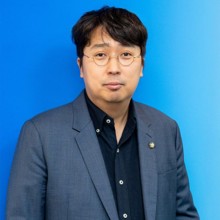
- Ji-Ho Cha is a Member of the National Assembly of the Republic of Korea, representing Osan in Gyeonggi Province since 2024 as a member of the Democratic Party of Korea. A physician by training, he is widely regarded for his expertise in global health, humanitarian response, and the application of artificial intelligence to public health systems, and has built a career of more than two decades combining frontline medical practice, academic research, international policy work, and legislative leadership. Before entering the National Assembly, Cha served as a professor at KAIST's Moon Soul Graduate School of Future Strategy, where his research focused on AI-based strategic systems for anticipating and responding to future crises, including the design of AI-enabled public health services for regions facing social and humanitarian emergencies. He previously served as a professor at the University of Manchester in the United Kingdom, and has worked with Médecins Sans Frontières, the World Health Organization, and Human Rights Watch on humanitarian and refugee health issues. His interest in humanitarian and refugee studies began early in his career, when he provided medical care to North Korean defectors as a public health doctor at the Hanawon resettlement center. Cha currently serves as co-chair of the Lancet Commission on Sea-Level Rise, Health and Justice. He graduated from medical school in 2005 and holds an M.Sc. in Refugee and Forced Migration Studies from the University of Oxford and a Ph.D. in International Health from Johns Hopkins University.
Figure 1.AI Universal Basic Society (AI-UBS): using universal AI to minimize risk across finance, healthcare, education, welfare, labor, and disaster management, and to guarantee all citizens a basic standard of living and safety.
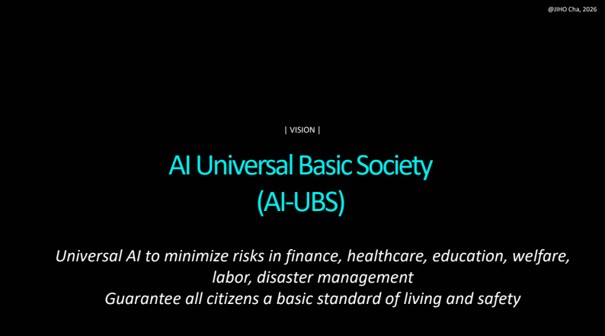
Figure 2.The connected intelligence system: closing the equity gap between artificial and human intelligence.
Citations
Citations to this article as recorded by


 IGEE



 PubReader
 ePub Link
 Cite
 XML Download