IGEE

Articles
- Page Path
- HOME > IGEE Proc > Forthcoming articles > Article
-
Article
Where the Effort Disappears: Opacity, Reciprocity, and Household Organic Waste Practice in Hyderabad, India† - Sohye Park1*, Sara Nuruddin Panjawani2
-
DOI: https://doi.org/10.69841/igee.2026.020
Published online: October 15, 2026
1Sustainable Development and Cooperation, Humanities, Arts, and Social Sciences Division, Underwood International College, Yonsei University, Seoul, Korea
2Business Administration, Yonsei School of Business, Yonsei University, Seoul, Korea
- *Corresponding author: Sohye Park, E-mail: sohyethere@gmail.com
- †This research is supported by the Social Engagement Fund (SEF) 2025.
© 2026 by the authors.
Submitted for possible open-access publication under the terms and conditions of the Creative Commons Attribution (CC BY) license (http://creativecommons.org/licenses/by/4.0/).
- 134 Views
- 2 Download

Abstract
- Indian waste policy has largely framed the gap between segregation mandates and household practice as a behavioural problem, to be addressed through messaging and outreach. Where residents already know the rules and still do not follow them, the question becomes under what conditions the practice is sustained. This study examines how urban households in Hyderabad, Telangana, handle organic waste and what judgements about the waste system those practices rest on. Ten household-level semi-structured interviews and in-home observation were conducted, with 35 participants recruited through community networks. Standard composting kits were distributed, followed by a return visit after two and a half months. A contrast observation was conducted in Yavatmal, Maharashtra, where municipal collection is irregular. Data were analysed through reflexive thematic analysis. In Hyderabad, verification of sorted waste stopped at the building gate, where the only visible stage was the watchman consolidating separated bags. Participants explained their departure from official segregation by citing the state's own record, suspending their obligation without denying it. The kits were unused at revisit, yet five of the ten households were diverting peels, eggshells, and used tea to their own plants, one for fifteen years. Set against Yavatmal, where infrequent collection left waste to accumulate and be burned in an open field, the Hyderabad case indicates that where collection infrastructure functions, the obstacle lies in what households can see of it. In the households studied, neither knowledge nor equipment was absent. The findings suggest that intervention should target the visibility of the chain rather than household attitudes, and that performance measurement should record where separation breaks down and whether organic material is diverted at home.
- India's Solid Waste Management Rules, 2016 made source segregation a legal obligation rather than a voluntary practice (Ministry of Environment, Forest and Climate Change [MoEFCC], 2016), and the Solid Waste Management Rules, 2026 have since extended this to four mandatory streams (Press Information Bureau, 2026). Under Swachh Bharat Mission–Urban, the persistent shortfall between mandate and practice has been treated primarily as a behavioural problem, addressed through intensified messaging and household outreach (Press Information Bureau, 2022). Implementation nonetheless remains uneven, and the diagnosis that households do not segregate because they do not know they should is increasingly difficult to sustain. Recent qualitative work reports that residents can articulate the rules and still not follow them, and that segregation functions less as a stable household attribute than as a situational accomplishment negotiated against collection timing, vehicle design, and the perceived credibility of downstream service (Sahoo et al., 2022; Sahoo et al., 2024; Trushna et al., 2026). Where awareness is already present, the question is not what households fail to understand but under what conditions they sustain the practice.
- This study pursues that question in Hyderabad, Telangana. Organic material is often the largest component of Indian household waste, and a recent seven-day pick analysis in Ujjain recorded it at 69% of the household stream, with almost half of what households placed in dry bins turning out to be mis-sorted, most of it organic (Kalyanasundaram et al., 2026). Household-level diversion of organic material is therefore a significant means of reducing landfill dependence. Existing qualitative accounts of Indian household segregation have been generated largely through focus groups and interviews conducted away from the home (Trushna et al., 2026), documenting what residents say rather than what occurs in the kitchen. This study enters ten households, combining semi-structured interviews with in-home observation of where organic material is actually placed and sorted, and distributing standard composting kits as a material intervention before revisiting the same households. What the visits made visible allows the study to ask the following questions.
- Main question: How do urban households in Hyderabad handle (organic) waste, and on what understandings of and judgements about the waste management system do these practices rest?
- Sub-question 1: How do households understand what happens to waste after it is collected, and where does that understanding come from?
- Sub-question 2: On what grounds do participants account for their own departure from official segregation?
- Sub-question 3: While the distributed standard composting kits went unused, how were households handling organic material?
- The visits found households that could state the rules and had received containers twice without using either, while five of the ten were directing part of their food waste into their own plants. Participants located the last point at which they could check their own sorting at the building gate, where they watched it being merged, and they explained their departure from official segregation by citing what the state had failed to do.
- The policy–practice gap in urban Indian waste management
- The regulatory architecture for household segregation in India is well established. The SWM Rules, 2016 assigned segregation duties directly to waste generators (MoEFCC, 2016). SBM-U treats behaviour change as a central component of its strategy, funding IEC campaigns and door-to-door outreach accordingly (Sahoo et al., 2022; Press Information Bureau, 2022). And Swachh Survekshan tied municipal reputation to measured performance. Yet unprocessed waste continues to accumulate at dumpsites nationally, and household segregation is not consistently maintained. Qualitative research has identified several common constraints: the temporal squeeze of morning routines, spatial limits on storing separated waste in small households, doubt about whether separation survives collection, and the gendered allocation of waste handling to women (Sahoo et al., 2022; Sahoo et al., 2024; Trushna et al., 2026). These studies suggest that non-segregation is reasoned rather than ignorant. They were, however, generated through focus groups and interviews conducted in community halls, Anganwadi centres, and municipal offices. Conducted away from the sites where waste is actually handled, these studies could not reach the moment of sorting itself.
- The visibility of infrastructure
- Infrastructure characteristically goes unnoticed when it works, becoming visible only through breakdown (Star, 1999). The underexamined implication for waste from this observation is that users of a functioning collection system have little opportunity to see what happens to what they hand over. Where J. C. Scott's (1998) account of legibility describes the state's capacity to see its subjects, the waste chain poses the reverse problem of how far citizens can see the state's operations. In India, this opacity is compounded by the fact that much of the sorting labour that does occur is performed informally and off the record, by workers whose contribution is structurally unacknowledged (Doron & Jeffrey, 2018; Gidwani & Reddy, 2011). Reframing the segregation problem as a question of visibility rather than of knowledge shifts attention from what households are told to what they can verify.
- Conditional cooperation and the conditions of compliance
- Experimental work has established that contributions to public goods are conditional on the expectation that others are contributing (Fischbacher et al., 2001). Levi's (1988) concept of quasi-voluntary compliance extends this logic to the state, holding that citizens comply willingly but conditionally, contingent on the state performing its own side of the bargain. Tax compliance research provides the clearest empirical demonstration that perceived fairness and institutional trustworthiness, rather than enforcement alone, sustain voluntary contribution (Frey & Torgler, 2007). On this reading, withdrawal of cooperation is a defensible response to a perceived breach.
- Theoretical position: how practices are explained
- This study treats participants' explanations for their conduct as accounts rather than as reports of underlying causes (Mills, 1940; M. B. Scott & Lyman, 1968). Accounts are socially available justifications that people use to make their conduct understandable to others. When a participant says that the government fails to do its part, the analysis therefore asks not whether the statement is accurate, but what obligation it releases the speaker from and what it leaves unexplained.
- Social Practice Theory describes practices as configurations of materials, meanings, and competences, and its vocabulary fits parts of this material well (Shove, 2010; Shove et al., 2012). Some of that vocabulary is used descriptively in what follows. It is not adopted as the analytical framework, however. SPT deliberately shifts attention away from individuals and toward practices as the unit of analysis. This study is concerned with what that shift makes hard to see, the judgements households make about the state and the relationship those judgements assume.
- Contributions
- Observational data generated inside the household. Much of the qualitative research on segregation in India has relied on focus groups and interviews conducted outside the home. This study visited ten households directly and observed where organic material is placed and how it is sorted, documenting the relation between what people report doing and what occurs in the kitchen.
- Tracing the rejection of a distributed technology. Interventions are more often reported when they succeed than when they fail. This study distributed composting kits and revisited the same households, finding the kits unused while organic material continued to be handled through the households' own arrangements. Treating that failure as an object of analysis makes visible the specific points at which a standardised technology conflicts with the spatial and temporal conditions of the home.
- Contrast between two sites with different infrastructural conditions. The study observed a setting where collection functions but its interior is not visible (Hyderabad) alongside one where collection is irregular or absent (Yavatmal), where the progression from open dumping to open burning was directly observed. The contrast permits shifts in waste practice to be attributed to differences in system conditions rather than in levels of awareness.
1. Introduction
- Study Design
- This study used a multi-method qualitative case study design, combining semi-structured interviews, in-home participant observation, and the distribution of standard composting kits followed by a return visit to the same households (Table 1). The kits served two purposes at once, generating data about how households responded to a standardised technology while their non-use became an object of analysis in its own right.
- Site, sample, and fieldwork
- Fieldwork was conducted in Hyderabad, Telangana, with ten households and 35 participants recruited by snowball sampling through community networks and personal connections. Participants were therefore linked to one another and to the research team before the study began. Households are identified by a code (HH01 to HH10) and are not otherwise described, so that individual households cannot be traced. Hyderabad served as the main study site, where all interviews, household observation, and kit distribution took place. Yavatmal, Maharashtra, was observed for approximately two days as a contrast site, chosen because municipal collection was irregular, so that household practice could be set against a setting with different infrastructural conditions.
- The first visit lasted two weeks and included interviews, observation of where organic material was placed and sorted, and distribution of the kits. Ten household-level interviews were conducted, each lasting 30 to 40 minutes. All were audio-recorded with consent and conducted in English, Hindi, Telugu, or a regional language spoken within the community according to participant preference. Interviews followed a semi-structured guide covering four areas. These were household waste routines and segregation practice, perceived challenges and responsibility for waste, knowledge of collection and post-collection processing, and awareness of and attitudes toward composting. Field notes were written during and immediately after each visit. The team returned approximately two and a half months later for one week to assess kit use and the reasons for non-use, and to observe the handling of organic material at home. Sample size was assessed using information power (Malterud et al., 2016), given the study's narrow aim, a sample specific to the practices in question, and an analytic strategy based on close reading of individual cases.
- Analysis and ethics
- Data were analysed through reflexive thematic analysis (Braun & Clarke, 2022). Coding was carried out and then discussed within the team, with codes grouped into subcategories and themes through repeated readings. The research team included a Korean researcher and a local researcher, who conducted interviews together. Asking about kit use created an obvious pressure toward socially desirable answers, since the question came from the people who had given the kits. That participants nonetheless reported not using them is treated here as data rather than as a problem to be discounted. The study was approved by the Institutional Review Board of Yonsei University (IRB No. 7001988-202512-HR-3030-02), and informed consent was obtained from all participants. All participants are anonymised, and identifying details about the community have been removed or generalised to reduce the risk that the group can be located.
2. Methods
- Three themes were developed from the Hyderabad material, together with a fourth drawn from the contrast site (Table 2). The source of each code is marked as interview, observation, or both. The first two themes concern why cooperation with the municipal system was not sustained, the third concerns what households were doing with organic material instead, and the fourth sets these against a site where collection is largely absent.
- Where the effort disappears I: opacity in the post-handover chain
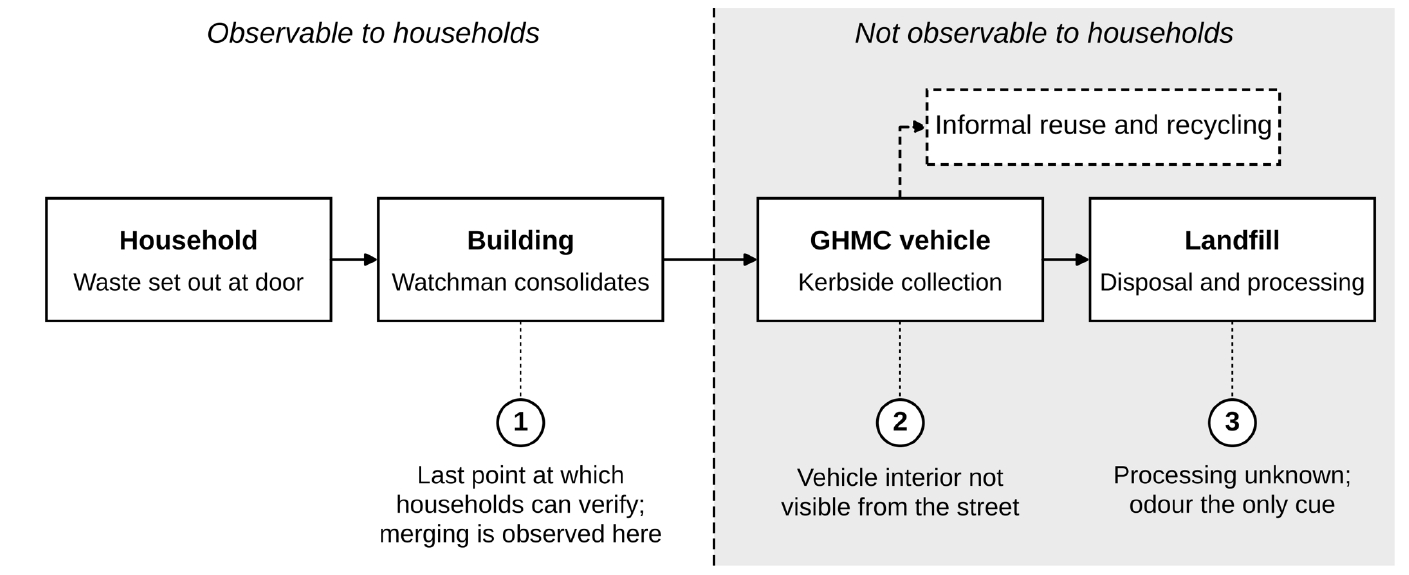
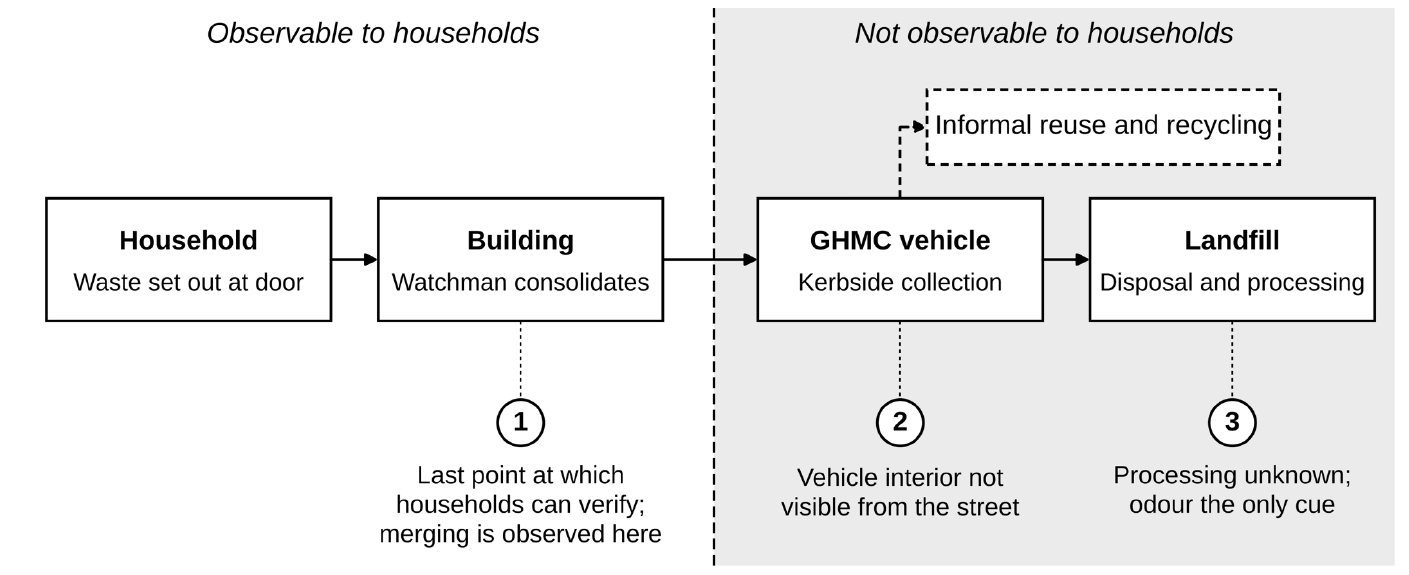
- Figure 1 traces the chain that carries household waste to the landfill and marks the points at which households lose sight of it. The chain is visible to households at only one point, and what becomes visible there is the undoing of their own sorting.
- Participants who separated paper or recyclables described watching the building watchman consolidate those bags with everything else before handing them to the collection vehicle. This is the last stage at which verification is possible, and several participants reverted to a single bag once they had seen it.
- "I recycle paper, so I keep paper separately. But the watchman still gives it to the truck along with everything else." (HH01)
- Beyond the building gate, verification stops. Participants consistently reported that collection vehicles mix whatever they receive, and a number of them named this as the reason they had abandoned separation at home. The research team's own observation, together with accounts from the few participants who had looked inside or asked the crew, indicates that compartmentalised collection does in fact occur. The vehicles are simply too tall and too enclosed to be seen into from the street. This divergence is offered here as an observation rather than a settled finding, since the data on vehicle operation are limited.
- "I was given the two bins earlier, but I am not using them now. The bins became old over time, and the trash collectors still mixed all the waste together, so it felt pointless." (HH06)
- At the final stage the gap widens further. Almost no participant could describe what happens at the landfill, and the only sensory contact anyone reported was the smell. Into that gap participants placed competing assumptions, most commonly that the waste is burned, occasionally that it is sorted again.
- Where the effort disappears II: reciprocity and withdrawn cooperation
- Participants did not explain their non-participation by saying that segregation was pointless in principle, nor that they did not know how. They explained it by pointing to what the state had failed to do. The record they cited was cumulative rather than episodic. Colour-coded bins had been distributed once, after the pandemic, and never replaced when they wore out; some households reported receiving none at all. Collection vehicles arrived late or not at all, and in one building the residents had to pool money so that a neighbour could lodge a formal complaint, which succeeded only after that expense. Running through these accounts was the judgement that the shortfall was not accidental. Participants named corruption and indifference among municipal staff, and described the state as an actor that had already decided not to hold up its end.
- "I didn't receive the two coloured bins." (HH09)
- "My neighbour protested against the garbage collection and succeeded, and now the people in the building support her financially." (HH04)
- Participants expressed this judgement as a matter of exchange, framing their own effort as owed only in return for the state's. One participant put it as a question with an obvious answer.
- "The government is not doing their part. Why should I do mine?" (HH05)
- Others described themselves as angry at the government, and named that anger as the reason for disposing of waste in the street rather than carrying it to a bin. Read as accounts in M. B. Scott and Lyman's (1968) sense, these are justifications rather than excuses. The speakers do not deny responsibility for what they do. They reject the claim that doing it is wrong. It is a vocabulary of motive available to anyone in this setting, and it goes unchallenged because it draws on a standard of fairness that others recognise (Mills, 1940). The claim is not that the obligation does not exist, but that it has been suspended by the other party's failure to meet its own.
- "Many citizens think the government is doing nothing, so they feel like, 'what can we even do?'" (HH10)
- That this is a claim about fairness rather than a disclaimer of duty becomes clearer in what the same participants said about responsibility. Asked who is responsible for waste, most participants described responsibility as jointly held by the government, citizens, and the companies that produce packaging, and several named specific obligations on each side. From the state they expected adequate public bins, separation maintained at collection, and proper processing. From residents they expected proper cooperation. One participant located responsibility with citizens on the grounds that citizens are the ones who live with the consequences. Withdrawal of cooperation is therefore not a denial that the obligation exists but a suspension of performance pending performance by the other side. Asked what would restore their cooperation, participants named evidence that separation is maintained after collection before anything else. Others proposed fiscal incentives such as property tax or health insurance rebates, penalties for improper disposal, and pointed to the conduct of neighbours as something that would make them reconsider. Compliance here is quasi-voluntary in Levi's (1988) sense, willingly given but contingent on the state meeting its own commitments.
- What is withheld, however, is cooperation with the municipal waste system. They did not stop dealing with their food waste. Households that failed every official measure of segregation were, at the same time, sorting part of their food waste for purposes of their own.
- Organic diversion outside standardised methods
- By the measures used to assess programme performance, the households in this study were not practising segregation. Only one household maintained a systematic separation of household waste, and at revisit the composting kits distributed two and a half months earlier had not been used by anyone. On these criteria the group registers as a near-total failure of uptake. What the home visits found was that five of the ten households were nonetheless diverting a portion of their food waste away from the collection stream, into the soil of their own plants.
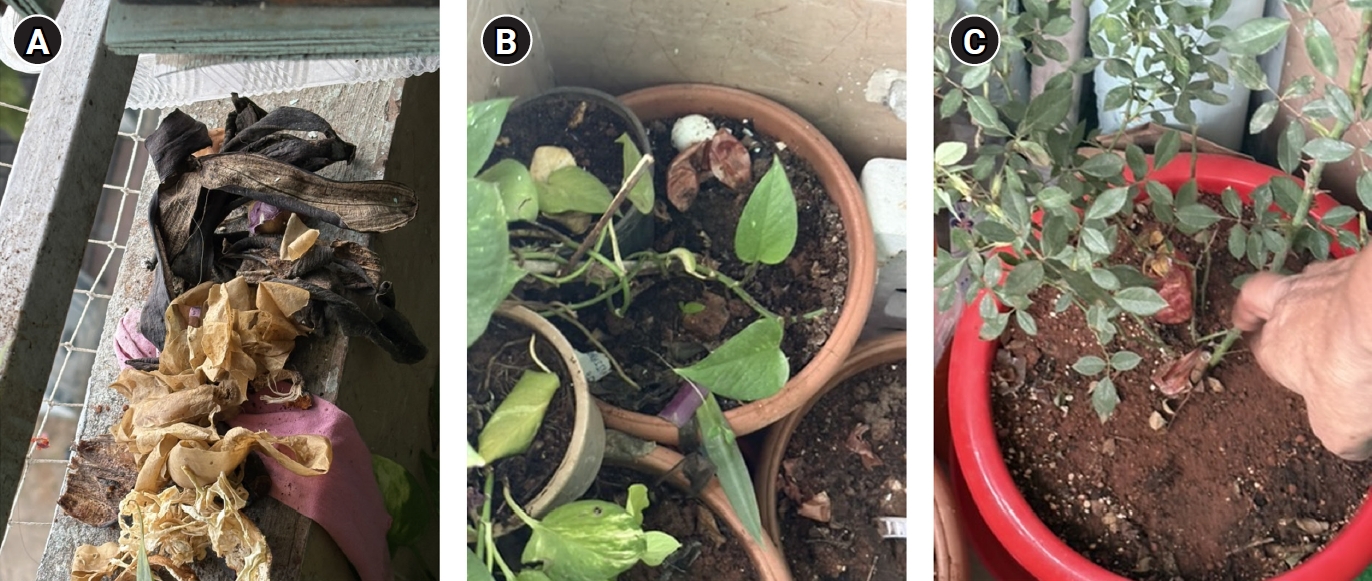
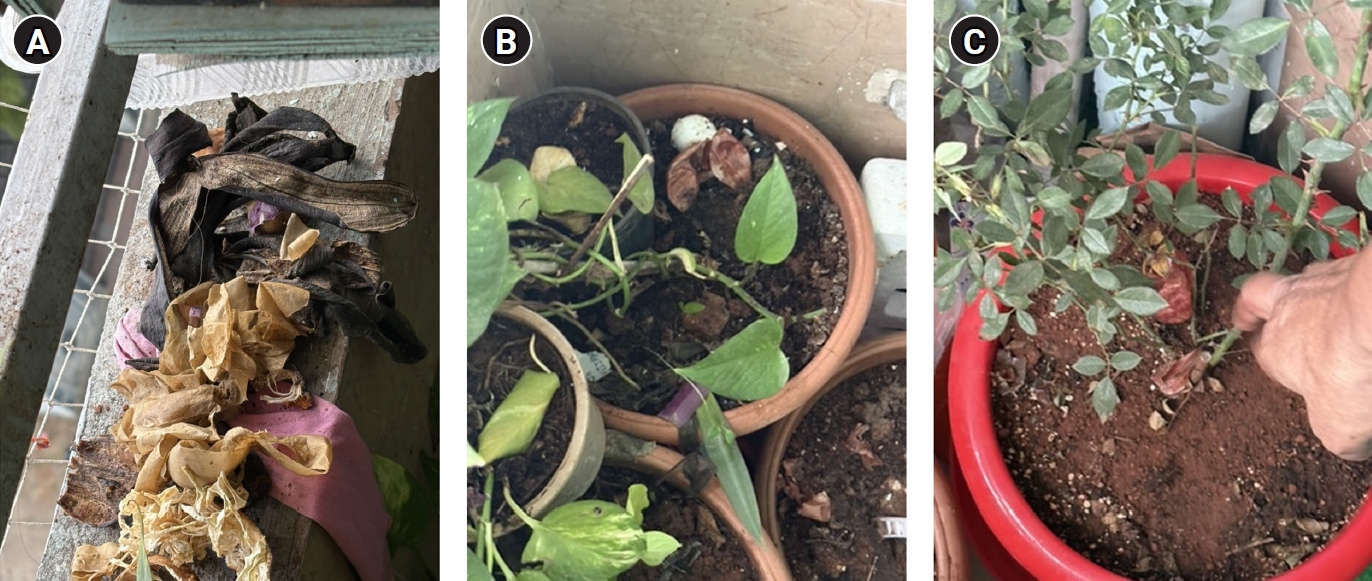
- The materials were specific and the routines were established. Banana peels, onion and potato skins, eggshells, used tea leaves, and the water left from soaking rice or almonds were applied to household pots (Figure 2). Eggshells were dried and crushed first. Peels were sometimes steeped and the water used rather than the solid. One household described the practice as continuous over fifteen years. The work fell to the same person who managed waste for the household generally, in most cases the mother or grandmother, and it was carried out in whatever space existed, which in these apartments meant a balcony. One participant had gone as far as asking a vegetable seller for the onion peels he was discarding so that she could take them home for her plants.
- "I use things like rice water, tea leaves water, egg shells, and soaked almonds water for my plants." (HH01)
- "Yes, we have been practising composting for over 15 years on a regular basis." (HH03)
- The reasons participants gave were not environmental. Nobody described the practice as waste reduction or as a response to landfill pressure. They described it as feeding the plants, and the plants mattered because they were cared for. Households kept between five and thirty of them, with many participants expressing considerable attachment and care toward these plants.
- Meanwhile, participants who explained their non-use of the distributed composting kits described being overwhelmed by the layering procedure, unable to find a point in the day at which to begin, and uncertain how to start at all. Further constraints included insects and odour, along with building rules and the space a bin would occupy. One participant had attempted formal composting previously and abandoned it for exactly these reasons before settling on the method she now used. By comparison, the existing practice asks for no dedicated container, no schedule, and no procedure to learn. It used the pots that were already on the balcony and fitted into work someone was doing anyway.
- Cooperation with municipal segregation requires households to accept, without evidence, that their effort survives handover. However, within the domestic organic diversion process, the material is placed in a pot the household owns, in a room the household occupies, and the result is identifiable within weeks. Whether the plant grows or dies is not a matter of trust. The practice persists in part because it operates entirely inside the zone the household can still see.
- Contrast case: infrastructural absence in Yavatmal
- This section sets the Hyderabad material against observations from a second site, Yavatmal in Maharashtra. The two sites fall under different state administrations and were not studied to equivalent depth, so the material is presented as a contrast rather than as a comparative case. What it shows is how practices shift when the constraint is not opacity but the absence of provision.
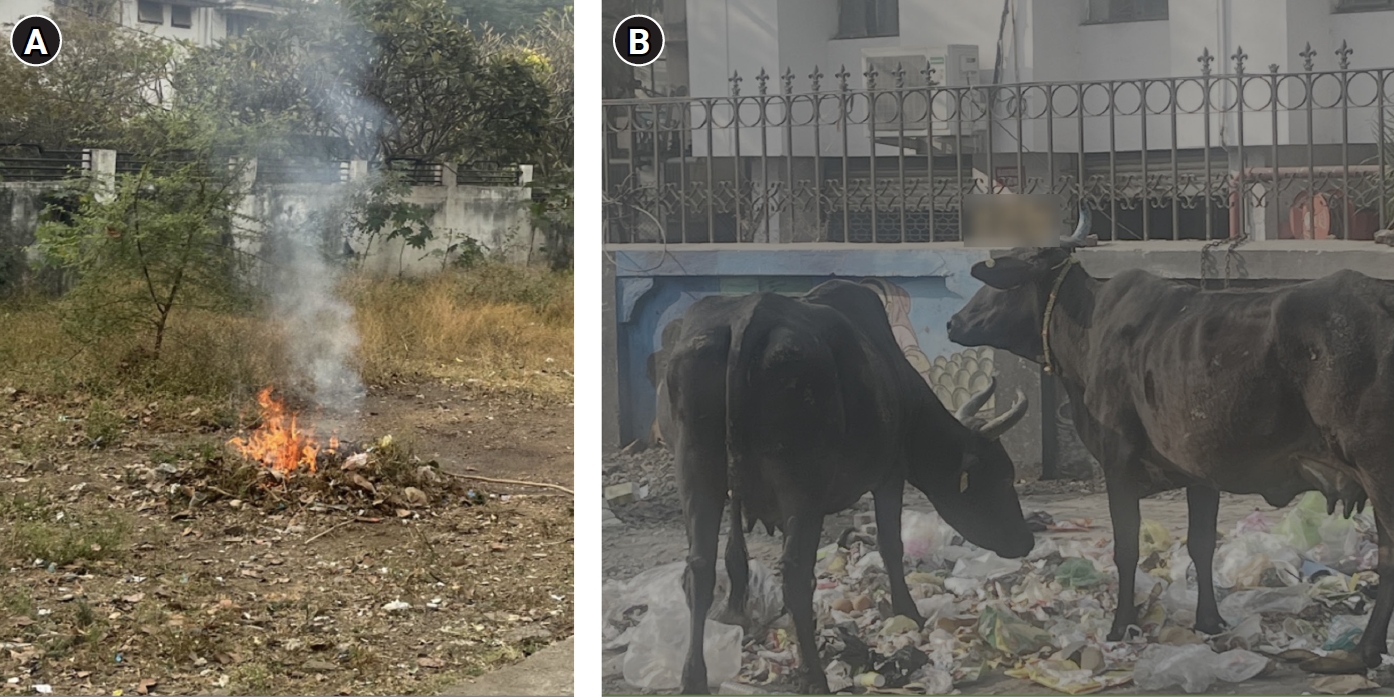
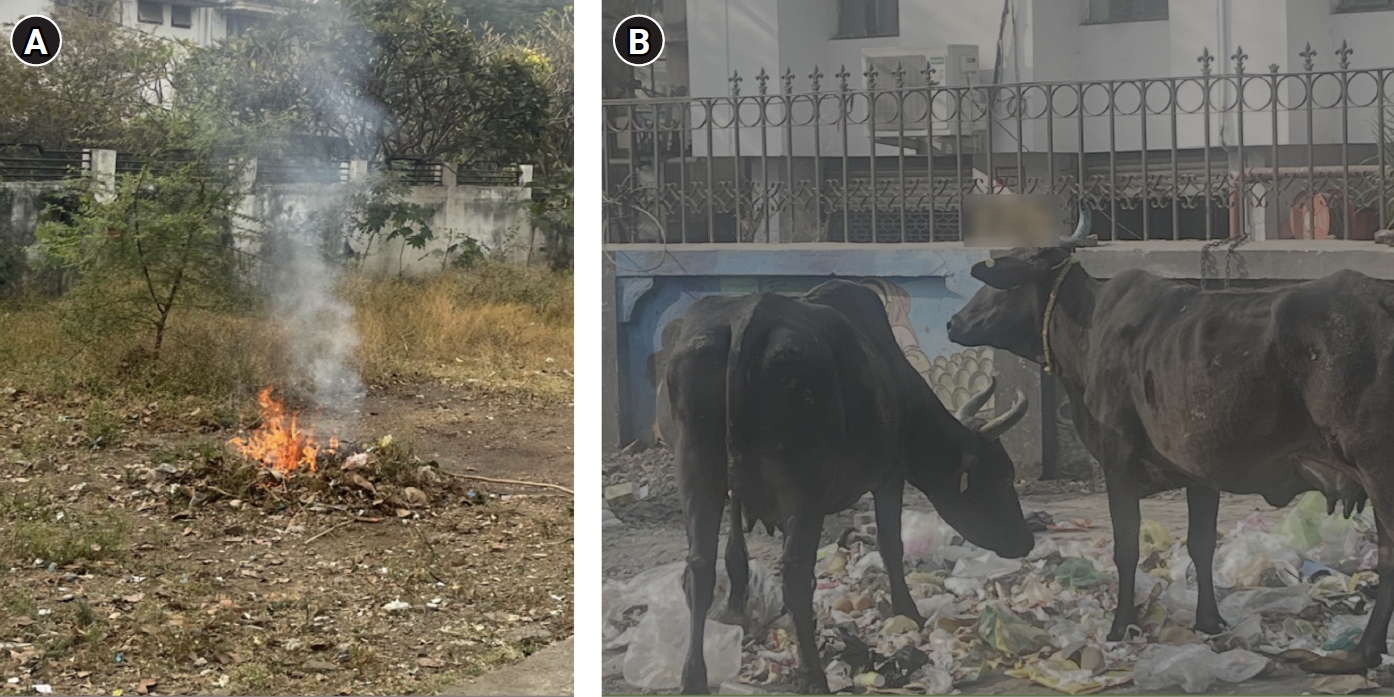
- In the areas observed in Yavatmal, there was no building-level collection arrangement of the kind found in Hyderabad. Residents placed waste in a large open field beside the buildings, in some accounts throwing it from windows, and municipal collection was described as occurring once or twice a month without a fixed schedule. Service within Yavatmal was uneven. Some areas had collection about once a week, and others had none. Dogs, cows, horses, buffaloes, and monkeys were observed feeding at the site and scattering material across it (Figure 3B).
- The research team observed how accumulation was resolved. Waste gathered in the field was burned on site for approximately three hours (Figure 3A). The material was predominantly plastic, the ground afterwards was blackened, and the vegetation growing there was destroyed. Residents described this as a recurring procedure followed for years.
- The two sites make different demands on households. In Hyderabad the infrastructure exists and functions, and the problem for households is that they cannot see inside it. Their withdrawal is a response to a system they are asked to trust without evidence. In Yavatmal that question does not arise, because there is no system to trust. Waste goes to the open field because there is nowhere else for it to go, and it burns because it accumulates. The problem in the first case is opacity, and in the second it is absence.
3. Results
- Reconsidering the diagnosis of missing awareness and tools
- Policy in this area has largely addressed two presumed deficits on the household side. Campaigns and outreach target knowledge (Press Information Bureau, 2022), and the municipality distributed colour-coded bins to address equipment. Neither deficit was present here in the form the policy assumes. Most participants could state which materials belong in which stream and explain why separation matters. Equipment had been supplied twice over, by the municipality after the pandemic and by this study two and a half months before the revisit, and neither was in use. What was missing was of a different kind. Households could not verify what happened to sorted waste after handover, the state had not sustained the services it began, and the equipment supplied did not fit the space or the daily schedule of an apartment household.
- How opacity and grievance reinforce one another
- Opacity and withdrawn cooperation resulting from a sense of reciprocity are separate findings and neither causes the other, but each strengthens the other. Because households cannot observe what happens after handover, the judgement that the state is failing to do its part is reinforced. Because that judgement is already in place, the gap left by opacity is filled with the least favourable available assumption, namely that the vehicle undoes the sorting. Section 3.1 indicates that this assumption is probably mistaken. The participants who described compartmentalised collection were those who had looked inside or asked the crew, and those who described mixing had not, so the difference between them was not what they believed about the municipality but what they had seen. The data on vehicle operation are limited and this is offered as an observation rather than a settled finding. If it holds, what failed at this point in the chain was not the infrastructure but the transparency and delivery of information.
- Withdrawal as a policy signal
- The grievance was consistent with the service record participants described. Bins were distributed once and not replaced when they deteriorated, some households received none, collection times were not kept, and in one building residents had to pool money before a complaint could be filed. Participants also did not disclaim their own obligation, since most participants described responsibility as shared between the state, citizens, and the firms that produce packaging. They asked the state to act first rather than asking to be excused.
- Section 3.2 recorded what would restore their cooperation, and the first item was evidence that separation is maintained after collection, followed by property tax rebates, insurance rebates, penalties for improper disposal, and the visible conduct of neighbours. Campaigns and outreach are largely designed to change what households think (Press Information Bureau, 2022). These participants identified a defect in delivery and were able to say where it lay.
- What the standard performance metric does not register
- Under the current Swachh Survekshan framework, source segregation is assessed primarily through an indicator on segregation at source and segregated transportation, scored as the proportion of sampled points that pass, with validation carried out at residential areas, transfer stations, and processing facilities together with citizen validation interviews (Ministry of Housing and Urban Affairs [MoHUA], 2025). Applied to Section 3.1, the difficulty is that a single pass rate represents two different situations, households that did not sort and households whose sorting was merged at the building gate, and nothing in the score separates them.
- A second category is absent from the framework altogether. Diverting food waste to household pots requires the household to separate organic from non-organic material first, and this separation never enters the collection stream. Five of the ten households here were diverting organic material in this way at the moment they were recorded as non-compliant. The quantities are small and bounded by the number of pots a balcony holds, so the claim is not that this practice is a sole solution. The claim is that a framework which cannot register a practice cannot learn from it, and there was something here to learn.
- Conditions for a practice that lasts
- Municipal segregation was abandoned, the composting kits were never begun, and the diversion of peels and shells to household plants was sustained, in one case for fifteen years. Setting them side by side identifies what the surviving arrangement had that the other two lacked.
- The first condition is that the result be observable. A household that applies eggshells to a pot sees within weeks whether the plant responds. A household that hands a sorted bag to the watchman sees only the merging described in Section 3.1. Visibility matters here because it is what allows a household to determine whether its own effort accomplished anything.
- The second condition is that the labour yields a return. What the household does to its pots produces something the household keeps, such as edible plants including curry leaves, mint, chilli, and papaya, and ornamental ones including roses, hibiscus, and bonsai. Municipal segregation offers no return of this kind. The sorted bag leaves the building and nothing comes back. Section 3.2 recorded participants asking for property tax rebates and health insurance rebates. Households were asking to receive something for work they had done.
- The third condition is that the arrangement uses what the household already has. The kits required three things that did not exist beforehand. They needed room for a bin, in apartments where participants named space as a constraint and where building rules sometimes prohibited one. They needed a layering procedure to be learned. And they needed a point in the day at which to begin, which participants described being unable to find. The pots were already on the balcony and plant care was already part of someone's routine, so adding organic material created no new task.
- The fourth condition is that the other party performs. Municipal segregation requires the state to collect on schedule, to replace bins that wear out, and to keep separation intact after handover. Section 3.2 recorded participants citing each of these as something that had not happened. The plant arrangement has no counterpart to fail. Where an arrangement depends on another party, whether that party performs determines whether the arrangement holds.
- Relation to previous research
- Trushna et al. (2026) document post-collection opacity and its effect on institutional trust across three small Indian cities, together with a form of accountability among residents that is contingent on system performance. Sahoo et al. (2022, 2024) report related constraints in Ujjain. This study finds similar patterns in a metropolitan setting and indicates the pattern is not specific to small-city administration.
- What is added lies in how the material was generated. Previous work has relied on focus groups and interviews conducted away from the home, and Trushna et al. (2026) report practices that bypass the municipal stream as participant statements. Entering households made it possible to observe what was done in the kitchen. Distributing a standard technology and returning to the same households recorded the conditions against which that technology was rejected.
4. Discussion
- This study asked how urban households in Hyderabad handle organic waste and what understandings of the waste management system those practices rest on. Households could state the rules and had received containers twice, once from the municipality and once from this study, and were using neither. At the same time, five households were directing part of their food waste into the soil of their own plants, in one case for fifteen years. In these households, the capacity and the willingness to separate organic material were present.
- What households could not do was verify. Observation stops at the building gate, where the single visible stage is the watchman consolidating separated bags, and participants filled the remaining gap with the assumption that sorting is undone in the truck. The team's observations and the accounts of participants who had looked inside indicate that compartmentalised collection does occur, though the evidence on vehicle operation is limited. Alongside this, participants accounted for their departure from official segregation by citing the state's record, naming bins distributed once and never replaced, collection times not kept, and a complaint that required residents to pool money before it was heard. These accounts suspend the obligation without denying it, since most participants described responsibility as shared among the state, citizens, and packaging producers. Cooperation here is quasi-voluntary in Levi's (1988) sense. Meanwhile the organic material moved through an arrangement that asked for neither verification nor a counterparty, into pots the household owned and tended for reasons participants described as caring for plants rather than managing waste.
- Two implications follow for how the existing system is administered.
- The first concerns the direction of information. Programmes have largely been designed to send information to households, and participants named the reverse flow as what would restore cooperation, meaning evidence that separation survives handover. If compartmentalised collection is taking place, the defect lies in what households can observe rather than in how waste is transported. What follows is that the target of intervention is the visibility of the chain, whether through vehicles that can be seen into, sorting performed where residents are present, or some form of reporting back on what was collected. Which of these is workable is a question for operational research beyond the scope of this study.
- The second concerns what performance measurement records. Source segregation is scored as the proportion of sampled points that pass an assessment conducted at residential areas, transfer stations, and processing facilities (MoHUA, 2025), so a building where households sort and the watchman consolidates registers the same way as one where no household sorts. Assessment that recorded the stage at which separation breaks down would show municipalities where to intervene, and in these buildings that stage was the consolidation point rather than the household. In practice, this would mean recording segregation separately at the household door, at the building consolidation point, and on the collection vehicle, rather than as a single pass rate for each sampled point. Counting organic material diverted at home would register practices the current framework treats as absent, since five of the ten households here were separating organic material at the moment they were recorded as failing to do so. This would require a separate category within the household-level assessment for organic material retained for home use, verified during residential validation visits and recognised as source segregation rather than recorded as non-compliance. The quantities are limited by what a balcony holds and are no substitute for municipal processing, but a framework that cannot register a practice cannot learn from it.
5. Conclusion
- Four limitations bear on how far these findings extend. The ten households were recruited by snowball sampling through a single community network and personal connections, so participants were linked to one another and shared a residential and social context that shaped what could be observed, and the findings are not intended to generalise to Indian households at large. The interval between visits was two and a half months, long enough to establish that the kits went unused but not long enough to say whether the practices recorded here persist or how they change. Observations of vehicle operation were incidental to the fieldwork and rest on a small number of sightings and participant accounts, which is why the divergence between what participants assumed and what appeared to occur is offered as an observation requiring vehicle specifications and operational records to confirm. Finally, the researchers who asked about kit use were the researchers who had supplied the kits, and while participants reported non-use readily, the same relationship may have shaped what was said about the reasons.
6. Limitations
-
Funding
This research was supported by the Social Engagement Fund of the Institute for Global Engagement and Empowerment, Yonsei University (Grant No. 2025 SEF-11).
-
Conflicts of Interest
The authors declare no conflicts of interest.
-
Data Availability Statement
Interview transcripts and field notes are not publicly available. The households in this study were recruited through a single community network, and the accounts include details of residence, household composition, and relations with municipal staff that could identify participants even after removal of names. Anonymised excerpts beyond those reported here may be made available by the corresponding author on reasonable request, subject to the terms of the ethics approval.
-
Use of AI-assisted Technologies
The authors used Claude to edit language and grammar and to assist in producing Figure 1. The tool was not used for study design, data collection, coding, analysis, or the formulation of conclusions. The authors reviewed all such material and take full responsibility for the content of this article.
NOTES
- Braun, V., & Clarke, V. (2022). Thematic analysis: A practical guide. SAGE.
- Doron, A., & Jeffrey, R. (2018). Waste of a nation: Garbage and growth in India. Harvard University Press.
- Fischbacher, U., Gächter, S., & Fehr, E. (2001). Are people conditionally cooperative? Evidence from a public goods experiment. Economics Letters, 71(3), 397-404. https://doi.org/10.1016/S0165-1765(01)00394-9Article
- Frey, B. S., & Torgler, B. (2007). Tax morale and conditional cooperation. Journal of Comparative Economics, 35(1), 136-159. https://doi.org/10.1016/j.jce.2006.10.006Article
- Gidwani, V., & Reddy, R. N. (2011). The afterlives of "waste": Notes from India for a minor history of capitalist surplus. Antipode, 43(5), 1625-1658. https://doi.org/10.1111/j.1467-8330.2011.00902.xArticle
- Kalyanasundaram, M., Krishnan, K., Raj, D., Singh, S., Parashar, V., Vishwakarma, D., Soni, R., Sahoo, K. C., Sabde, Y., Pathak, A., Purohit, M., Atkins, S., Stålsby Lundborg, C., Rousta, K., & Diwan, V. (2026). Quantitative assessment of household waste composition and segregation pattern in urban settings of Ujjain, Madhya Pradesh: A pick analysis/waste composition analysis study. Frontiers in Sustainability, 6, 1707300. https://doi.org/10.3389/frsus.2025.1707300Article
- Levi, M. (1988). Of rule and revenue. University of California Press.
- Malterud, K., Siersma, V. D., & Guassora, A. D. (2016). Sample size in qualitative interview studies: Guided by information power. Qualitative Health Research, 26(13), 1753-1760. https://doi.org/10.1177/1049732315617444ArticlePubMedPMC
- Mills, C. W. (1940). Situated actions and vocabularies of motive. American Sociological Review, 5(6), 904-913. https://doi.org/10.2307/2084524Article
- Ministry of Environment, Forest and Climate Change. (2016). Solid Waste Management Rules, 2016. Government of India. https://cdnbbsr.s3waas.gov.in/s30f46c64b74a6c964c674853a89796c8e/uploads/2024/07/20240710555191345.pdf
- Ministry of Housing and Urban Affairs. (2025). Swachh Survekshan 2025-26: Toolkit. Swachh Bharat Mission–Urban, Government of India. https://swachh.jk.gov.in/wp-content/uploads/2026/02/Swachh-Survekshan-2025-26-Toolkit.pdf
- Press Information Bureau. (2022). Swachh Bharat Mission–Urban 2.0 launches National Behaviour Change Communication Framework for Garbage Free Cities. Government of India. https://www.pib.gov.in/PressReleasePage.aspx?PRID=1821417
- Press Information Bureau. (2026). New Solid Waste Management Rules notified; to come into force from April 1, 2026. Government of India. https://www.pib.gov.in/PressReleasePage.aspx?PRID=2219676
- Sahoo, K. C., Soni, R., Kalyanasundaram, M., Singh, S., Parashar, V., Pathak, A., Purohit, M. R., Sabde, Y., Stålsby Lundborg, C., Sidney Annerstedt, K., Atkins, S., Rousta, K., & Diwan, V. (2022). Dynamics of household waste segregation behaviour in urban community in Ujjain, India: A framework analysis. International Journal of Environmental Research and Public Health, 19(12), 7321. https://doi.org/10.3390/ijerph19127321ArticlePubMedPMC
- Sahoo, K. C., Kalyanasundaram, M., Singh, S., Soni, R., Parashar, V., Pathak, A., Stålsby Lundborg, C., Rousta, K., Atkins, S., & Diwan, V. (2024). Service providers and program managers' perspectives on household waste segregation in Ujjain, India. Sustainable Environment, 10(1), 2383472. https://doi.org/10.1080/27658511.2024.2383472Article
- Scott, J. C. (1998). Seeing like a state: How certain schemes to improve the human condition have failed. Yale University Press.
- Scott, M. B., & Lyman, S. M. (1968). Accounts. American Sociological Review, 33(1), 46-62. https://doi.org/10.2307/2092239ArticlePubMed
- Shove, E. (2010). Beyond the ABC: Climate change policy and theories of social change. Environment and Planning A, 42(6), 1273-1285. https://doi.org/10.1068/a42282Article
- Shove, E., Pantzar, M., & Watson, M. (2012). The dynamics of social practice: Everyday life and how it changes. SAGE.
- Star, S. L. (1999). The ethnography of infrastructure. American Behavioral Scientist, 43(3), 377-391. https://doi.org/10.1177/00027649921955326Article
- Trushna, T., Yadav, M., Sahoo, K. C., Singh, S., Parashar, V., Pandey, A. K., Sabde, Y. D., Pati, S., Tiwari, R. R., & Diwan, V. (2026). Contextualising household waste segregation in India's small cities: A multi-stakeholder qualitative study. Frontiers in Sustainable Cities, 8, 1716184. https://doi.org/10.3389/frsc.2026.1716184Article
References
Figure & Data
References
Citations

 PubReader
 ePub Link
 Cite
 XML Download