IGEE

Articles
- Page Path
- HOME > IGEE Proc > Forthcoming articles > Article
-
Letter
Introducing the 2025 ‘Social Engagement Fund’ Cohort - Sarah Soyeon Oh*, Eun Kyoung Rhee
-
DOI: https://doi.org/10.69841/igee.2026.022
Published online: October 19, 2026
Institute for Global Engagement & Empowerment (IGEE), Yonsei University, Seoul, Korea
- *Corresponding author: Sarah Soyeon Oh, E-mail: sarahoh@yonsei.ac.kr
• Received: October 10, 2026 • Revised: October 13, 2026 • Accepted: October 14, 2026
© 2026 by the authors.
Submitted for possible open-access publication under the terms and conditions of the Creative Commons Attribution (CC BY) license (http://creativecommons.org/licenses/by/4.0/).
- 30 Views
- 1 Download

- 1. Can Electric Motorcycles Save Lives? Causal Evidence from Uganda and Rider-Level Barriers to Electric Transition
- 2. Where the Effort Disappears: Opacity, Reciprocity, and Household Organic Waste Practice in Hyderabad, India
- 3. Environmental Inequality and Socioeconomic Vulnerability: A Meta-Analysis and Exploratory GIS-Based Spatial Analysis of Seoul
- 4. Climate Action for Balanced Regional Development: Exploratory Youth Preferences for Renewable Energy Policy Using Conjoint-Informed Scenario Ratings
- Authors: Hyeongchan Yun, Beomjun Kim, Seoyoon Jung
- Departments: Underwood International College; School of Economics, College of Commerce and Economics; Department of Cultural Anthropology, College of Social Sciences
- Confronting the intertwined challenges of air pollution, road safety, and precarious livelihoods in Kampala’s motorcycle taxi (boda boda) sector, this project asked whether electric motorcycles can save lives, and why riders may find it difficult to switch to electric transition in Uganda. Utilizing a complex, difference-in-differences (DID) design that incorporates data about the 2022 Ebola-induced lockdown in Mubende district as a natural experiment, the team estimated that transportation accounts for roughly half of ambient PM2.5, implying that full boda boda electrification could reduce PM2.5 by 18% and avert approximately 510 premature deaths annually in Kampala.
1. Can Electric Motorcycles Save Lives? Causal Evidence from Uganda and Rider-Level Barriers to Electric Transition
- Authors: Sohye Park, Sara Nuruddin Panjawani
- Departments: Underwood International College; Yonsei School of Business
- This study examined how urban households in Hyderabad, India handle organic waste, and why segregation mandates so often fail to translate into everyday practice. Through ten household interviews, in-home observation, and the distribution of composting kits followed by a return visit two and a half months later, the team found that neither knowledge nor equipment was missing: households could state the rules and had received containers twice, yet the only stage of the waste chain they could see was the building gate, where their separated bags were consolidated. As one participant explained, “The government is not doing their part. Why should I do mine?” The authors concluded that “where collection infrastructure functions, the obstacle lies in what households can see of it.”
2. Where the Effort Disappears: Opacity, Reciprocity, and Household Organic Waste Practice in Hyderabad, India
- Authors: Seoyoung Park, Minseo Kim, Dayoung Lee, Seohyun Lee, Sohye Lee
- Departments: Department of Chinese Language and Literature; College of Nursing
- This research examined the relationship between environmental inequality and socioeconomic vulnerability by combining a PRISMA-guided systematic review and meta-analysis of ten empirical studies with an exploratory GIS analysis of Seoul’s 426 administrative dongs. The meta-analysis yielded a positive pooled association between environmental disadvantage and socioeconomic vulnerability (r = 0.316, 95% CI: 0.183–0.438) despite substantial between-study heterogeneity, while the Seoul analysis identified a weak positive association between environmental infrastructure facility proximity and the proportion of publicly supported housing (r = 0.187), together with statistically significant spatial clustering of the proximity indicator (Moran’s I = 0.216).
- The project was commended for its methodological ambition and, equally, for its restraint: the Seoul findings are framed as a first-stage screening tool for identifying candidate areas for closer investigation rather than as definitive evidence of environmental injustice. The study aligned with SDGs 10 and 11.
3. Environmental Inequality and Socioeconomic Vulnerability: A Meta-Analysis and Exploratory GIS-Based Spatial Analysis of Seoul
- Authors: Sujin Kim, Dain Jin, Sihyun Jung
- This project, led by the student initiative REGREEN (Regional Equity for GREEN Action), investigated which features of renewable energy policy design make young Koreans willing to participate in climate action initiatives. A field study at the Yeongdeok community wind energy cooperative informed an online pilot study (N = 50, ages 18–29) combining an educational video, four gamified learning modules, a simulated cooperative market, and a conjoint-informed rating of six policy scenarios. According to the research data, renewable energy awareness increased from 4.2 to 5.7 on a 7-point scale (Cohen’s d = 1.18), and governance structure emerged as the strongest preference signal, with cooperative joint ownership rated on average 1.77 points higher than the expert-managed scenario. In quote of the authors:
- “Governance architecture emerged as the strongest observed preference signal among these young Korean university participants, but the finding should be interpreted as exploratory and post-intervention rather than as a stable national estimate for Korean youth.”
- The study was commended for developing a potentially replicable research platform and for the transparency with which it reports the limits of a pilot study. The project contributed especially to SDG 7 (affordable and clean energy) and SDG 13 (climate action), with its emphasis on balanced regional development speaking to SDG 10 as well.
- These projects were a testament to the creativity, research expertise, and empathy valued by our student community. SEF 2025 reminded us that the SDGs are not abstract targets but lived commitments shaped by our students’ commitment to foster a more sustainable world.
- We extend our deepest congratulations to all SEF 2025 finalists and look forward to the continued impact of their work.
- Warm regards,
-

- Sarah Soyeon Oh is a research professor at the Institute for Global Engagement & Empowerment (IGEE) at Yonsei University, where she helps coordinate the Social Engagement Fund and leads a range of research projects focused on sustainable development and student empowerment. With a background in public health, Oh’s primary interests include applying machine learning and statistical analyses techniques to maternal and child epidemiological research to build inclusive support systems for underrepresented communities.

- Eun Kyoung Rhee is a visiting professor at Yonsei University’s Institute for Global Engagement & Empowerment (IGEE), where she supports the Social Engagement Fund and conducts research on sustainable development. With a background in Political Science, her work focuses on balanced regional development as a core strategy for achieving sustainable development, exploring policy approaches and practical solutions to address social challenges such as regional decline.
4. Climate Action for Balanced Regional Development: Exploratory Youth Preferences for Renewable Energy Policy Using Conjoint-Informed Scenario Ratings
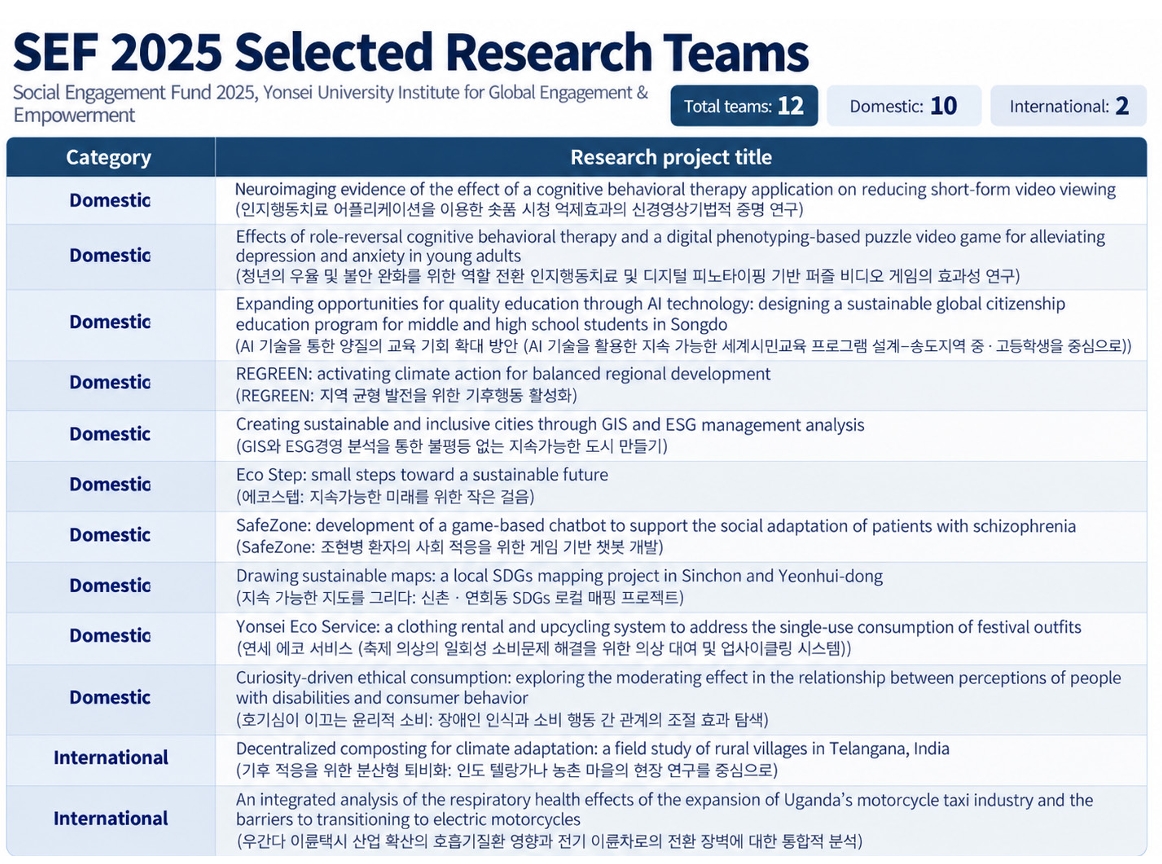
Figure & Data
References
Citations
Citations to this article as recorded by 
 PubReader
 ePub Link
 Cite
 XML Download