IGEE

Articles
- Page Path
- HOME > IGEE Proc > Forthcoming articles > Article
-
Article
Climate Action for Balanced Regional Development: Exploratory Youth Preferences for Renewable Energy Policy Using Conjoint-Informed Scenario Ratings - Sujin Kim*, Dain Jin, Sihyun Jung
-
DOI: https://doi.org/10.69841/igee.2026.021
Published online: October 20, 2026
Yonsei University, Seoul, Korea
- *Corresponding author: Sujin Kim, E-mail: aknsg05@yonsei.ac.kr
© 2026 by the authors.
Submitted for possible open-access publication under the terms and conditions of the Creative Commons Attribution (CC BY) license (http://creativecommons.org/licenses/by/4.0/).
- 178 Views
- 5 Download

Abstract
-
Background
- Korea's Renewable Energy 3020 Implementation Plan targeted a 20% share of power generation from new and renewable energy by 2030, yet such sources supplied only 10.6% of electricity in 2024. This implementation gap highlights social acceptance, community governance, and youth civic participation as important barriers alongside technology and finance. Quantitative evidence on which specific policy design attributes shape young Koreans' willingness to participate in renewable energy initiatives remains limited, and the mechanism by which educational engagement translates into pro-environmental behavioral choice has not been directly examined in this population.
-
Methods
- The study employed a two-phase sequential design. Phase 1 consisted of an on-site preliminary field study at the Yeongdeok Renewable Energy Exhibition Hall (November 2025), involving direct observation of operational infrastructure and structured engagement with local cooperative stakeholders to ground subsequent instrument development in real-world context. Phase 2 was a one-group pre-post quasi-experimental online pilot study (N = 50, ages 18-29) in which participants completed a five-stage integrated protocol: a baseline awareness survey, a 15-minute educational video, four gamified learning modules linked to an Energy Coin (E.C.) reward system, a simulated cooperative online market transaction under experimentally induced point-budget constraints, and a post-survey incorporating an exploratory conjoint-informed scenario-rating task across six policy scenarios defined by four attributes (installation location, economic benefit type, participation mechanism, and governance structure). The six profiles are reported explicitly and treated as a burden-reduced profile set for main-effect exploration rather than a fully orthogonal conjoint design. Sample size was determined via G*Power 3.1 analysis of the paired awareness comparison (93% power at n = 50 for a medium within-person effect); the same n is not sufficient for regression-based attribute modelling, so the attribute results are reported as exploratory.
-
Results
- Renewable energy awareness increased significantly from M = 4.2 to M = 5.7 on a 7-point scale (t(49) = 8.34, p < 0.001, Cohen's d = 1.18). Because the six-profile set cannot identify a full dummy-coded specification, attribute effects are reported as marginal means. Governance structure showed the widest spread (design-dependent relative importance 47.8%; cooperative joint ownership M = 5.69 vs. expert-managed M = 3.92, Δ = +1.77, 95% CI [1.27, 2.26]), followed by economic benefit (26.0%) and installation location (22.2%, Δ = +0.82 for farmland/idle land, 95% CI [0.37, 1.27]); the six scenario profiles accounted for 24.9% of the total variance in ratings (η² = 0.25). Participation mechanism accounted for 4.1% and was not significant; inferential claims are treated cautiously because ratings were repeated within participants, the profile set was small and nonorthogonal, and preferences were measured immediately after the educational intervention. In the only pair of scenarios that differed on governance structure alone (S6 vs. S4), the cooperative joint-ownership profile was rated 1.59 points higher than the expert-managed profile (95% CI [1.08, 2.10]). Energy Coin accumulation was associated with ecofriendly product selection (r = 0.42, 95% CI [0.16, 0.63], p = 0.002), although this association is descriptive because the same E.C. score also determined participants' simulated purchasing budget.
-
Conclusion
- Governance architecture emerged as the strongest observed preference signal among these young Korean university participants, but the finding should be interpreted as exploratory and post-intervention rather than as a stable national estimate for Korean youth. A two-phase design combining field exposure with gamified online simulation was associated with large immediate awareness gains and simulated pro-environmental choice under explicit point-budget tradeoffs, offering a scalable evidence-generating approach for youth-centered climate policy research while requiring replication with more diverse regional and socioeconomic samples.
- Korea's energy transition confronts a structurally revealing paradox. The country has pledged carbon neutrality by 2050 and, under the Renewable Energy 3020 Implementation Plan, targeted a 20% renewable share by 2030; however, new and renewable energy sources supplied only 10.6% of electricity in 2024, up from 4.99% in 2018 and crossing the 10% threshold for the first time (International Energy Agency, 2020; Korea Energy Agency, 2024). The trajectory is positive, but the gap between policy ambition and implementation reality remains substantial, and it cannot be closed by technology deployment and capital investment alone. A convergent body of interdisciplinary research points to a more intractable constraint: the absence of structured, community-level social acceptance for the infrastructure that energy transition demands.
- This distinction is consequential. Renewable energy projects-particularly wind installations and distributed solar-are uniquely vulnerable to forms of community resistance that differ in character from opposition to conventional energy infrastructure. Rather than objecting only on environmental grounds, communities often contest renewable projects on procedural and distributional grounds: concerns about who governs the project, who benefits from its revenues, and whether the terms of community engagement are genuine or performative. Wüstenhagen, Wolsink, and Bürer (2007) conceptualize renewable-energy acceptance across sociopolitical, community, and market dimensions, while Walker and Devine-Wright (2008) and Warren and McFadyen (2010) show that community ownership and local participation can shape public attitudes toward wind energy. From a behavioral perspective, Thaler and Sunstein (2008) further demonstrate that choice architecture-the way options are framed, structured, and presented-can shape engagement independently of objective policy content.
- Young people aged 18–29 occupy a theoretically central but empirically underexamined position in this landscape. As the cohort that will bear the preponderance of long-term climate consequences, constitute the future labor force of the green economy, and be called upon to sustain political legitimacy of the energy transition across multiple decades, their preferences are not merely demographically interesting—they are a policy-critical input whose absence from the evidence base represents a genuine gap in governance quality. Yet despite the proliferation of youth-oriented climate communication campaigns, Korean research on which specific dimensions of renewable energy policy design resonate most strongly with young people—and how educational interventions translate into behavioral choice rather than mere attitude change—remains thin.
- In this study, balanced regional development is used in a specific operational sense: renewable energy policy designs are considered regionally balanced when they distribute economic, participatory, and symbolic benefits to non-metropolitan communities that host or support energy infrastructure. This concept is operationalized through the installation-location attribute (where infrastructure is placed), the economic-benefit attribute (how material benefits are distributed), the governance-structure attribute (who holds decision authority), and the cooperative market's regional products and Development Fund surcharge (how value circulates back to local communities).
- This study addresses that gap through REGREEN (Regional Equity for GREEN Action), a student-led research initiative at Yonsei University. The project employed a two-phase design: Phase 1 was a preliminary field study at the Yeongdeok community energy cooperative, designed to ground the research team's understanding of real-world cooperative governance before instrument construction; Phase 2 was an online simulation study incorporating educational video content, four game-based learning modules, a cooperative market with simulated cost constraints, and a conjoint-informed scenario-rating survey. The study pursues four research objectives:
- (1) to describe the design-dependent relative importance of four policy attributes-installation location, economic benefit type, participation mechanism, and governance structure-in shaping willingness to support renewable energy initiatives among the recruited pilot sample;
- (2) to assess whether a structured, gamified educational intervention produces measurable pre-post change in renewable energy awareness;
- (3) to examine whether educational engagement, operationalized through game performance and E.C. accumulation, is associated with pro-environmental behavioral choice in a simulated cooperative market; and
- (4) to derive evidence-informed hypotheses for youth-oriented renewable energy policy in the Korean context rather than definitive national policy prescriptions.
- Consistent with the pilot character of the project, the empirical claims are framed as exploratory and hypothesis-generating. The study estimates post-intervention preference patterns among a small, digitally recruited university sample rather than making definitive claims about all Korean youth. This framing is important because the Phase 2 sample is geographically concentrated in the Seoul metropolitan area, the ratings were collected after-not before-the educational intervention, and the Yeongdeok cooperative case may have made cooperative governance especially salient.
- The theoretical contribution of this study is threefold. First, it adapts conjoint logic-well established in consumer choice, stated-preference, and political survey research-to a youth-focused energy policy context in Korea while explicitly acknowledging that the six-profile design cannot support full conjoint inference (Green & Srinivasan, 1990; Hainmueller, Hopkins, & Yamamoto, 2014; Louviere, Hensher, & Swait, 2000). Second, it operationalizes the attitude-behavior gap not through self-report intention scales alone but through a simulated point-budget market transaction, offering a behaviorally richer proxy than conventional survey items while not equating the task with real market behavior. Third, it tests whether gamified climate education is associated with immediate awareness change and simulated downstream choice within a single integrated session, moving beyond awareness measurement to capture explicit trade-offs under simulated cost premiums.
1. Introduction
- Materials
- The REGREEN research infrastructure consisted of four integrated components. The primary digital interface was a custom browser-based web application (https://fullhqkb.gensparkspace.com) developed by the REGREEN team, hosting game modules, the cooperative market, and the participant progress dashboard. Survey instruments were administered via Google Forms (baseline and post-survey), chosen for compatibility across device types used by participants accessing the protocol remotely. The central educational component was a narrated, slide-based video of approximately 15 minutes, developed from publicly available sources and the REGREEN team's Phase 1 field documentation from Yeongdeok. External data sources included the IEA policy description of Korea's Renewable Energy 3020 Plan, 2024 Korean power-generation statistics reported by the Korea Energy Agency from Ministry of Trade, Industry and Energy data, the Global Carbon Budget 2024, United Nations SDG documentation, and Korea's 2050 Carbon Neutral Strategy (Friedlingstein et al., 2025; Government of the Republic of Korea, 2020; International Energy Agency, 2020; Korea Energy Agency, 2024; United Nations, 2015). Video content covered: the definition and typology of renewable energy sources; Korea's current energy mix and policy trajectory toward the 2030 renewable target; global fossil CO2 emissions projected at approximately 37.4 GtCO2 in 2024 and total anthropogenic CO2 emissions projected at approximately 41.6 GtCO2; SDG 7 (Affordable and Clean Energy) and SDG 13 (Climate Action); and a 5-minute documentary case study of the Yeongdeok community wind energy cooperative, drawing directly on field observations and stakeholder interviews conducted in Phase 1. Phase 1 fieldwork materials included structured observation protocols, semi-structured interview guides used with cooperative managers and local school partners, and participant briefing materials for the workshop. These Phase 1 materials informed both the Yeongdeok case study content in the educational video and the formulation of the governance attribute levels in the scenario-rating design, ensuring that the cooperative and resident co-management levels reflected institutional arrangements encountered in the field rather than purely abstract constructs.
- Methods
- The study was organized into two sequential participant groups corresponding to the two phases. Phase 1 — Yeongdeok Field Study (29 November 2025): A convenience sample of 17 university-affiliated participants (four REGREEN team members and 13 affiliated university students; n = 17) attended the on-site workshop at the Renewable Energy Exhibition Hall in Yeongdeok, North Gyeongsang Province. All 17 Phase 1 participants were university-affiliated members of the project network; cooperative managers, local school representatives, and a local social-enterprise partner took part as stakeholder informants in structured conversations with the research team, not as study participants. The workshop served a dual function:
- (a) as an experiential pre-study for the research team to calibrate the policy attribute levels against real-world cooperative governance structures encountered at the site, and
- (b) as a pilot run of the educational materials in a face-to-face setting. No scenario-rating data were collected in Phase 1, and no Phase 1 data enter the Phase 2 analyses. Phase 1 data consisted of (i) a pilot administration of the five pre- and post-awareness items to the 17 participants, (ii) pilot runs of the four game modules and an in-person version of the market task in which participants allocated E.C. to physically labelled products, and (iii) qualitative field notes and stakeholder interview records. The pilot survey and market data are reported descriptively in the Results; the field notes and interview records produced a refined understanding of how community energy cooperatives operate in practice that directly informed Phase 2 instrument development. Field notes were reviewed by the research team and organized by consensus into four practical themes: governance transparency, benefit-sharing, educational accessibility, and regional circulation of value. Because formal independent coding and inter-coder reliability checks were not conducted, Phase 1 is reported as a structured qualitative pilot rather than as a stand-alone qualitative study.
- Phase 2 - Online Platform Study (N = 50): Fifty participants (Table 1) were enrolled via a two-stage recruitment and screening process; recruitment and data collection took place between 13 and 31 December 2025. Stage one involved public posting through the Yonsei University Everytime application, departmental mailing lists, Instagram, and Facebook via the REGREEN team's official accounts. Stage two applied a structured screening form to verify:
- (a) age between 18 and 29 years;
- (b) Korean language proficiency sufficient for survey and game instructions;
- (c) absence of academic or professional specialization in renewable energy or energy policy, to minimize systematic prior knowledge bias;
- (d) no participation in an energy policy study within the previous six months; and
- (e) absence of physical or cognitive barriers to computer-based game participation. Instructor-affiliated classes were excluded from recruitment to minimize researcher-participant power imbalances. All participants provided informed consent via an online checkbox acknowledgment after reading a standardized digital participant information sheet; participation was voluntary; data were stored anonymized and separately from identifying information.
- The resulting sample should be understood as a purposive pilot sample of digitally active university-age participants, not as a probability sample of Korean youth. This distinction is carried through the analysis and discussion: effect sizes and preference rankings are reported as internally informative patterns requiring external validation rather than as nationally representative estimates.
- Sample size justification: The target of 50 participants was set with reference to a power analysis conducted in G*Power 3.1 (Faul, Erdfelder, Lang, & Buchner, 2007) for the study's confirmatory outcome, the paired pre-post awareness comparison. In the initial submission the sample-size justification was anchored to the regression-based attribute model; because the six-profile design does not identify that model and the attribute analysis is reported as exploratory marginal means, the justification has been re-anchored to the paired awareness comparison, the only inferential test the design was powered to support, and the regression-based calculation is retained below for transparency. For a two-tailed paired-samples t-test with α = 0.05 and a medium within-person effect (d = 0.50), n = 34 is required for 80% power and n = 50 provides 93% power. The same n is not sufficient for a regression-based attribute model: with four predictors, α = 0.05 and f² = 0.15, 80% power would require n = 85, and power at n = 50 is 0.52. This asymmetry is stated explicitly rather than smoothed over, and it is the reason the attribute-level results are framed as exploratory throughout. The calculation likewise does not establish that six policy profiles are sufficient for fully orthogonal conjoint estimation, interaction testing, or subgroup analysis. Rather, N = 50 should be understood as adequate for an initial exploratory platform test and immediate pre-post awareness analysis, while the scenario-rating coefficients remain design-dependent. A maximum recruitment ceiling of 60 was set to buffer against an anticipated 15-20% attrition rate typical of online behavioral research. The achieved 100% completion rate rendered attrition analysis moot, though the protocol included pre-specified criteria for identifying and excluding inattentive respondents based on response-time flags and game abandonment rates.
- Four categories of measures were employed across the protocol.
- (1) Renewable energy awareness was assessed at baseline and post-intervention using a five-item composite scale administered on a 7-point Likert scale. Items included: "How important do you consider renewable energy for Korean society?"; "How much do you currently know about renewable energy?"; "How interested are you in eco-friendly products and services?"; "Do you believe renewable energy can realistically address climate change?"; and "How willing would you be to support a renewable energy project in your local area?" The composite score was the mean across items (Cronbach's α = 0.81 at baseline, indicating good internal consistency).
- (2) Game performance was operationalized as total Energy Coins (E.C.) accumulated across the four modules (theoretical range: 200–800 E.C.), with performance-linked E.C. tiers calibrated per game as specified below. E.C. served dual analytical functions: it indexed educational engagement as a continuous variable for correlation analysis, and it constituted the point-budget constraint in the Stage 4 cooperative market, creating experimentally induced scarcity that approximated real purchasing tradeoffs.
- (3) Cooperative market behavior was automatically logged by the platform, capturing: product category selected (eco-friendly, general, or regionally-produced); proportion of total E.C. allocated to each category; and binary acceptance of the Green Tax surcharge (eco-friendly items) and Development Fund surcharge (regional items). The primary behavioral outcome was a binary variable: eco-purchase = 1 if at least one eco-friendly product was selected, 0 otherwise. Because E.C. were in-platform points, the outcome is interpreted as simulated cost-bearing choice rather than verified real-world purchase behavior.
- (4) Policy scenario preference was the dependent variable in the conjoint-informed scenario rating analysis: a 1–7 willingness-to-participate rating (1 = "Would not participate at all"; 7 = "Would participate very actively") for each of six policy scenarios. Because each respondent rated all six scenarios, these observations were analyzed as repeated measures rather than as independent observations.
- The study was organized as a sequential two-phase design in which Phase 1 qualitative field observations informed Phase 2 instrument construction, and Phase 2 employed a one-group pre-post quasi-experimental design within a five-stage integrated protocol. The logic model framing the overall inquiry is: Input (Phase 1 field knowledge + Phase 2 educational video + four game modules + cooperative market) → Process (sequential engagement with escalating cognitive and behavioral demands, building from awareness through knowledge to consequential choice) → Output (conjoint preference structure + pre-post awareness gain + behavioral market choice data) → Outcome/Impact (evidence base for youth-centered renewable energy policy redesign in Korea).
- Phase 1 - Yeongdeok Field Study: On 29 November 2025, the research team conducted a structured site visit and workshop at the Renewable Energy Exhibition Hall in Yeongdeok, North Gyeongsang Province. The visit included: guided observation of operational wind turbine infrastructure and photovoltaic installations; semi-structured conversations with cooperative managers regarding benefit-sharing mechanisms, governance structures, and community engagement history; and structured meetings with representatives from Yeongdeok middle and high schools and from Cafe BOUM, a local social enterprise that collaborates with the cooperative. The field observations served two functions for Phase 2. First, they grounded the "cooperative joint ownership with transparent management" governance attribute level in observed institutional practice-the Yeongdeok cooperative's resident board, transparent revenue accounts, and annual community meetings provided the practical template. Second, the Yeongdeok case study embedded in the Phase 2 educational video was documented during this visit, ensuring the educational content reflected verifiable, on-the-ground conditions rather than idealized descriptions.
- Phase 2 — Online Platform Protocol: The five-stage online protocol was designed as a sequential engagement funnel (Table 2), where each stage deepened participants' cognitive and affective engagement with renewable energy while generating distinct categories of analytical data.
- Stage 3 — Gamified Learning Modules: Four sequential browser-based games were administered, each designed to operationalize a distinct educational or behavioral construct:
- ● Game 1 (Knowledge Quiz): A 20-item multiple-choice quiz modeled on the Kahoot platform format (20-second time limit per item; four answer options), assessing comprehension of the educational video content across domains: renewable energy definitions, Korea's energy statistics, the SDG framework, global carbon emissions, and the Yeongdeok cooperative model. Reward tiers: 18–20 correct → 200 E.C.; 15–17 → 150 E.C.; 12–14 → 100 E.C.; ≤11 → 50 E.C. Construct measured: knowledge acquisition and video comprehension.
- ● Game 2 (Precision Timer): A browser-based timer task requiring participants to stop a running clock at precisely 60.00 seconds (maximum 90 seconds before auto-termination). This game carried no content-specific renewable energy dimension; its inclusion was motivated by the need to measure executive attention and temporal self-regulation—cognitive constructs associated with the quality of sustained learning engagement—while maintaining participant arousal during what might otherwise be a monotonic survey session. Reward tiers: deviation ≤ 0.05s → 200 E.C.; ≤ 0.15s → 150 E.C.; ≤ 0.30s → 100 E.C.; otherwise → 50 E.C.
- ● Game 3 (Turbine Matching Puzzle): A 30-second visual matching task pairing six wind turbine image types (blade-type, paddle-type, cross-flow, Dutch, Darrieus, and propeller) with their correct labels. Construct measured: technical domain recognition and visual knowledge consolidation. Reward tiers: 6 correct → 200 E.C.; 5 → 150 E.C.; 4 → 100 E.C.; ≤3 → 50 E.C.
- ● Game 4 (Solar Car Racing): A 3D mouse-tracking racing game in which a solar-powered vehicle follows the participant's cursor around an obstacle course; completion time was automatically recorded. Construct measured: hand-eye coordination, sustained attention, and hedonic engagement—included explicitly to maintain motivational state and assess subjective enjoyment as a secondary construct relevant to platform replicability. Reward tiers: ≤10s → 200 E.C.; ≤12s → 150 E.C.; ≤15s → 100 E.C.; ≤18s → 50 E.C.
- Stage 4 — Cooperative Market Transaction: Participants accessed a simulated cooperative market interface populated with three product categories, each priced in E.C.:
- (a) eco-friendly products, carrying a "Green Tax" surcharge—a deliberate simulation of the price premium associated with sustainably produced goods and a proxy for carbon pricing tradeoffs;
- (b) regionally-produced goods from Yeongdeok and North Gyeongsang, carrying a "Development Fund" surcharge simulating the localized revenue-sharing premium of cooperative market structures; and
- (c) general products without surcharge. The E.C. budget was bounded by Stage 3 performance, creating a simulated scarcity constraint. All transactions were server-logged automatically.
- Stage 5 — Post-Survey: Survey A presented six policy scenarios constructed from the attribute levels in Table 3 (Table 4) and asked participants to rate each on the 1–7 willingness-to-participate scale. The scenario set was a burden-reduced profile set selected from the full 3^4 profile universe to preserve respondent attention in a 45–55-minute online protocol; it was not intended to estimate interaction effects or stable population-level part-worth utilities. Survey B measured: game learning effectiveness (1–7); game engagement (1–7); cooperative market satisfaction (five items, 1–7); and future research participation intent (binary Yes/No).
- Design generation and constraints: The profile design began with the 3^4 = 81 possible combinations of location, economic benefit, participation mechanism, and governance structure (Table 3). Six profiles were retained for the online pilot to minimize fatigue after the video and game modules and to retain ecological plausibility based on Phase 1 field observations. The exact retained profiles are reported in Table 4 to make the design transparent and replicable. However, a six-profile design cannot achieve full orthogonality for four three-level attributes, cannot support interaction estimates, and cannot identify causal average marginal component effects in the sense of fully randomized conjoint experiments (Hainmueller et al., 2014). Several features of the retained set should be borne in mind when reading the attribute-level results, because the effects of some attributes cannot be separated from one another within this design: the reference level of participation mechanism (information sessions only) does not appear in any retained profile; open, continuous participation occurs in exactly the profiles in which resident youth co-management occurs (S1–S3), so those two levels cannot be separated; expert management appears only in S4; and the reference levels of installation location (residential/campus vicinity) and economic benefit (electricity bill discount) both appear only in S3, so those two reference levels are confounded with each other. S6 and S4 are the only pair of profiles that differ on a single attribute (governance structure), and that contrast is therefore reported separately in the Results. Consequently, the estimates below are reported as exploratory, design-dependent rating contrasts rather than conclusive part-worth utilities, and the participation coefficients in particular should be read as descriptive of the profile set rather than as isolated attribute effects.
- Five analytical procedures were employed, organized from descriptive to inferential.
- Descriptive statistics: Frequency distributions and percentages were computed for demographic variables; means, standard deviations, and ranges were computed for game performance and scenario preference scores.
- Conjoint-informed scenario-rating analysis (primary exploratory analysis): Attribute effects were estimated as marginal means rather than as dummy-coded regression part-worths. For each attribute level, the marginal mean is the mean willingness-to-participate rating across the scenarios that contain that level, averaged over participants, and is computed from the same pooled dataset (50 participants x 6 scenarios = 300 observations). This estimator was chosen because a full main-effects specification for four three-level attributes requires nine parameters (an intercept plus eight level indicators), whereas the six retained profiles span only six independent design points; a dummy-coded regression is therefore not identified, and marginal means are the recommended quantity when reference-category-dependent estimates would be unstable or undefined (Leeper, Hobolt, & Tilley, 2020). Standard errors follow a deliberately conservative convention: the standard deviation used for a level spanning k scenarios is the mean of those scenarios' standard deviations, an upper bound on the standard deviation of the participant-level average whenever the within-person correlation is non-negative. Contrasts between levels use the corresponding independent-samples standard error, which likewise overstates the paired standard error under non-negative within-person correlation (the pre-post data imply r = 0.45), so the reported confidence intervals and p-values are conservative bounds. The resulting quantities are descriptive of the observed profile set; they are not stable population-level part-worth utilities or causal average marginal component effects. The design-dependent relative importance (RI) for attribute k was calculated as:
- where
- Repeated-measures adjustment: Because each participant rated all six profiles, the ratings are repeated measures. The conservative standard-error convention described above is applied throughout, and the omnibus test of between-profile differences treats observations as independent, which is a lower bound on the corresponding within-subjects test when ratings are positively correlated within person. This adjustment addresses within-person correlation but does not overcome the limited number of unique profiles or the absence of a fully randomized orthogonal profile design.
- Pre-post awareness comparison: A paired-samples t-test (two-tailed, α = 0.05) was used to assess statistical significance of composite awareness change from pre- to post-intervention.
- Correlation analysis: The point-biserial Pearson correlation coefficient (r) between total E.C. score (continuous) and the binary eco-purchase variable was computed. A partial correlation was additionally computed controlling for age and gender to assess robustness of the association to demographic confounds. Because E.C. score also determined the simulated purchasing budget, this association is treated as descriptive rather than causal evidence that learning independently produced eco-purchase.
- All analyses were conducted in R (version 4.3.2), including the marginal-mean estimates and the variance decomposition; supplementary descriptive checks were performed in SPSS 25.0. Statistical significance was set at α = 0.05 throughout.
- This study was conducted in two phases. Phase 1 (the Yeongdeok field study) consisted of preliminary fieldwork and a face-to-face pilot run of the study materials with 17 university-affiliated participants (four REGREEN team members and 13 affiliated university students), carried out on 29 November 2025 as a precursor to the online pilot protocol. Phase 2 (the online platform study) involved human participants. Phase 2 recruitment and data collection took place from 13 December 2025 to 31 December 2025. An application for ethical review (No. 202601-HR-5140-01), comprising a research protocol, recruitment materials, informed-consent language, and risk-management procedures, was submitted to the Yonsei University Institutional Review Board in December 2025, during the Phase 2 data-collection period, but approval had not been obtained when data collection began. The Board requested successive revisions to the application, and after those revisions it was ultimately returned without approval because the Phase 2 data had already been collected. The Phase 2 data reported here therefore have no IRB approval, and none is claimed; this procedural limitation should be considered when interpreting the findings as student-led, minimal-risk pilot evidence. Participants received a digital information sheet, provided online checkbox consent before any survey or platform activity, participated voluntarily, could withdraw without penalty, and had their responses anonymized and stored separately from identifying information. Future confirmatory replications should secure IRB approval before recruitment and should report the approval number, approval date, and data-collection window.
2. Materials and Methods
1) Participants
2) Measures
3) Study Model
4) Analysis
- Demographic Characteristics
- The Phase 2 analytical sample of 50 participants was consistent with the recruited population of digitally active Korean university students aged 18–29, but not representative of Korean youth as a whole (Table 1). The sample was majority female (56%), predominantly in the 18–22 age range (62%), and drawn overwhelmingly from the Seoul metropolitan area (90%). Business, economics, and social sciences constituted the most common disciplinary background (48%). The deliberate exclusion of energy-related majors produced a sample with a mean pre-intervention awareness score of 4.2 (SD = 1.3)—consistent with general-public familiarity rather than domain expertise, validating the screening procedure's effectiveness. The 100% five-stage protocol completion rate is substantively noteworthy given the 45–55 minute total time commitment and the voluntary, uncompensated nature of participation, and suggests the sequential engagement design was effective in sustaining motivation across all stages within this recruited sample.
- The Phase 1 Yeongdeok pilot cohort (n = 17) was by design a convenience sample of four REGREEN team members and 13 affiliated university students who travelled to the site, as described in the Methods; it skewed older (mean age 23.4 vs. 21.8 in Phase 2), had a higher proportion of participants with prior community-level renewable energy exposure, and produced ceiling effects on several awareness items (pre-intervention mean = 4.9 on the composite; Table 5). These characteristics confirm that Phase 1 served its intended purpose as an ecologically rich experiential pilot rather than as a representative sampling frame, and justify the decision to analyze Phase 1 data separately from the primary conjoint and behavioral analyses.
- Phase 1: Yeongdeok Field Study — Qualitative and Pilot Findings
- The Yeongdeok session yielded three categories of findings that directly informed the design refinements implemented before Phase 2. First, participants consistently identified the cooperative governance model of the Yeongdeok facility as its most distinctive and resonant feature, spontaneously contrasting it with hypothetical expert-managed alternatives during structured discussion. This qualitative signal—that governance architecture may generate a stronger affective response than economic benefit structure—was subsequently operationalized as a distinct attribute in Phase 2, where governance structure showed the widest spread of marginal means in the exploratory scenario-rating analysis; the correspondence offers informal, post-hoc triangulation between the field-grounded impression and the quantitative pattern rather than independent confirmation.
- Second, pilot testing of the Knowledge Quiz (Game 1) identified three items with ambiguous phrasing that produced response distributions inconsistent with expected difficulty gradients; these items were revised before Phase 2 deployment. Similarly, pilot participants in the Turbine Matching Puzzle (Game 3) consistently reported confusion between the Darrieus and cross-flow turbine images at the resolution used; image quality was upgraded before Phase 2.
- Third, the in-person market transaction component piloted in Yeongdeok—where participants physically handled product labels before making E.C. allocation decisions—produced qualitatively richer verbal explanations of product choice than the online interface. While the online format necessarily sacrifices tactile engagement, the Green Tax and Development Fund pricing mechanisms were calibrated based on the price sensitivity patterns observed in the Yeongdeok pilot to ensure that the surcharges were large enough to constitute a real cost signal without being so prohibitive as to eliminate variation in eco-purchase rates.
- Phase 2: Online Platform Study
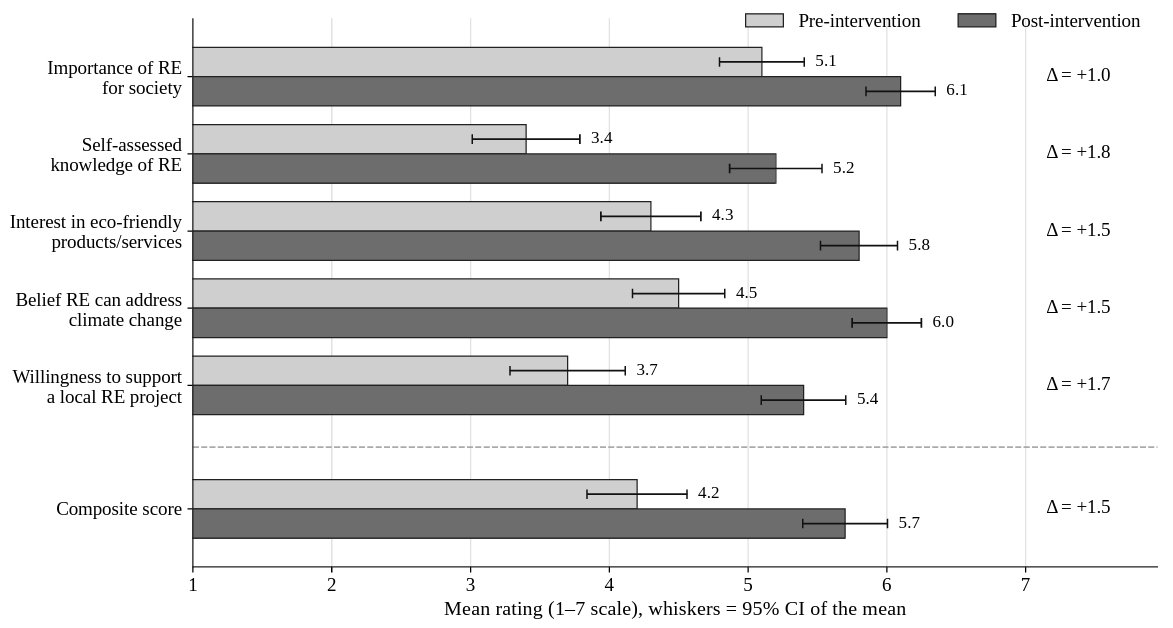
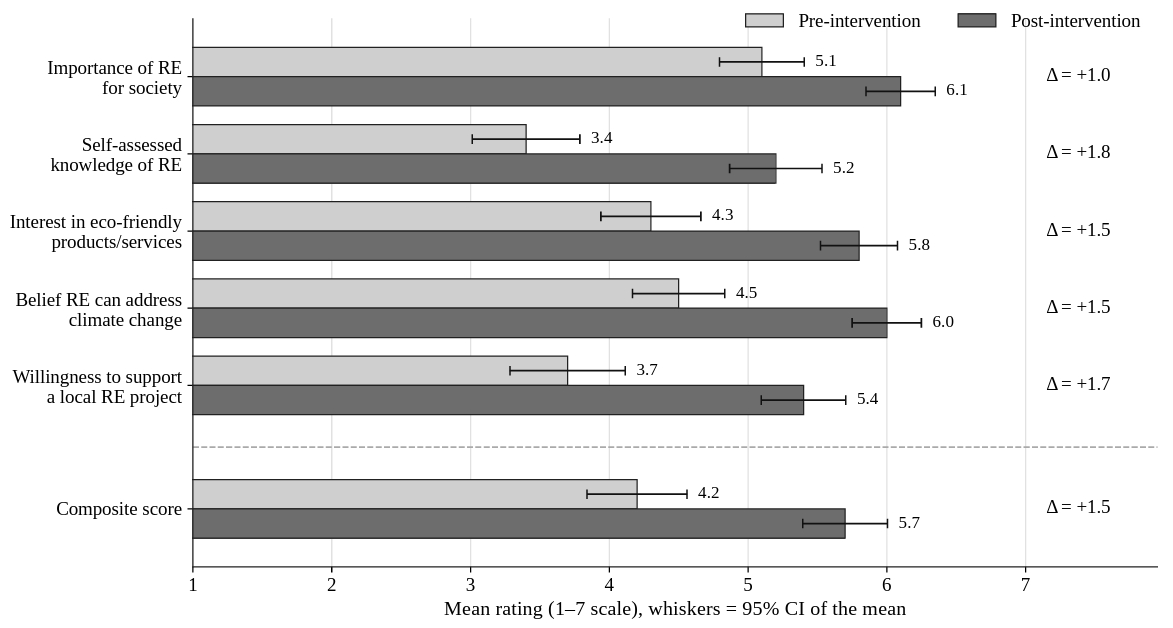
- The paired-samples t-test revealed a statistically significant increase in composite renewable energy awareness from M = 4.2 (SD = 1.3) at baseline to M = 5.7 (SD = 1.1) post-intervention (t(49) = 8.34, p < 0.001, Cohen's d = 1.18). A Cohen's d of 1.18 constitutes a large within-person change by conventional benchmarks (Cohen, 1988) and is consistent with literature suggesting that gamification can support cognitive and motivational learning outcomes, although effects vary by design and outcome type (Douglas & Brauer, 2021; Sailer & Homner, 2020). The 1.5-point absolute gain represents a 21.4% improvement relative to the 7-point scale maximum and is consistent in magnitude with the 1.2-point gain observed in the smaller Phase 1 Yeongdeok cohort. Because no randomized control group or delayed follow-up was included, this result should be interpreted as an immediate post-intervention awareness gain rather than evidence of durable attitude change.
- Item-level analysis revealed meaningful variation in the distribution of gains (Table 6, Figure 1). Self-assessed knowledge ("How much do you currently know about renewable energy?") showed the largest absolute gain (Δ = +1.8), consistent with the content-specific nature of the educational video targeting factual knowledge gaps. The behavioral intention item ("How willing would you be to support a local RE project?") showed the second largest gain (Δ = +1.7), consistent with, though not demonstrating, a translation of knowledge acquisition into motivational change within the same session. The smallest gain was observed for the broad societal importance item (Δ = +1.0), consistent with ceiling effects on a value that participants already rated relatively high at baseline (M = 5.1 pre-intervention).
- The four game modules produced distinct performance distributions reflecting their different cognitive demands (Table 7). The Knowledge Quiz (Game 1) showed the widest variance in E.C. outcomes, with a bimodal distribution concentrated at the 150 E.C. (15–17 correct, 34%) and 200 E.C. (18–20 correct, 28%) tiers, indicating that most participants demonstrated substantive video comprehension. The Precision Timer (Game 2) showed a more uniform distribution across tiers, reflecting the task's dependence on individual temporal self-regulation capacity rather than learned content. The Turbine Matching Puzzle (Game 3) produced the highest ceiling performance, with 42% of participants achieving the maximum 200 E.C. tier (6/6 correct), likely reflecting the visual distinctiveness of turbine types following the educational video. The Solar Car Racing Game (Game 4) produced the most right-skewed distribution, with 24% of participants achieving the top tier (≤10 seconds), reflecting heterogeneity in fine motor coordination. The composite E.C. score across all four games ranged from 200 to 800, with a sample mean of 554 E.C. (SD = 112), the sum of the four tier-weighted per-game means (139, 126, 154, and 135 E.C.).
- Of the 50 participants, 38 (76%) voluntarily selected at least one eco-friendly product in the simulated cooperative market despite the Green Tax surcharge (Table 8). An additional 18 participants (36%) selected at least one regionally-produced product carrying a Development Fund surcharge, and 12 participants (24%) - the complement of the eco-purchasing group - chose general products exclusively. Mean expenditure was 435 E.C. per participant, or 78.5% of the 554 E.C. earned on average, indicating that the point budget operated as a binding but not exhaustive constraint. The result is substantively interesting because research on renewable-energy adoption documents that supportive attitudes do not always translate into cost-bearing behavior when barriers and reasons against adoption are introduced (Claudy, Peterson, & O'Driscoll, 2013). However, the current market used in-platform E.C. rather than externally verified monetary transactions; therefore, the outcome should be interpreted as a simulated trade-off under point-budget scarcity, not as evidence of actual consumer purchasing behavior.
- The point-biserial correlation between total E.C. score (game performance composite) and eco-purchase was r = 0.42 (95% CI [0.16, 0.63], p = 0.002). This relationship remained significant after controlling for age and gender in partial correlation analysis (r_partial = 0.39, p = 0.006), indicating that the association is not explained by these two demographic variables. At the same time, higher E.C. performance mechanically increased the participant's simulated purchasing capacity, so the correlation cannot be interpreted as an independent causal effect of learning on eco-purchase. Notably, the correlation was stronger for Game 1 (Knowledge Quiz) performance alone (r = 0.38, p = 0.006) than for the precision and motor coordination games (Game 2, r = 0.19, p = 0.186; Game 4, r = 0.21, p = 0.143), which is consistent with-but does not prove-a content-learning pathway.
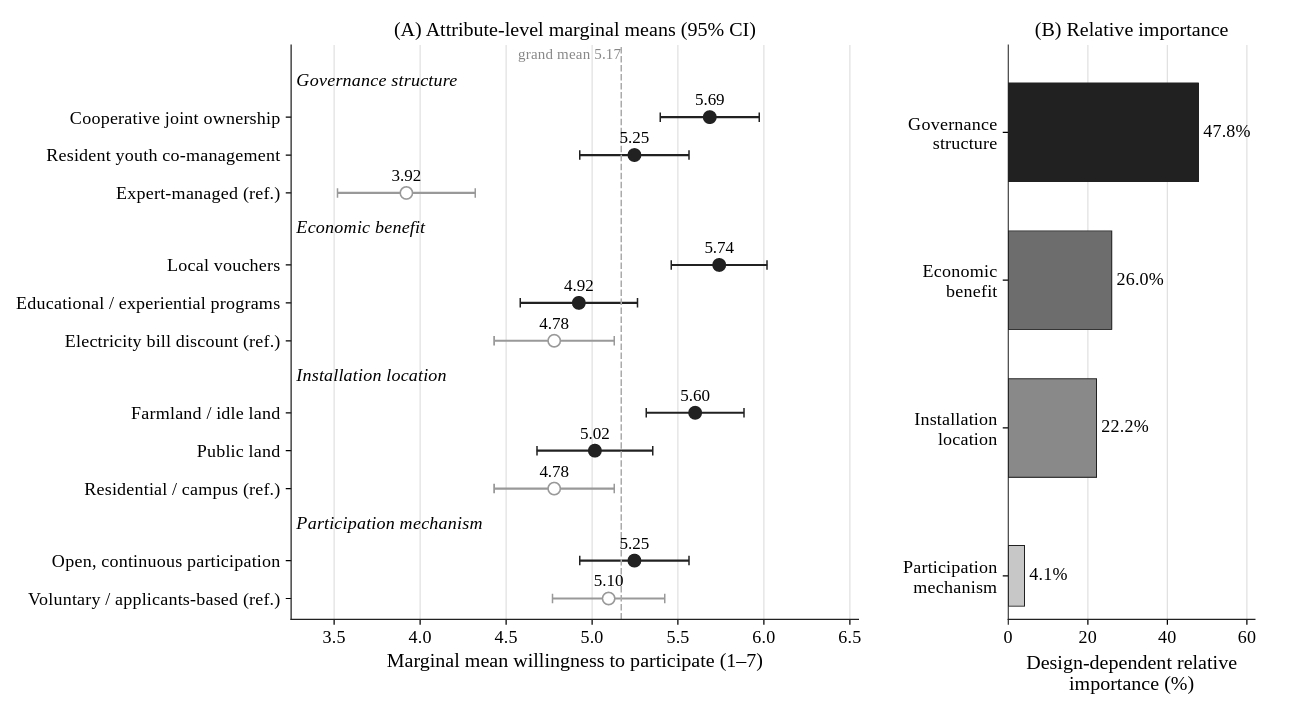
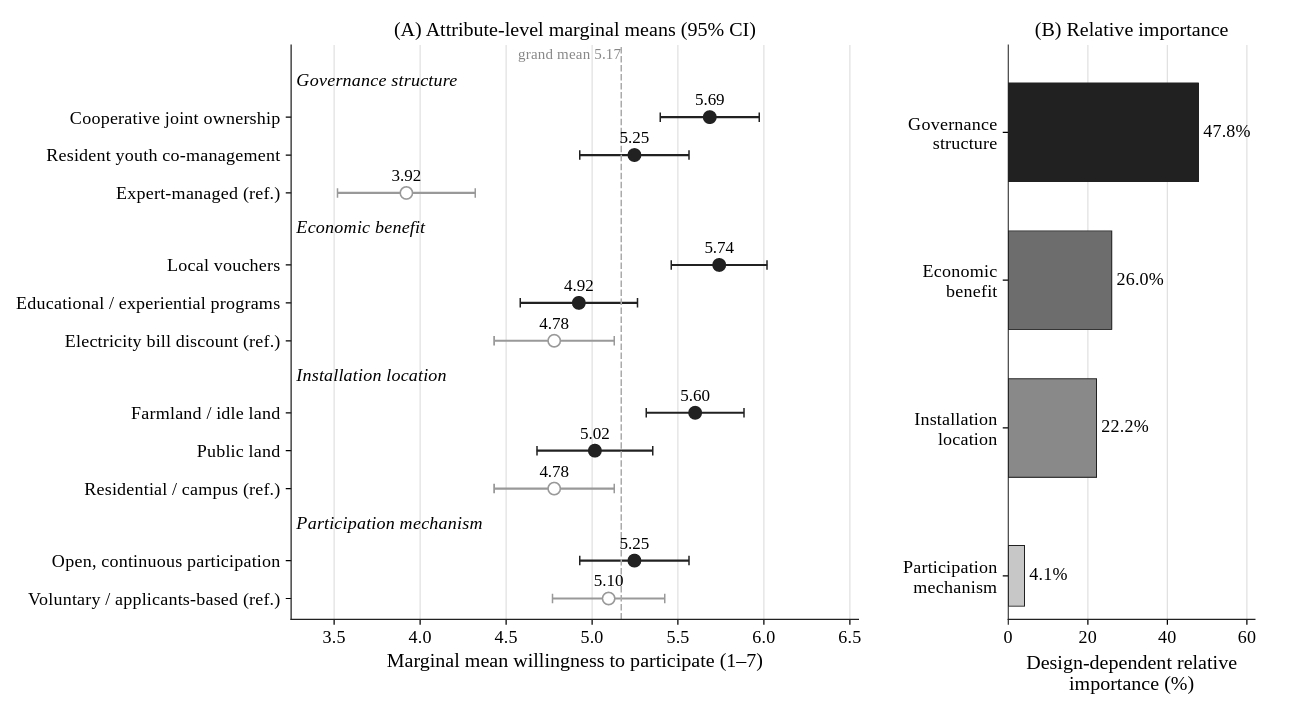
- The exploratory scenario-rating analysis (300 observations: 50 participants x 6 scenarios) shows that the six-profile structure accounts for 24.9% of the total variance in ratings (η² = 0.25; F(5, 294) = 19.45, p < 0.001), computed from the scenario-level means and standard deviations. Conservative standard errors were used because each participant rated all six profiles. Within this exploratory specification, governance structure produced the widest spread of marginal means and the largest design-dependent relative importance (Table 9, Table 10, Figure 2), and installation location and economic benefit produced intermediate spreads, whereas the participation-mechanism contrast that the design supports did not reach conventional significance.
- Figure 2 summarizes this pattern. In panel (A), the intervals for cooperative joint ownership, local vouchers, and farmland/idle land lie entirely above the grand mean of 5.17, the interval for the expert-managed reference level lies far below it, and the two participation-mechanism levels straddle it; panel (B) shows that governance structure accounts for nearly half of the summed attribute ranges, whereas participation mechanism contributes almost nothing. Three aspects of these results warrant specific, cautious interpretive attention because the six-profile design is exploratory. First, the governance structure attribute generates the widest spread of marginal means: within the observed profile set, scenarios featuring transparent cooperative governance averaged 1.77 scale points higher than the expert-managed reference level. That estimate rests on a single expert-managed scenario (S4), so it is more exposed to scenario-specific idiosyncrasy than the other attributes. The cleanest evidence available within the design is the comparison of S6 with S4, the only two profiles that differ on a single attribute: both place the installation on public land with educational/experiential benefits and voluntary participation, and they differ only in governance structure. S6 (cooperative joint ownership) was rated M = 5.51 (SD = 1.11) versus M = 3.92 (SD = 1.41) for S4 (expert management; Table 11), a difference of 1.59 scale points (95% CI [1.08, 2.10]; t(49) = 6.27, p < 0.001 under the same conservative convention). Because this contrast holds the other three attributes constant, it is not affected by the aliasing described in the Methods, although it still rests on a single pair of profiles rated after the educational intervention. This magnitude is substantively large in the pilot sample, but it should not be read as a nationally generalizable effect size or as a fully isolated counterfactual effect from changing a single attribute. Second, the participation-mechanism contrast that the design permits - open, continuous versus voluntary/applicants-based - is small and does not reach conventional statistical significance, and the third level of that attribute was never presented; its 4.1% relative importance should therefore be read as no evidence of an effect within the two levels tested rather than as evidence that participation format does not matter. Third, the design-dependent relative importance of economic benefit (26.0%) is meaningful but much smaller than governance (47.8%) and close to installation location (22.2%); the economic benefit and location spreads have overlapping confidence intervals and should be treated as comparable in this sample rather than rank-ordered. Within this pilot design, governance and spatial embedding warrant further testing as possible drivers of youth support rather than treating financial incentives as the sole policy lever.
- The 1.94-point gap between the highest-rated scenario (S5, M = 5.86) and the lowest (S4, M = 3.92) is descriptively instructive: S4 and S5 differ on governance structure, installation location, and economic benefit (both use voluntary participation), making the contrast suggestive of the importance of institutional design but not a controlled causal estimate. The large magnitude of this contrast—spanning the difference between a "moderate-to-strong" willingness level and a "neutral-to-reluctant" one—is consistent with the governance pattern in the rating-contrast model. The two cooperative joint-ownership scenarios occupy the first and third ranks (S5, S6), interleaved with the highest-rated resident-youth co-management scenario (S1); averaged over scenarios, cooperative joint ownership (M = 5.69) is rated above resident-youth co-management (M = 5.25), which in turn is rated above the expert-managed scenario (M = 3.92), consistent with a preference ordering within the observed profile set: full cooperative ownership > resident-youth co-management > expert management.
- Post-survey satisfaction data indicated a strongly positive reception to the gamified protocol. Participants rated game learning effectiveness at M = 5.4 (SD = 0.9) and game engagement at M = 5.7 (SD = 1.0) on the 7-point scale. Cooperative market satisfaction averaged 5.2 (SD = 1.1) across the five satisfaction items. Eighty-two percent of participants (41 of 50) indicated willingness to participate in a future similar research study—an uncommonly high re-participation intent rate that supports the platform's potential for longitudinal follow-up studies.
- Open-ended qualitative responses converged on three themes:
- (a) the Energy Coin mechanism was perceived as creating stake-like trade-offs, transforming the learning experience from purely performative to more consequential within the simulation;
- (b) the Yeongdeok cooperative case study embedded in the educational video was spontaneously identified by the largest number of respondents as influential in shaping governance preferences, which also means it may have primed cooperative governance before the rating task; and
- (c) several participants described the cooperative market transaction as "the first time I thought about what eco-friendly products actually cost," indicating that the Green Tax operationalization communicated the simulated price-premium dimension of sustainable consumption in a way that abstract survey items about willingness-to-pay typically do not.
3. Results
1) Pre-Post Awareness Change
2) Game Performance Distribution
3) Cooperative Market Behavior
4) Conjoint-Informed Scenario-Rating Results
5) Mean Willingness-to-Participate by Scenario
6) Post-Survey Platform Experience
- A Two-Phase Design as a Methodological Contribution
- Before turning to the substantive findings, the REGREEN project's two-phase sequential design warrants discussion as a methodological contribution in its own right. The integration of a real-world field study (Phase 1, Yeongdeok) with a scalable online platform deployment (Phase 2) addresses a persistent tension in policy preference research between ecological validity and statistical power. Field-based methods generate rich, contextually grounded data but are resource-intensive and difficult to scale; online survey experiments are scalable and cost-efficient but risk producing preferences that are abstract, hypothetical, and disconnected from the real-world conditions that would actually govern participant behavior. The REGREEN design attempts to resolve this tension by using Phase 1 as a credibility bridge: by grounding the educational content (the Yeongdeok cooperative case study), the governance scenario wording, and the market product categories in observed reality, the online protocol's stimuli become anchored to something participants can evaluate not just as policy abstractions but as recognizable institutional forms.
- The convergence of findings across phases supports this design logic while remaining exploratory. The governance preference hierarchy observed qualitatively in Phase 1 (cooperative ownership > resident-youth co-management > expert management) reappeared directionally in Phase 2. The eco-purchase rates (71% in Phase 1 vs. 76% in Phase 2) are also similar across phases despite the very different delivery formats. These convergences provide informal cross-phase triangulation, but they should not be treated as independent validation because both phases were non-randomized and relied on convenience samples exposed to the Yeongdeok cooperative frame.
- A Possible Governance Premium: Institutional Architecture as a Candidate Driver of Youth Support
- The finding that governance structure has the largest design-dependent relative importance score (47.8%) and that cooperative joint ownership carries the largest positive rating contrast (+1.77 relative to expert management) constitutes the central hypothesis-generating result of this study. Standard political economy accounts of infrastructure acceptance often emphasize economic benefit as a primary determinant of public support, with governance treated as secondary or procedural. The REGREEN scenario-rating results suggest a different possible hierarchy in this recruited sample: young Korean university participants responded especially positively to cooperative and transparent governance designs, even when economic benefit was not the most generous attribute in the profile.
- This pattern is interpretable through at least two theoretical lenses. From a procedural-justice perspective (Lind & Tyler, 1988; Tyler, 2006), individuals evaluate policies and the institutions that deliver them not only by their distributional outcomes but also by the fairness, transparency, and participatory structure of the process through which outcomes are determined, and perceived procedural fairness has been shown to shape community acceptance of wind-energy projects independently of the outcomes themselves (Gross, 2007). This procedural dimension complements the choice-architecture account (Thaler & Sunstein, 2008), in which the framing and structure of options shape engagement independently of policy content. A cooperative governance model—by conferring co-ownership rights, transparency obligations, and participatory decision-making—may signal procedural fairness in ways that expert-managed models do not. From an energy-citizenship perspective (Schlindwein & Montalvo, 2023), cooperative governance can reconstitute participants as active civic stakeholders rather than passive beneficiaries, activating civic identity as a motivational driver of participation. These interpretations remain theoretical mechanisms for future testing rather than mechanisms directly identified by the current data.
- The policy implications are suggestive rather than definitive. Many utility-scale renewable projects are planned and governed through expert-led institutional arrangements, while community energy cooperatives remain comparatively marginal in installed capacity and policy investment relative to corporate-scale projects. The REGREEN results do not prove that cooperative governance would produce higher national acceptance, but they suggest that expert-managed models may underuse participatory institutional designs that could matter for youth legitimacy. Cooperative and community-managed structures therefore warrant further testing in larger, regionally diverse, and IRB-approved policy pilots.
- Game-Based Simulation and the Attitude-Behavior Gap
- The 76% eco-purchase rate under simulated budget constraints and explicit price premiums, combined with the significant association between E.C. accumulation and behavioral choice (r = 0.42), is consistent with the value of game-based simulation as an engagement methodology in the energy domain, while not proving behavior change. The critical design element is not gamification per se but the integration of the gamified education component with the downstream behavioral task: participants earned E.C. through platform engagement and then spent that E.C. in a market where eco-friendly choices were more expensive. This sequence created motivational continuity from learning to choice, but it also created a methodological confound because the same performance measure used as the predictor also determined the available budget.
- The specificity of the game performance-behavior association-strongest for the Knowledge Quiz (r = 0.38) and weaker for the motor coordination game (r = 0.21)-is consistent with the content-learning dimension of engagement being relevant to simulated eco-purchase. However, the current design cannot establish that factual knowledge was the proximate cause of the purchasing decision. Future experimental work should separate knowledge scores from the purchasing budget, estimate eco-friendly spending share as E.C. spent on eco-friendly products divided by total E.C. earned, and test whether the Knowledge Quiz component alone drives behavioral choice or whether the cumulative engagement architecture of all four games is necessary.
- Regional Embeddedness and the Spatial Politics of Energy Justice
- The 22.2% design-dependent relative importance of installation location, with farmland/idle-land scenarios rated 0.82 scale points higher than campus-adjacent ones (95% CI [0.37, 1.27]), suggests a spatial pattern among young urban participants that resists simplistic NIMBY framing. The classic NIMBY model predicts opposition to proximate installations and support for distant ones. The REGREEN pattern is more nuanced: participants appeared to make land-use appropriateness judgments—they preferred installations on land where the renewable energy function reinforces rather than displaces existing use patterns (agricultural, idle). Notably, public land was not rated significantly above residential/campus siting (+0.24, p = 0.332), so the pattern is specifically about agricultural and idle land rather than about distance from the respondent as such. Residential and campus-adjacent sites generated lower willingness, possibly because they were perceived as locations where the trade-offs were more personal and insufficiently justified by the governance or benefit structures on offer.
- More substantively, the preference for regional installation-understood in the context of the Yeongdeok case study-may reflect an emerging understanding of renewable energy infrastructure as a vehicle for balanced regional development rather than solely a climate mitigation instrument. Young participants who learned about a real community cooperative in a rural industrial region responded to that spatial story: the frame is not only "where to put turbines to minimize disruption" but also "where to put turbines to distribute economic and social benefits more equitably." This dual-purpose frame-energy transition and regional revitalization-is consistent with the study's operational definition of balanced regional development, but the durability and external validity of this interpretation require confirmation in broader samples and in designs where regional development framing is experimentally varied.
- Limitations and Future Directions
- Eight limitations require explicit acknowledgment. First, the Phase 2 sample's geographic and institutional concentration (90% Seoul metropolitan area, predominantly university students and largely Yonsei-affiliated recruitment channels) limits generalizability to rural youth, working-age adults, non-university youth, and regional populations who may hold systematically different preferences about installation location and community benefit design (Bidwell, 2016). Future work should deploy the platform through stratified sampling across Korean regions, particularly North and South Gyeongsang provinces where renewable energy development is actively proceeding, and should include socioeconomic background measures. Second, the one-group pre-post design cannot isolate the specific contribution of the video, games, and cooperative market to observed awareness gains; factorial or randomized controlled designs with active comparison conditions would be required to estimate component-specific effects. Third, the scenario-rating task used only six profiles for four three-level attributes. This reduced burden and improved completion, but it prevents full orthogonality, interaction estimation, and stable subgroup analysis; within the retained set the reference level of participation mechanism was never presented, open, continuous participation is not separable from resident youth co-management, expert management appears in a single profile (S4), and the reference levels of installation location and economic benefit are both carried by a single profile (S3), so these levels cannot be separated from one another. Because a dummy-coded main-effects model is not identified on six design points, attribute effects are reported as marginal means, which are defined for every observed level but remain partly confounded with the attributes that co-occur with them. The reported quantities should therefore be interpreted as exploratory, design-dependent descriptive contrasts rather than definitive population part-worths, and a replication should use at least a nine-run orthogonal main-effects array for a 3^4 design. Fourth, preference ratings were collected at the end of a 45–55-minute protocol, immediately after an educational intervention (a 15-minute video followed by four gamified learning modules) designed to increase renewable energy awareness. Because the Yeongdeok cooperative case was presented before the rating task, cooperative governance may have been made especially salient; the observed governance preference should therefore be interpreted as a post-intervention preference pattern under cooperative-case exposure, not as an unprimed baseline attitude. Fifth, E.C. performance was both a measure of game engagement and the determinant of the simulated purchasing budget, so the association between E.C. accumulation and eco-purchase is partly confounded by purchasing capacity. Sixth, the cooperative market relied on simulated point-budget behavior rather than longitudinal tracking of actual energy behavior, product purchasing, or political participation. Seventh, Phase 2 data were collected while the IRB application was still under review, and the application was ultimately returned without approval because data collection had already been completed, as described in the ethical statement; this limits the evidentiary status of the study for formal publication, and future replications should complete IRB approval before data collection and report the approval number. Eighth, the sample is powered for the paired awareness comparison but not for attribute-level hypothesis testing, so the scenario-rating estimates are best treated as effect-size inputs for future power planning rather than as tests. The field is now sufficiently mature to warrant 6-month and 12-month follow-up studies examining whether attitudes and behavioral intentions observed post-intervention translate into actual energy-related civic behavior.
- Conclusions
- This study provides an exploratory, conjoint-informed scenario-rating analysis of renewable energy policy preferences among young Korean university participants, grounded in a two-phase methodology that combines community-level field immersion in Yeongdeok with a scaled online gamified simulation platform. Three findings carry policy relevance, but they should be read as hypothesis-generating rather than conclusive. First, cooperative governance emerged as the strongest observed attribute in the pilot scenario set, generating a design-dependent contrast of +1.77 scale points over expert-managed alternatives. This pattern suggests that participatory institutional design may matter for youth acceptance and should be tested more rigorously in future Korean energy-policy research. Second, a 45–55-minute gamified protocol was associated with a large immediate awareness gain (Cohen's d = 1.18) and 76% simulated pro-environmental choice under explicit point-budget trade-offs. Because the design lacks a control group, delayed measurement, and budget-independent behavioral outcome, this finding supports further experimentation rather than definitive claims about durable behavior change. Third, preference for regionally embedded installations appears consistent with interest in the energy transition as a vehicle for regional economic revitalization and spatial equity. Taken together, the findings support future research and policy pilots that test cooperative governance, regional development framing, and game-based civic education using larger, more geographically diverse, longitudinal, and ethically pre-approved samples.
- The REGREEN platform itself, having now been developed, tested in the field, and deployed online, represents a potentially replicable protocol rather than a fully validated policy instrument. Its main value is methodological: it offers a modular infrastructure that future researchers, government agencies, and NGOs can adapt to measure youth energy preferences across diverse regional and national contexts, provided that future deployments use stronger sampling, a more complete conjoint or discrete-choice design, pre/post or delayed preference measurement, and clearer separation between learning scores and purchasing budgets.
- To support replication, the manuscript reports the core reproducibility elements required to reconstruct the pilot: the five awareness items, E.C. scoring tiers for all four games, market categories and surcharges, the six-profile design matrix, the repeated-measures structure, the conservative standard-error convention, and the interpretation limits of the profile set. A complete supplementary package for future submission should include the Korean and English survey wording, the educational-video script or slides, screenshots or source code for each game module, the product list and E.C. prices used in the cooperative market, any scenario or product-order randomization protocol, the de-identified scenario-level dataset, and R syntax for the marginal-mean, variance-decomposition, and pre-post analyses.
- Because the sample is small and drawn from a concentrated university population, participant-level data should be shared only in de-identified form and only after review for re-identification risk. Analysis code and the scenario-level data structure can be made available as supplementary material or from the corresponding author, subject to ethical and institutional requirements.
4. Discussion and Conclusions
Phase 1 data are descriptive only; no inferential statistics were computed for the pilot sample. Phase 1 values come from the pilot administration of the awareness items and the in-person market task to the 17 university-affiliated participants; the governance row summarizes structured discussion and does not reflect a scenario-rating task, which was not administered in Phase 1.
The item-level values reported here were recomputed during revision from the Phase 2 online sample alone (N = 50) and supersede the post-intervention item means reported in the initial submission, which had been computed before the Phase 1 field-pilot responses (n = 17) were separated from the online sample; the values reported here are the correct values. In each column the composite equals the unweighted mean of the five item means (pre: 4.2; post: 5.7; change: +1.5), which can be verified from the table.
Participants could select products from multiple categories, so the n selecting column does not sum to 50; 12 participants (24%) selected general products only. Mean E.C. allocated is averaged across all 50 participants (zero for non-selectors) and therefore sums to mean total expenditure (435 E.C.); the final column expresses each category as a share of that total. E.C. allocations reflect choices in a simulated point-budget market, not verified external purchases.
The marginal mean is the unweighted mean of the scenario means listed in the Scenarios column (Table 11). SE is a conservative upper bound (mean of the component scenario SDs divided by the square root of 50); contrast standard errors assume independence and therefore overstate the paired standard error whenever the within-person correlation is non-negative, making the reported intervals and p-values conservative. The six profiles account for 24.9% of the total variance in ratings (η² = 0.25; F(5, 294) = 19.45, p < 0.001, under the same conservative convention). Because the profile set is non-orthogonal and partially aliased, these are design-dependent descriptive quantities, not part-worth utilities or causal average marginal component effects; open, continuous participation is not separable from resident youth co-management in this profile set, so those two rows rest on the same scenarios.
- Bidwell, D. (2016). The effects of information on public attitudes toward renewable energy. Environment and Behavior, 48(6), 743-768. https://doi.org/10.1177/0013916514554696Article
- Claudy, M. C., Peterson, M., & O'Driscoll, A. (2013). Understanding the attitude-behavior gap for renewable energy systems using behavioral reasoning theory. Journal of Macromarketing, 33(4), 273-287. https://doi.org/10.1177/0276146713481605Article
- Cohen, J. (1988). Statistical power analysis for the behavioral sciences (2nd ed.). Lawrence Erlbaum Associates.
- Douglas, B. D., & Brauer, M. (2021). Gamification to prevent climate change: A review of games and apps for sustainability. Current Opinion in Psychology, 42, 89-94. https://doi.org/10.1016/j.copsyc.2021.04.008ArticlePubMed
- Faul, F., Erdfelder, E., Lang, A.-G., & Buchner, A. (2007). G*Power 3: A flexible statistical power analysis program for the social, behavioral, and biomedical sciences. Behavior Research Methods, 39(2), 175-191. https://doi.org/10.3758/BF03193146ArticlePubMedPMC
- Friedlingstein, P., O'Sullivan, M., Jones, M. W., Andrew, R. M., Hauck, J., Landschützer, P., Le Quéré, C., Li, H., Luijkx, I. T., Olsen, A., Peters, G. P., Peters, W., Pongratz, J., Schwingshackl, C., Sitch, S., Canadell, J. G., Ciais, P., Jackson, R. B., & Zeng, J. (2025). Global Carbon Budget 2024. Earth System Science Data, 17(3), 965-1039. https://doi.org/10.5194/essd-17-965-2025Article
- Government of the Republic of Korea. (2020). 2050 Carbon Neutral Strategy of the Republic of Korea: Towards a sustainable and green society. United Nations Framework Convention on Climate Change.
- Green, P. E., & Srinivasan, V. (1990). Conjoint analysis in marketing: New developments with implications for research and practice. Journal of Marketing, 54(4), 3-19. https://doi.org/10.1177/002224299005400402Article
- Gross, C. (2007). Community perspectives of wind energy in Australia: The application of a justice and community fairness framework to increase social acceptance. Energy Policy, 35(5), 2727-2736. https://doi.org/10.1016/j.enpol.2006.12.013Article
- Hainmueller, J., Hopkins, D. J., & Yamamoto, T. (2014). Causal inference in conjoint analysis: Understanding multidimensional choices via stated preference experiments. Political Analysis, 22(1), 1-30. https://doi.org/10.1093/pan/mpt024Article
- International Energy Agency. (2020). Korea Renewable Energy 3020 Plan [Policies database entry]. https://www.iea.org/policies/6569-korea-renewable-energy-3020-plan
- Korea Energy Agency. (2024). 2024 Korea energy handbook: New and renewable energy statistics. Ministry of Trade, Industry and Energy.
- Leeper, T. J., Hobolt, S. B., & Tilley, J. (2020). Measuring subgroup preferences in conjoint experiments. Political Analysis, 28(2), 207-221. https://doi.org/10.1017/pan.2019.30Article
- Lind, E. A., & Tyler, T. R. (1988). The social psychology of procedural justice. Plenum Press.
- Louviere, J. J., Hensher, D. A., & Swait, J. D. (2000). Stated choice methods: Analysis and applications. Cambridge University Press. https://doi.org/10.1017/CBO9780511753831
- Sailer, M., & Homner, L. (2020). The gamification of learning: A meta-analysis. Educational Psychology Review, 32(1), 77-112. https://doi.org/10.1007/s10648-019-09498-wArticle
- Schlindwein, L. F., & Montalvo, C. (2023). Energy citizenship: Accounting for the heterogeneity of human behaviours within energy transition. Energy Policy, 180, Article 113662. https://doi.org/10.1016/j.enpol.2023.113662Article
- Thaler, R. H., & Sunstein, C. R. (2008). Nudge: Improving decisions about health, wealth, and happiness. Yale University Press.
- Tyler, T. R. (2006). Psychological perspectives on legitimacy and legitimation. Annual Review of Psychology, 57, 375-400. https://doi.org/10.1146/annurev.psych.57.102904.190038ArticlePubMed
- United Nations. (2015). Transforming our world: The 2030 agenda for sustainable development. https://sdgs.un.org/goals
- Walker, G., & Devine-Wright, P. (2008). Community renewable energy: What should it mean. Energy Policy, 36(2), 497-500. https://doi.org/10.1016/j.enpol.2007.10.019Article
- Warren, C. R., & McFadyen, M. (2010). Does community ownership affect public attitudes to wind energy. A case study from south-west Scotland. Land Use Policy, 27(2), 204-213. https://doi.org/10.1016/j.landusepol.2008.12.010Article
- Wüstenhagen, R., Wolsink, M., & Bürer, M. J. (2007). Social acceptance of renewable energy innovation: An introduction to the concept. Energy Policy, 35(5), 2683-2691. https://doi.org/10.1016/j.enpol.2006.12.001Article
References
Figure & Data
References
Citations

 PubReader
 ePub Link
 Cite
 XML Download